

90
2 Actual Potentials of Theoretical Chemistry: What Can Be Obtained
HO
LU
HO
LU
(a)
(b)
Band level (eV)
Band level (eV)
Wave vector (k)
Wave vector (k)
Density of states
(states/eV for unit cell)
Density of states
(states/eV for unit cell)
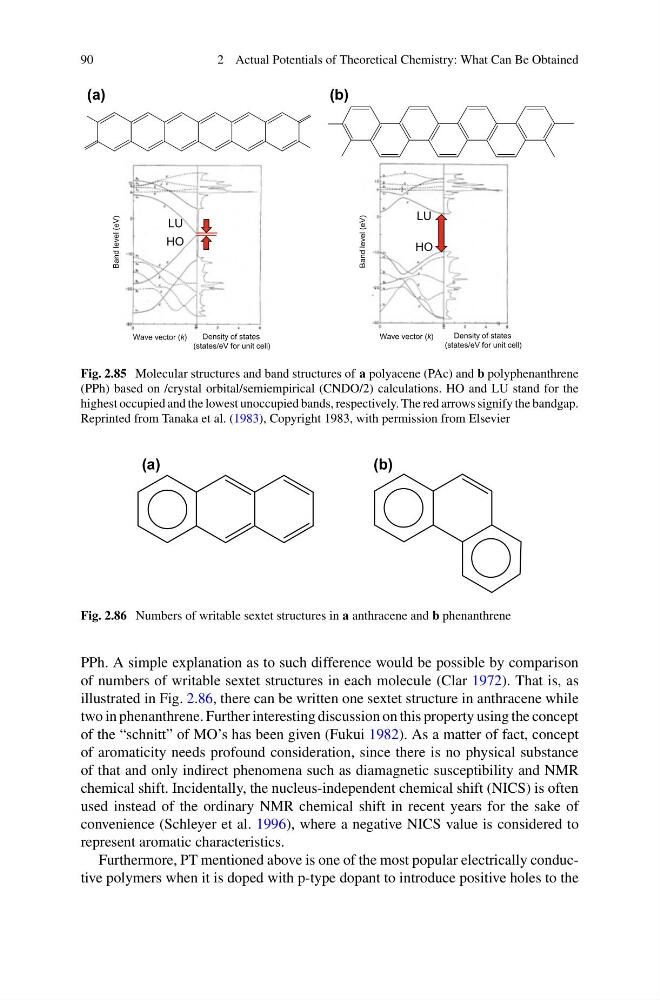
Fig. 2.85 Molecular structures and band structures of a polyacene (PAc) and b polyphenanthrene
(PPh) based on /crystal orbital/semiempirical (CNDO/2) calculations. HO and LU stand for the
highest occupied and the lowest unoccupied bands, respectively. The red arrows signify the bandgap.
Reprinted from Tanaka et al. (1983), Copyright 1983, with permission from Elsevier
(a)
(b)
Fig. 2.86 Numbers of writable sextet structures in a anthracene and b phenanthrene
PPh. A simple explanation as to such difference would be possible by comparison
of numbers of writable sextet structures in each molecule (Clar 1972). That is, as
illustrated in Fig. 2.86, there can be written one sextet structure in anthracene while
two in phenanthrene. Further interesting discussion on this property using the concept
of the “schnitt” of MO’s has been given (Fukui 1982). As a matter of fact, concept
of aromaticity needs profound consideration, since there is no physical substance
of that and only indirect phenomena such as diamagnetic susceptibility and NMR
chemical shift. Incidentally, the nucleus-independent chemical shift (NICS) is often
used instead of the ordinary NMR chemical shift in recent years for the sake of
convenience (Schleyer et al. 1996), where a negative NICS value is considered to
represent aromatic characteristics.
Furthermore, PT mentioned above is one of the most popular electrically conductive polymers when it is doped with p-type dopant to introduce positive holes to the
2 Actual Potentials of Theoretical Chemistry: What Can Be Obtained
HO
LU
HO
LU
(a)
(b)
Band level (eV)
Band level (eV)
Wave vector (k)
Wave vector (k)
Density of states
(states/eV for unit cell)
Density of states
(states/eV for unit cell)
Fig. 2.85 Molecular structures and band structures of a polyacene (PAc) and b polyphenanthrene
(PPh) based on /crystal orbital/semiempirical (CNDO/2) calculations. HO and LU stand for the
highest occupied and the lowest unoccupied bands, respectively. The red arrows signify the bandgap.
Reprinted from Tanaka et al. (1983), Copyright 1983, with permission from Elsevier
(a)
(b)
Fig. 2.86 Numbers of writable sextet structures in a anthracene and b phenanthrene
PPh. A simple explanation as to such difference would be possible by comparison
of numbers of writable sextet structures in each molecule (Clar 1972). That is, as
illustrated in Fig. 2.86, there can be written one sextet structure in anthracene while
two in phenanthrene. Further interesting discussion on this property using the concept
of the “schnitt” of MO’s has been given (Fukui 1982). As a matter of fact, concept
of aromaticity needs profound consideration, since there is no physical substance
of that and only indirect phenomena such as diamagnetic susceptibility and NMR
chemical shift. Incidentally, the nucleus-independent chemical shift (NICS) is often
used instead of the ordinary NMR chemical shift in recent years for the sake of
convenience (Schleyer et al. 1996), where a negative NICS value is considered to
represent aromatic characteristics.
Furthermore, PT mentioned above is one of the most popular electrically conductive polymers when it is doped with p-type dopant to introduce positive holes to the