

2.8 Molecular Design
91
polymer main chain. The intrinsic PT before doping has a band-gap value g of
1.965 eV as listed in Table 2.26. It will be possible to obtain polymers of narrower
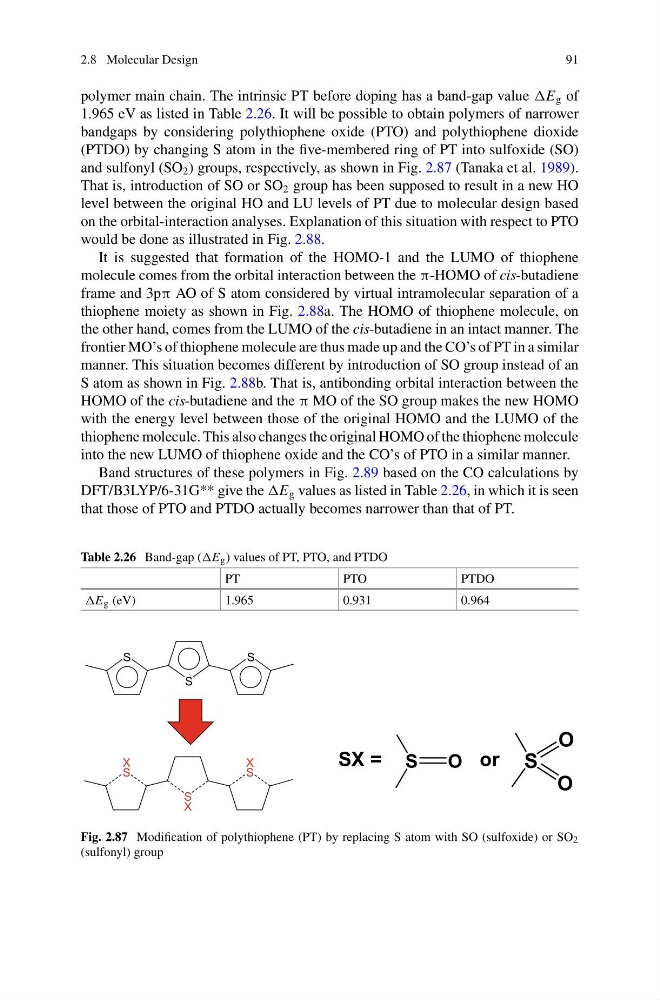
bandgaps by considering polythiophene oxide (PTO) and polythiophene dioxide
(PTDO) by changing S atom in the five-membered ring of PT into sulfoxide (SO)
and sulfonyl (SO 2 ) groups, respectively, as shown in Fig. 2.87 (Tanaka et al. 1989).
That is, introduction of SO or SO 2 group has been supposed to result in a new HO
level between the original HO and LU levels of PT due to molecular design based
on the orbital-interaction analyses. Explanation of this situation with respect to PTO
would be done as illustrated in Fig. 2.88.
It is suggested that formation of the HOMO-1 and the LUMO of thiophene
molecule comes from the orbital interaction between the π-HOMO of cis-butadiene
frame and 3pπ AO of S atom considered by virtual intramolecular separation of a
thiophene moiety as shown in Fig. 2.88a. The HOMO of thiophene molecule, on
the other hand, comes from the LUMO of the cis-butadiene in an intact manner. The
frontier MO’s of thiophene molecule are thus made up and the CO’s of PT in a similar
manner. This situation becomes different by introduction of SO group instead of an
S atom as shown in Fig. 2.88b. That is, antibonding orbital interaction between the
HOMO of the cis-butadiene and the π MO of the SO group makes the new HOMO
with the energy level between those of the original HOMO and the LUMO of the
thiophene molecule. This also changes the original HOMO of the thiophene molecule
into the new LUMO of thiophene oxide and the CO’s of PTO in a similar manner.
Band structures of these polymers in Fig. 2.89 based on the CO calculations by
DFT/B3LYP/6-31G** give the g values as listed in Table 2.26, in which it is seen
that those of PTO and PTDO actually becomes narrower than that of PT.
Table 2.26 Band-gap ( g ) values of PT, PTO, and PTDO
PT
PTO
PTDO
g (eV)
1.965
0.931
0.964
S
S
S
X
S
X
S
S
X
S
O
S
O
O
SX =
or
Fig. 2.87 Modification of polythiophene (PT) by replacing S atom with SO (sulfoxide) or SO 2
(sulfonyl) group
91
polymer main chain. The intrinsic PT before doping has a band-gap value g of
1.965 eV as listed in Table 2.26. It will be possible to obtain polymers of narrower
bandgaps by considering polythiophene oxide (PTO) and polythiophene dioxide
(PTDO) by changing S atom in the five-membered ring of PT into sulfoxide (SO)
and sulfonyl (SO 2 ) groups, respectively, as shown in Fig. 2.87 (Tanaka et al. 1989).
That is, introduction of SO or SO 2 group has been supposed to result in a new HO
level between the original HO and LU levels of PT due to molecular design based
on the orbital-interaction analyses. Explanation of this situation with respect to PTO
would be done as illustrated in Fig. 2.88.
It is suggested that formation of the HOMO-1 and the LUMO of thiophene
molecule comes from the orbital interaction between the π-HOMO of cis-butadiene
frame and 3pπ AO of S atom considered by virtual intramolecular separation of a
thiophene moiety as shown in Fig. 2.88a. The HOMO of thiophene molecule, on
the other hand, comes from the LUMO of the cis-butadiene in an intact manner. The
frontier MO’s of thiophene molecule are thus made up and the CO’s of PT in a similar
manner. This situation becomes different by introduction of SO group instead of an
S atom as shown in Fig. 2.88b. That is, antibonding orbital interaction between the
HOMO of the cis-butadiene and the π MO of the SO group makes the new HOMO
with the energy level between those of the original HOMO and the LUMO of the
thiophene molecule. This also changes the original HOMO of the thiophene molecule
into the new LUMO of thiophene oxide and the CO’s of PTO in a similar manner.
Band structures of these polymers in Fig. 2.89 based on the CO calculations by
DFT/B3LYP/6-31G** give the g values as listed in Table 2.26, in which it is seen
that those of PTO and PTDO actually becomes narrower than that of PT.
Table 2.26 Band-gap ( g ) values of PT, PTO, and PTDO
PT
PTO
PTDO
g (eV)
1.965
0.931
0.964
S
S
S
X
S
X
S
S
X
S
O
S
O
O
SX =
or
Fig. 2.87 Modification of polythiophene (PT) by replacing S atom with SO (sulfoxide) or SO 2
(sulfonyl) group