

92
2 Actual Potentials of Theoretical Chemistry: What Can Be Obtained
S
S
S
HO
LU
HO
LU
SO
HO
HO
LU
LU
3pπ of S
(a)
(b)
O
S
O
S
S
O
Energy
=
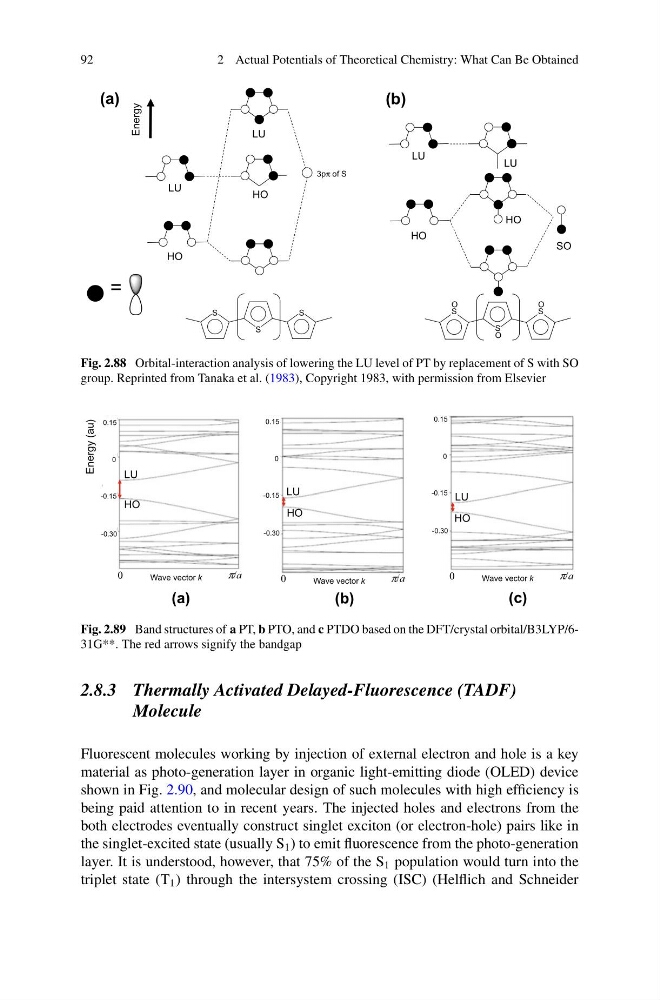
Fig. 2.88 Orbital-interaction analysis of lowering the LU level of PT by replacement of S with SO
group. Reprinted from Tanaka et al. (1983), Copyright 1983, with permission from Elsevier
Wave vector k
π/a
0
Energy (au)
0.15
0
-0.15
-0.30
0.15
0
-0.15
-0.30
0.15
0
-0.15
-0.30
Wave vector k
π/a
0
Wave vector k
π/a
0
(a)
(b)
(c)
LU
LU
LU
HO
HO
HO
Fig. 2.89 Band structures of a PT, b PTO, and c PTDO based on the DFT/crystal orbital/B3LYP/631G**. The red arrows signify the bandgap
2.8.3 Thermally Activated Delayed-Fluorescence (TADF)
Molecule
Fluorescent molecules working by injection of external electron and hole is a key
material as photo-generation layer in organic light-emitting diode (OLED) device
shown in Fig. 2.90, and molecular design of such molecules with high efficiency is
being paid attention to in recent years. The injected holes and electrons from the
both electrodes eventually construct singlet exciton (or electron-hole) pairs like in
the singlet-excited state (usually S 1 ) to emit fluorescence from the photo-generation
layer. It is understood, however, that 75% of the S 1 population would turn into the
triplet state (T 1 ) through the intersystem crossing (ISC) (Helflich and Schneider
2 Actual Potentials of Theoretical Chemistry: What Can Be Obtained
S
S
S
HO
LU
HO
LU
SO
HO
HO
LU
LU
3pπ of S
(a)
(b)
O
S
O
S
S
O
Energy
=
Fig. 2.88 Orbital-interaction analysis of lowering the LU level of PT by replacement of S with SO
group. Reprinted from Tanaka et al. (1983), Copyright 1983, with permission from Elsevier
Wave vector k
π/a
0
Energy (au)
0.15
0
-0.15
-0.30
0.15
0
-0.15
-0.30
0.15
0
-0.15
-0.30
Wave vector k
π/a
0
Wave vector k
π/a
0
(a)
(b)
(c)
LU
LU
LU
HO
HO
HO
Fig. 2.89 Band structures of a PT, b PTO, and c PTDO based on the DFT/crystal orbital/B3LYP/631G**. The red arrows signify the bandgap
2.8.3 Thermally Activated Delayed-Fluorescence (TADF)
Molecule
Fluorescent molecules working by injection of external electron and hole is a key
material as photo-generation layer in organic light-emitting diode (OLED) device
shown in Fig. 2.90, and molecular design of such molecules with high efficiency is
being paid attention to in recent years. The injected holes and electrons from the
both electrodes eventually construct singlet exciton (or electron-hole) pairs like in
the singlet-excited state (usually S 1 ) to emit fluorescence from the photo-generation
layer. It is understood, however, that 75% of the S 1 population would turn into the
triplet state (T 1 ) through the intersystem crossing (ISC) (Helflich and Schneider