

2.8 Molecular Design
93
Anode
Cathode
Hole
transport
layer
Electron
transport
layer
Photogeneration
layer
Electron
injection
Hole
injection
Irradiation by
electron-hole
recombination
Fig. 2.90 Schematic diagram of organic light-emitting diode (OLED) device, in which all the
layers consist of organic molecules
1965). Usual organic molecules do not give phosphorescence from the T 1 state but
nonradiative transition. Hence efficient utilization of the T 1 state is desirable for
higher efficient photo radiation.
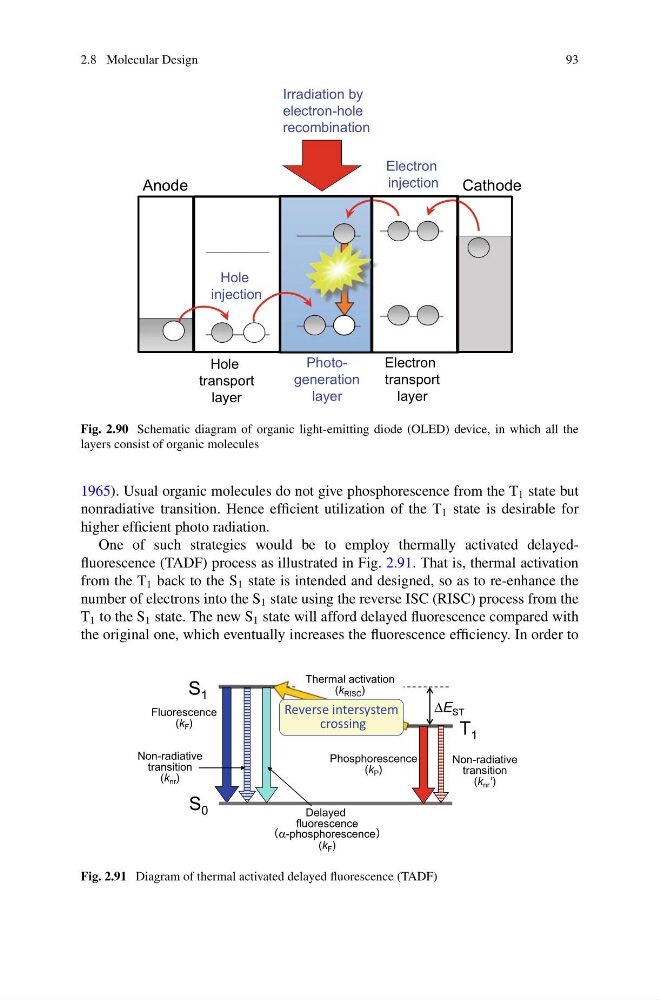
One of such strategies would be to employ thermally activated delayedfluorescence (TADF) process as illustrated in Fig. 2.91. That is, thermal activation
from the T 1 back to the S 1 state is intended and designed, so as to re-enhance the
number of electrons into the S 1 state using the reverse ISC (RISC) process from the
T 1 to the S 1 state. The new S 1 state will afford delayed fluorescence compared with
the original one, which eventually increases the fluorescence efficiency. In order to
S 1
T 1
S 0
ΔE ST
Fluorescence
(k F )
Non-radiative
transition
(k nr )
Phosphorescence
(k P )
Non-radiative
transition
(k nr )
Thermal activation
(k RISC )
Delayed
fluorescence
α-phosphorescence
(k F )
Reverse intersystem
crossing
Fig. 2.91 Diagram of thermal activated delayed fluorescence (TADF)
93
Anode
Cathode
Hole
transport
layer
Electron
transport
layer
Photogeneration
layer
Electron
injection
Hole
injection
Irradiation by
electron-hole
recombination
Fig. 2.90 Schematic diagram of organic light-emitting diode (OLED) device, in which all the
layers consist of organic molecules
1965). Usual organic molecules do not give phosphorescence from the T 1 state but
nonradiative transition. Hence efficient utilization of the T 1 state is desirable for
higher efficient photo radiation.
One of such strategies would be to employ thermally activated delayedfluorescence (TADF) process as illustrated in Fig. 2.91. That is, thermal activation
from the T 1 back to the S 1 state is intended and designed, so as to re-enhance the
number of electrons into the S 1 state using the reverse ISC (RISC) process from the
T 1 to the S 1 state. The new S 1 state will afford delayed fluorescence compared with
the original one, which eventually increases the fluorescence efficiency. In order to
S 1
T 1
S 0
ΔE ST
Fluorescence
(k F )
Non-radiative
transition
(k nr )
Phosphorescence
(k P )
Non-radiative
transition
(k nr )
Thermal activation
(k RISC )
Delayed
fluorescence
α-phosphorescence
(k F )
Reverse intersystem
crossing
Fig. 2.91 Diagram of thermal activated delayed fluorescence (TADF)