

94
2 Actual Potentials of Theoretical Chemistry: What Can Be Obtained
enhance the TADF process, the energy difference between T 1 and S 1 states defined
by E ST ought to be small due to the relationship (Berberan-Santos and Garcia 1996)
k RISC ∝ exp[−E ST ]
(2.55)
where k RISC stands for the rate of RISC process as shown in Fig. 2.91. The value E ST
is determined by the exchange integral K ij (see Sect. 3.1.1) under the condition that
electron configurations of the S 1 and T 1 states are mostly decided by the transition
from the HOMO i to the LUMO j. Also, it is favorable that the rate of fluorescence
k F expressed by
k F ∝ |m 01 |
2
(2.56)
should be large where m 01 represents the transition dipole moment between the
S 0 and the S 1 states to suppress the nonradiative transition (Toptygin 2003). This
moment can be simplified into m ij between the HOMO i and the LUMO j again
under the condition that electron configuration of the S 1 state is mostly decided by
the transition from the HOMO i to the LUMO j.
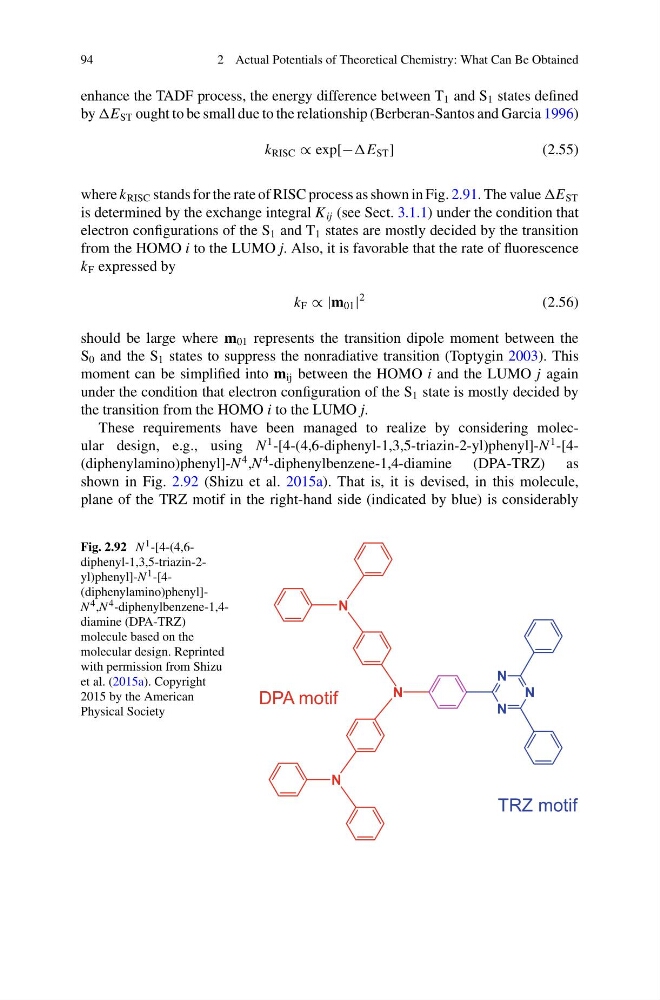
These requirements have been managed to realize by considering molecular design, e.g., using N
1 -[4-(4,6-diphenyl-1,3,5-triazin-2-yl)phenyl]-N
1 -[4(diphenylamino)phenyl]-N
4 ,N
4 -diphenylbenzene-1,4-diamine (DPA-TRZ) as
shown in Fig. 2.92 (Shizu et al. 2015a). That is, it is devised, in this molecule,
plane of the TRZ motif in the right-hand side (indicated by blue) is considerably
diphenyl-1,3,5-triazin-2yl)phenyl]-N
(diphenylamino)phenyl]N 4 ,N 4 -diphenylbenzene-1,4diamine (DPA-TRZ)
molecule based on the
molecular design. Reprinted
with permission from Shizu
et al. (2015a). Copyright
2015 by the American
Physical Society
N
N
N
N
N
N
DPA motif
TRZ motif
2 Actual Potentials of Theoretical Chemistry: What Can Be Obtained
enhance the TADF process, the energy difference between T 1 and S 1 states defined
by E ST ought to be small due to the relationship (Berberan-Santos and Garcia 1996)
k RISC ∝ exp[−E ST ]
(2.55)
where k RISC stands for the rate of RISC process as shown in Fig. 2.91. The value E ST
is determined by the exchange integral K ij (see Sect. 3.1.1) under the condition that
electron configurations of the S 1 and T 1 states are mostly decided by the transition
from the HOMO i to the LUMO j. Also, it is favorable that the rate of fluorescence
k F expressed by
k F ∝ |m 01 |
2
(2.56)
should be large where m 01 represents the transition dipole moment between the
S 0 and the S 1 states to suppress the nonradiative transition (Toptygin 2003). This
moment can be simplified into m ij between the HOMO i and the LUMO j again
under the condition that electron configuration of the S 1 state is mostly decided by
the transition from the HOMO i to the LUMO j.
These requirements have been managed to realize by considering molecular design, e.g., using N
1 -[4-(4,6-diphenyl-1,3,5-triazin-2-yl)phenyl]-N
1 -[4(diphenylamino)phenyl]-N
4 ,N
4 -diphenylbenzene-1,4-diamine (DPA-TRZ) as
shown in Fig. 2.92 (Shizu et al. 2015a). That is, it is devised, in this molecule,
plane of the TRZ motif in the right-hand side (indicated by blue) is considerably
diphenyl-1,3,5-triazin-2yl)phenyl]-N
(diphenylamino)phenyl]N 4 ,N 4 -diphenylbenzene-1,4diamine (DPA-TRZ)
molecule based on the
molecular design. Reprinted
with permission from Shizu
et al. (2015a). Copyright
2015 by the American
Physical Society
N
N
N
N
N
N
DPA motif
TRZ motif