

2.8 Molecular Design
89
2
2
1
1
3
3
4
4
5
5
6
6
11
11
12
12
14
14
13
13
15
15
16
16
7
8
9
10
10
7
8
9
(a)
(b)
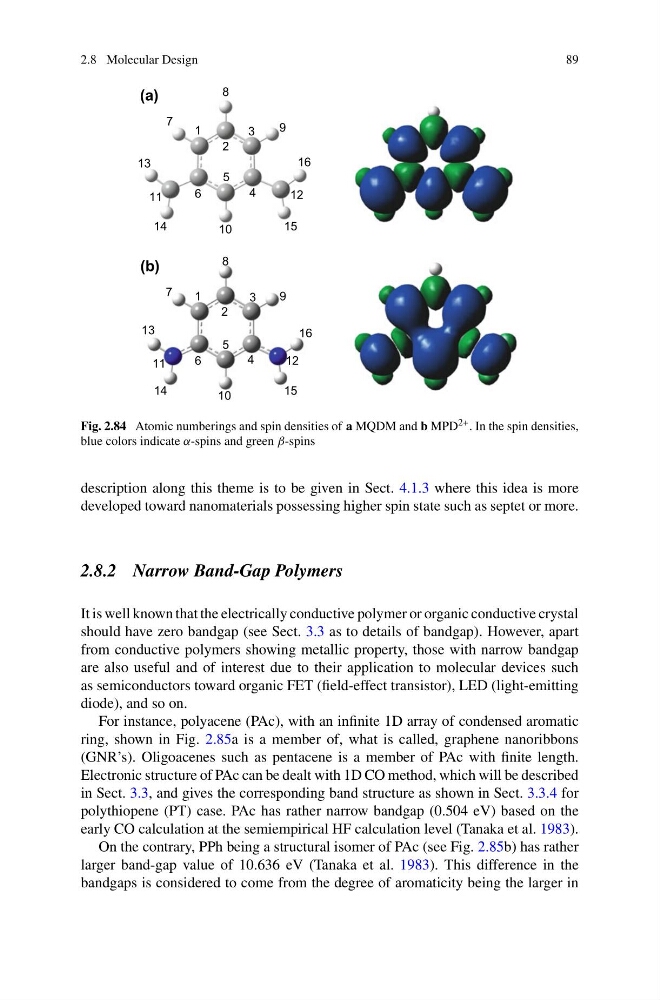
Fig. 2.84 Atomic numberings and spin densities of a MQDM and b MPD 2+ . In the spin densities,
blue colors indicate α-spins and green β-spins
description along this theme is to be given in Sect. 4.1.3 where this idea is more
developed toward nanomaterials possessing higher spin state such as septet or more.
2.8.2 Narrow Band-Gap Polymers
It is well known that the electrically conductive polymer or organic conductive crystal
should have zero bandgap (see Sect. 3.3 as to details of bandgap). However, apart
from conductive polymers showing metallic property, those with narrow bandgap
are also useful and of interest due to their application to molecular devices such
as semiconductors toward organic FET (field-effect transistor), LED (light-emitting
diode), and so on.
For instance, polyacene (PAc), with an infinite 1D array of condensed aromatic
ring, shown in Fig. 2.85a is a member of, what is called, graphene nanoribbons
(GNR’s). Oligoacenes such as pentacene is a member of PAc with finite length.
Electronic structure of PAc can be dealt with 1D CO method, which will be described
in Sect. 3.3, and gives the corresponding band structure as shown in Sect. 3.3.4 for
polythiopene (PT) case. PAc has rather narrow bandgap (0.504 eV) based on the
early CO calculation at the semiempirical HF calculation level (Tanaka et al. 1983).
On the contrary, PPh being a structural isomer of PAc (see Fig. 2.85b) has rather
larger band-gap value of 10.636 eV (Tanaka et al. 1983). This difference in the
bandgaps is considered to come from the degree of aromaticity being the larger in
89
2
2
1
1
3
3
4
4
5
5
6
6
11
11
12
12
14
14
13
13
15
15
16
16
7
8
9
10
10
7
8
9
(a)
(b)
Fig. 2.84 Atomic numberings and spin densities of a MQDM and b MPD 2+ . In the spin densities,
blue colors indicate α-spins and green β-spins
description along this theme is to be given in Sect. 4.1.3 where this idea is more
developed toward nanomaterials possessing higher spin state such as septet or more.
2.8.2 Narrow Band-Gap Polymers
It is well known that the electrically conductive polymer or organic conductive crystal
should have zero bandgap (see Sect. 3.3 as to details of bandgap). However, apart
from conductive polymers showing metallic property, those with narrow bandgap
are also useful and of interest due to their application to molecular devices such
as semiconductors toward organic FET (field-effect transistor), LED (light-emitting
diode), and so on.
For instance, polyacene (PAc), with an infinite 1D array of condensed aromatic
ring, shown in Fig. 2.85a is a member of, what is called, graphene nanoribbons
(GNR’s). Oligoacenes such as pentacene is a member of PAc with finite length.
Electronic structure of PAc can be dealt with 1D CO method, which will be described
in Sect. 3.3, and gives the corresponding band structure as shown in Sect. 3.3.4 for
polythiopene (PT) case. PAc has rather narrow bandgap (0.504 eV) based on the
early CO calculation at the semiempirical HF calculation level (Tanaka et al. 1983).
On the contrary, PPh being a structural isomer of PAc (see Fig. 2.85b) has rather
larger band-gap value of 10.636 eV (Tanaka et al. 1983). This difference in the
bandgaps is considered to come from the degree of aromaticity being the larger in