

2.7 Chemical Reactions
83
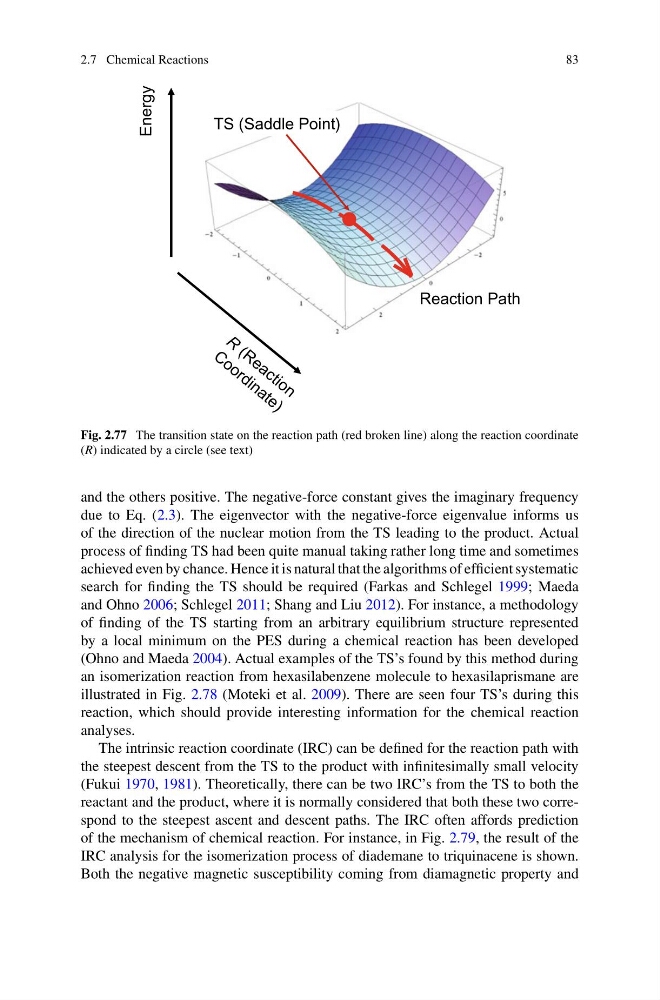
TS (Saddle Point)
Energy
Reaction Path
Fig. 2.77 The transition state on the reaction path (red broken line) along the reaction coordinate
(R) indicated by a circle (see text)
and the others positive. The negative-force constant gives the imaginary frequency
due to Eq. (2.3). The eigenvector with the negative-force eigenvalue informs us
of the direction of the nuclear motion from the TS leading to the product. Actual
process of finding TS had been quite manual taking rather long time and sometimes
achieved even by chance. Hence it is natural that the algorithms of efficient systematic
search for finding the TS should be required (Farkas and Schlegel 1999; Maeda
and Ohno 2006; Schlegel 2011; Shang and Liu 2012). For instance, a methodology
of finding of the TS starting from an arbitrary equilibrium structure represented
by a local minimum on the PES during a chemical reaction has been developed
(Ohno and Maeda 2004). Actual examples of the TS’s found by this method during
an isomerization reaction from hexasilabenzene molecule to hexasilaprismane are
illustrated in Fig. 2.78 (Moteki et al. 2009). There are seen four TS’s during this
reaction, which should provide interesting information for the chemical reaction
analyses.
The intrinsic reaction coordinate (IRC) can be defined for the reaction path with
the steepest descent from the TS to the product with infinitesimally small velocity
(Fukui 1970, 1981). Theoretically, there can be two IRC’s from the TS to both the
reactant and the product, where it is normally considered that both these two correspond to the steepest ascent and descent paths. The IRC often affords prediction
of the mechanism of chemical reaction. For instance, in Fig. 2.79, the result of the
IRC analysis for the isomerization process of diademane to triquinacene is shown.
Both the negative magnetic susceptibility coming from diamagnetic property and
83
TS (Saddle Point)
Energy
Reaction Path
Fig. 2.77 The transition state on the reaction path (red broken line) along the reaction coordinate
(R) indicated by a circle (see text)
and the others positive. The negative-force constant gives the imaginary frequency
due to Eq. (2.3). The eigenvector with the negative-force eigenvalue informs us
of the direction of the nuclear motion from the TS leading to the product. Actual
process of finding TS had been quite manual taking rather long time and sometimes
achieved even by chance. Hence it is natural that the algorithms of efficient systematic
search for finding the TS should be required (Farkas and Schlegel 1999; Maeda
and Ohno 2006; Schlegel 2011; Shang and Liu 2012). For instance, a methodology
of finding of the TS starting from an arbitrary equilibrium structure represented
by a local minimum on the PES during a chemical reaction has been developed
(Ohno and Maeda 2004). Actual examples of the TS’s found by this method during
an isomerization reaction from hexasilabenzene molecule to hexasilaprismane are
illustrated in Fig. 2.78 (Moteki et al. 2009). There are seen four TS’s during this
reaction, which should provide interesting information for the chemical reaction
analyses.
The intrinsic reaction coordinate (IRC) can be defined for the reaction path with
the steepest descent from the TS to the product with infinitesimally small velocity
(Fukui 1970, 1981). Theoretically, there can be two IRC’s from the TS to both the
reactant and the product, where it is normally considered that both these two correspond to the steepest ascent and descent paths. The IRC often affords prediction
of the mechanism of chemical reaction. For instance, in Fig. 2.79, the result of the
IRC analysis for the isomerization process of diademane to triquinacene is shown.
Both the negative magnetic susceptibility coming from diamagnetic property and