

84
2 Actual Potentials of Theoretical Chemistry: What Can Be Obtained
Relative Energy from Hexasilabenze (kcal/mol)
-20.00
-10.00
0.00
10.00
20.00
30.00
40.00
TS1
TS2
TS3
TS4
hexasilabenzene
hexasilaprismane
Si
Si
Si
Si
Si
Si
Si
Si
Si
Si
Si
Si
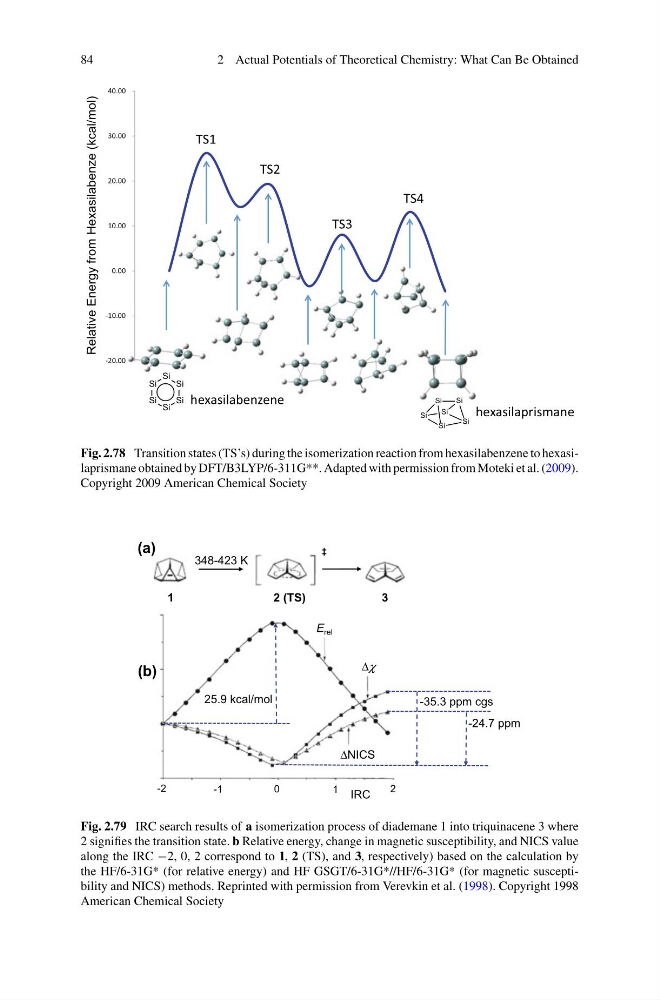
Fig. 2.78 Transition states (TS’s) during the isomerization reaction from hexasilabenzene to hexasilaprismane obtained by DFT/B3LYP/6-311G**. Adapted with permission from Moteki et al. (2009).
Copyright 2009 American Chemical Society
25.9 kcal/mol
-24.7 ppm
-35.3 ppm cgs
E rel
Δχ
ΔNICS
IRC
-2
-1
0
1
2
2 (TS)
1
3
‡
348-423 K
(a)
(b)
Fig. 2.79 IRC search results of a isomerization process of diademane 1 into triquinacene 3 where
2 signifies the transition state. b Relative energy, change in magnetic susceptibility, and NICS value
along the IRC −2, 0, 2 correspond to 1, 2 (TS), and 3, respectively) based on the calculation by
the HF/6-31G* (for relative energy) and HF GSGT/6-31G*//HF/6-31G* (for magnetic susceptibility and NICS) methods. Reprinted with permission from Verevkin et al. (1998). Copyright 1998
American Chemical Society
2 Actual Potentials of Theoretical Chemistry: What Can Be Obtained
Relative Energy from Hexasilabenze (kcal/mol)
-20.00
-10.00
0.00
10.00
20.00
30.00
40.00
TS1
TS2
TS3
TS4
hexasilabenzene
hexasilaprismane
Si
Si
Si
Si
Si
Si
Si
Si
Si
Si
Si
Si
Fig. 2.78 Transition states (TS’s) during the isomerization reaction from hexasilabenzene to hexasilaprismane obtained by DFT/B3LYP/6-311G**. Adapted with permission from Moteki et al. (2009).
Copyright 2009 American Chemical Society
25.9 kcal/mol
-24.7 ppm
-35.3 ppm cgs
E rel
Δχ
ΔNICS
IRC
-2
-1
0
1
2
2 (TS)
1
3
‡
348-423 K
(a)
(b)
Fig. 2.79 IRC search results of a isomerization process of diademane 1 into triquinacene 3 where
2 signifies the transition state. b Relative energy, change in magnetic susceptibility, and NICS value
along the IRC −2, 0, 2 correspond to 1, 2 (TS), and 3, respectively) based on the calculation by
the HF/6-31G* (for relative energy) and HF GSGT/6-31G*//HF/6-31G* (for magnetic susceptibility and NICS) methods. Reprinted with permission from Verevkin et al. (1998). Copyright 1998
American Chemical Society