

2.7 Chemical Reactions
77
Major
(a)
(b)
(c)
CHO
CHO
CHO
CHO
CHO
Me
Me
Me
Me
Me
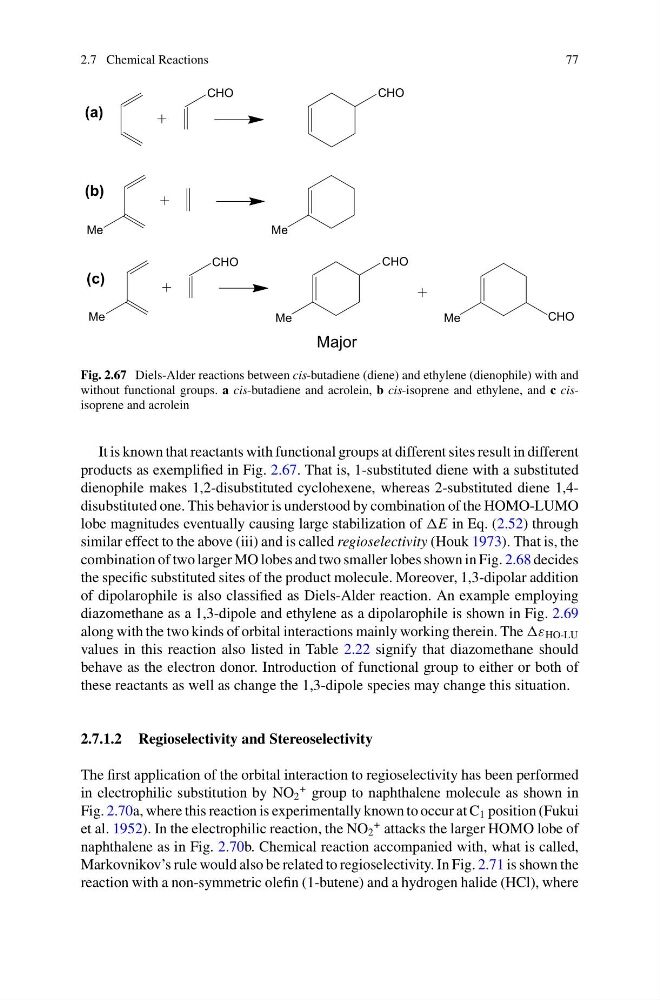
Fig. 2.67 Diels-Alder reactions between cis-butadiene (diene) and ethylene (dienophile) with and
without functional groups. a cis-butadiene and acrolein, b cis-isoprene and ethylene, and c cisisoprene and acrolein
It is known that reactants with functional groups at different sites result in different
products as exemplified in Fig. 2.67. That is, 1-substituted diene with a substituted
dienophile makes 1,2-disubstituted cyclohexene, whereas 2-substituted diene 1,4disubstituted one. This behavior is understood by combination of the HOMO-LUMO
lobe magnitudes eventually causing large stabilization of in Eq. (2.52) through
similar effect to the above (iii) and is called regioselectivity (Houk 1973). That is, the
combination of two larger MO lobes and two smaller lobes shown in Fig. 2.68 decides
the specific substituted sites of the product molecule. Moreover, 1,3-dipolar addition
of dipolarophile is also classified as Diels-Alder reaction. An example employing
diazomethane as a 1,3-dipole and ethylene as a dipolarophile is shown in Fig. 2.69
along with the two kinds of orbital interactions mainly working therein. The ε HO-LU
values in this reaction also listed in Table 2.22 signify that diazomethane should
behave as the electron donor. Introduction of functional group to either or both of
these reactants as well as change the 1,3-dipole species may change this situation.
2.7.1.2 Regioselectivity and Stereoselectivity
The first application of the orbital interaction to regioselectivity has been performed
in electrophilic substitution by NO 2
+ group to naphthalene molecule as shown in
Fig. 2.70a, where this reaction is experimentally known to occur at C 1 position (Fukui
et al. 1952). In the electrophilic reaction, the NO 2
+ attacks the larger HOMO lobe of
naphthalene as in Fig. 2.70b. Chemical reaction accompanied with, what is called,
Markovnikov’s rule would also be related to regioselectivity. In Fig. 2.71 is shown the
reaction with a non-symmetric olefin (1-butene) and a hydrogen halide (HCl), where
77
Major
(a)
(b)
(c)
CHO
CHO
CHO
CHO
CHO
Me
Me
Me
Me
Me
Fig. 2.67 Diels-Alder reactions between cis-butadiene (diene) and ethylene (dienophile) with and
without functional groups. a cis-butadiene and acrolein, b cis-isoprene and ethylene, and c cisisoprene and acrolein
It is known that reactants with functional groups at different sites result in different
products as exemplified in Fig. 2.67. That is, 1-substituted diene with a substituted
dienophile makes 1,2-disubstituted cyclohexene, whereas 2-substituted diene 1,4disubstituted one. This behavior is understood by combination of the HOMO-LUMO
lobe magnitudes eventually causing large stabilization of in Eq. (2.52) through
similar effect to the above (iii) and is called regioselectivity (Houk 1973). That is, the
combination of two larger MO lobes and two smaller lobes shown in Fig. 2.68 decides
the specific substituted sites of the product molecule. Moreover, 1,3-dipolar addition
of dipolarophile is also classified as Diels-Alder reaction. An example employing
diazomethane as a 1,3-dipole and ethylene as a dipolarophile is shown in Fig. 2.69
along with the two kinds of orbital interactions mainly working therein. The ε HO-LU
values in this reaction also listed in Table 2.22 signify that diazomethane should
behave as the electron donor. Introduction of functional group to either or both of
these reactants as well as change the 1,3-dipole species may change this situation.
2.7.1.2 Regioselectivity and Stereoselectivity
The first application of the orbital interaction to regioselectivity has been performed
in electrophilic substitution by NO 2
+ group to naphthalene molecule as shown in
Fig. 2.70a, where this reaction is experimentally known to occur at C 1 position (Fukui
et al. 1952). In the electrophilic reaction, the NO 2
+ attacks the larger HOMO lobe of
naphthalene as in Fig. 2.70b. Chemical reaction accompanied with, what is called,
Markovnikov’s rule would also be related to regioselectivity. In Fig. 2.71 is shown the
reaction with a non-symmetric olefin (1-butene) and a hydrogen halide (HCl), where