

76
2 Actual Potentials of Theoretical Chemistry: What Can Be Obtained
(a)
(b)
(c)
LUMO
O
M
O
H
O
M
O
H
LUMO
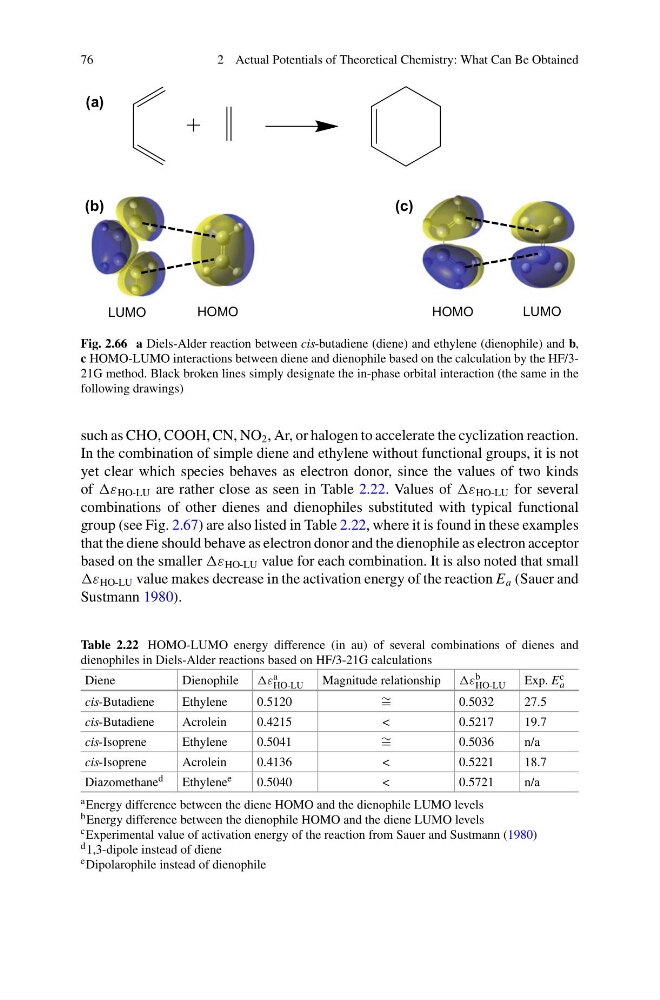
Fig. 2.66 a Diels-Alder reaction between cis-butadiene (diene) and ethylene (dienophile) and b,
c HOMO-LUMO interactions between diene and dienophile based on the calculation by the HF/321G method. Black broken lines simply designate the in-phase orbital interaction (the same in the
following drawings)
such as CHO, COOH, CN, NO 2 , Ar, or halogen to accelerate the cyclization reaction.
In the combination of simple diene and ethylene without functional groups, it is not
yet clear which species behaves as electron donor, since the values of two kinds
of ε HO-LU are rather close as seen in Table 2.22. Values of ε HO-LU for several
combinations of other dienes and dienophiles substituted with typical functional
group (see Fig. 2.67) are also listed in Table 2.22, where it is found in these examples
that the diene should behave as electron donor and the dienophile as electron acceptor
based on the smaller ε HO-LU value for each combination. It is also noted that small
ε HO-LU value makes decrease in the activation energy of the reaction E a (Sauer and
Sustmann 1980).
Table 2.22 HOMO-LUMO energy difference (in au) of several combinations of dienes and
dienophiles in Diels-Alder reactions based on HF/3-21G calculations
Diene
Dienophile a
HO-LU
Magnitude relationship b
HO-LU
Exp. E c
a
cis-Butadiene
Ethylene
0.5120
∼ =
0.5032
27.5
cis-Butadiene
Acrolein
0.4215
<
0.5217
19.7
cis-Isoprene
Ethylene
0.5041
∼ =
0.5036
n/a
cis-Isoprene
Acrolein
0.4136
<
0.5221
18.7
Diazomethane d Ethylene e
0.5040
<
0.5721
n/a
a Energy difference between the diene HOMO and the dienophile LUMO levels
b Energy difference between the dienophile HOMO and the diene LUMO levels
c Experimental value of activation energy of the reaction from Sauer and Sustmann (1980)
d 1,3-dipole instead of diene
e Dipolarophile instead of dienophile
2 Actual Potentials of Theoretical Chemistry: What Can Be Obtained
(a)
(b)
(c)
LUMO
O
M
O
H
O
M
O
H
LUMO
Fig. 2.66 a Diels-Alder reaction between cis-butadiene (diene) and ethylene (dienophile) and b,
c HOMO-LUMO interactions between diene and dienophile based on the calculation by the HF/321G method. Black broken lines simply designate the in-phase orbital interaction (the same in the
following drawings)
such as CHO, COOH, CN, NO 2 , Ar, or halogen to accelerate the cyclization reaction.
In the combination of simple diene and ethylene without functional groups, it is not
yet clear which species behaves as electron donor, since the values of two kinds
of ε HO-LU are rather close as seen in Table 2.22. Values of ε HO-LU for several
combinations of other dienes and dienophiles substituted with typical functional
group (see Fig. 2.67) are also listed in Table 2.22, where it is found in these examples
that the diene should behave as electron donor and the dienophile as electron acceptor
based on the smaller ε HO-LU value for each combination. It is also noted that small
ε HO-LU value makes decrease in the activation energy of the reaction E a (Sauer and
Sustmann 1980).
Table 2.22 HOMO-LUMO energy difference (in au) of several combinations of dienes and
dienophiles in Diels-Alder reactions based on HF/3-21G calculations
Diene
Dienophile a
HO-LU
Magnitude relationship b
HO-LU
Exp. E c
a
cis-Butadiene
Ethylene
0.5120
∼ =
0.5032
27.5
cis-Butadiene
Acrolein
0.4215
<
0.5217
19.7
cis-Isoprene
Ethylene
0.5041
∼ =
0.5036
n/a
cis-Isoprene
Acrolein
0.4136
<
0.5221
18.7
Diazomethane d Ethylene e
0.5040
<
0.5721
n/a
a Energy difference between the diene HOMO and the dienophile LUMO levels
b Energy difference between the dienophile HOMO and the diene LUMO levels
c Experimental value of activation energy of the reaction from Sauer and Sustmann (1980)
d 1,3-dipole instead of diene
e Dipolarophile instead of dienophile