

2.7 Chemical Reactions
75
R (Reaction Coordinate)
Transition State
Energy
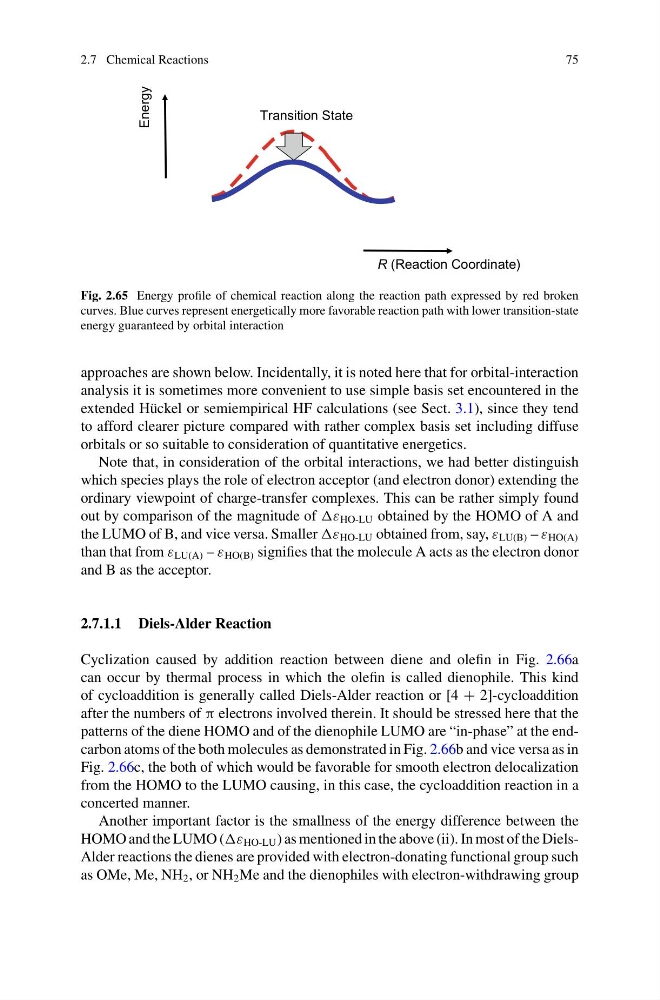
Fig. 2.65 Energy profile of chemical reaction along the reaction path expressed by red broken
curves. Blue curves represent energetically more favorable reaction path with lower transition-state
energy guaranteed by orbital interaction
approaches are shown below. Incidentally, it is noted here that for orbital-interaction
analysis it is sometimes more convenient to use simple basis set encountered in the
extended Hückel or semiempirical HF calculations (see Sect. 3.1), since they tend
to afford clearer picture compared with rather complex basis set including diffuse
orbitals or so suitable to consideration of quantitative energetics.
Note that, in consideration of the orbital interactions, we had better distinguish
which species plays the role of electron acceptor (and electron donor) extending the
ordinary viewpoint of charge-transfer complexes. This can be rather simply found
out by comparison of the magnitude of ε HO-LU obtained by the HOMO of A and
the LUMO of B, and vice versa. Smaller ε HO-LU obtained from, say, ε LU(B) – ε HO(A)
than that from ε LU(A) – ε HO(B) signifies that the molecule A acts as the electron donor
and B as the acceptor.
2.7.1.1 Diels-Alder Reaction
Cyclization caused by addition reaction between diene and olefin in Fig. 2.66a
can occur by thermal process in which the olefin is called dienophile. This kind
of cycloaddition is generally called Diels-Alder reaction or [4 + 2]-cycloaddition
after the numbers of π electrons involved therein. It should be stressed here that the
patterns of the diene HOMO and of the dienophile LUMO are “in-phase” at the endcarbon atoms of the both molecules as demonstrated in Fig. 2.66b and vice versa as in
Fig. 2.66c, the both of which would be favorable for smooth electron delocalization
from the HOMO to the LUMO causing, in this case, the cycloaddition reaction in a
concerted manner.
Another important factor is the smallness of the energy difference between the
HOMO and the LUMO (ε HO-LU ) as mentioned in the above (ii). In most of the DielsAlder reactions the dienes are provided with electron-donating functional group such
as OMe, Me, NH 2 , or NH 2 Me and the dienophiles with electron-withdrawing group
75
R (Reaction Coordinate)
Transition State
Energy
Fig. 2.65 Energy profile of chemical reaction along the reaction path expressed by red broken
curves. Blue curves represent energetically more favorable reaction path with lower transition-state
energy guaranteed by orbital interaction
approaches are shown below. Incidentally, it is noted here that for orbital-interaction
analysis it is sometimes more convenient to use simple basis set encountered in the
extended Hückel or semiempirical HF calculations (see Sect. 3.1), since they tend
to afford clearer picture compared with rather complex basis set including diffuse
orbitals or so suitable to consideration of quantitative energetics.
Note that, in consideration of the orbital interactions, we had better distinguish
which species plays the role of electron acceptor (and electron donor) extending the
ordinary viewpoint of charge-transfer complexes. This can be rather simply found
out by comparison of the magnitude of ε HO-LU obtained by the HOMO of A and
the LUMO of B, and vice versa. Smaller ε HO-LU obtained from, say, ε LU(B) – ε HO(A)
than that from ε LU(A) – ε HO(B) signifies that the molecule A acts as the electron donor
and B as the acceptor.
2.7.1.1 Diels-Alder Reaction
Cyclization caused by addition reaction between diene and olefin in Fig. 2.66a
can occur by thermal process in which the olefin is called dienophile. This kind
of cycloaddition is generally called Diels-Alder reaction or [4 + 2]-cycloaddition
after the numbers of π electrons involved therein. It should be stressed here that the
patterns of the diene HOMO and of the dienophile LUMO are “in-phase” at the endcarbon atoms of the both molecules as demonstrated in Fig. 2.66b and vice versa as in
Fig. 2.66c, the both of which would be favorable for smooth electron delocalization
from the HOMO to the LUMO causing, in this case, the cycloaddition reaction in a
concerted manner.
Another important factor is the smallness of the energy difference between the
HOMO and the LUMO (ε HO-LU ) as mentioned in the above (ii). In most of the DielsAlder reactions the dienes are provided with electron-donating functional group such
as OMe, Me, NH 2 , or NH 2 Me and the dienophiles with electron-withdrawing group