

78
2 Actual Potentials of Theoretical Chemistry: What Can Be Obtained
(a)
(b)
SS
SS
LL
LL
HOMO
HOMO
LUMO
LUMO
NH
H N
2
H N
2
F
F
F
F
2
NH 2
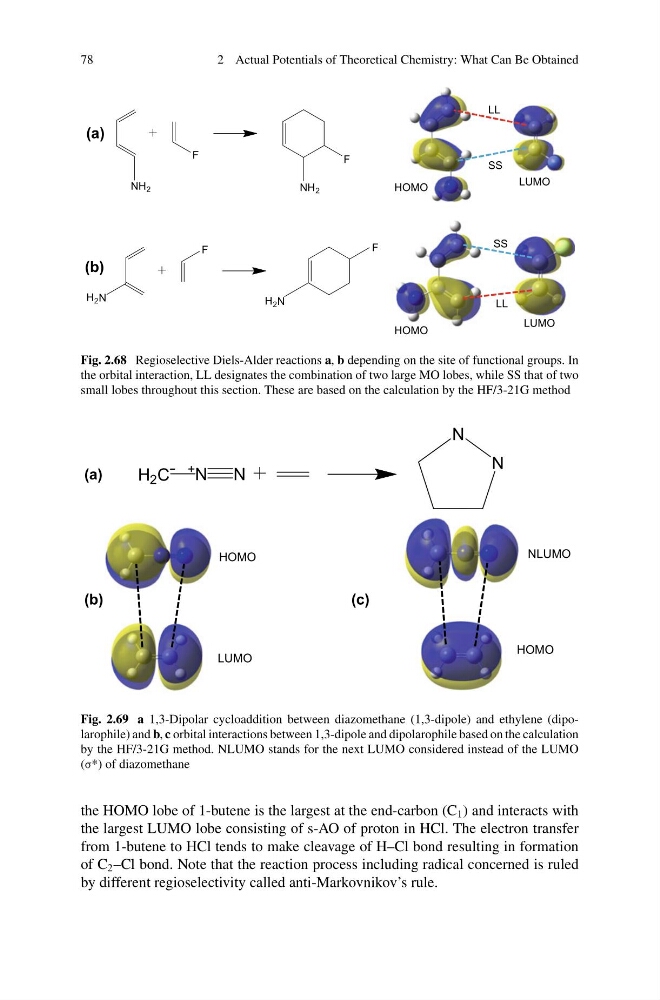
Fig. 2.68 Regioselective Diels-Alder reactions a, b depending on the site of functional groups. In
the orbital interaction, LL designates the combination of two large MO lobes, while SS that of two
small lobes throughout this section. These are based on the calculation by the HF/3-21G method
HOMO
LUMO
HOMO
NLUMO
(b)
(c)
(a)
2
+
Fig. 2.69 a 1,3-Dipolar cycloaddition between diazomethane (1,3-dipole) and ethylene (dipolarophile) and b, c orbital interactions between 1,3-dipole and dipolarophile based on the calculation
by the HF/3-21G method. NLUMO stands for the next LUMO considered instead of the LUMO
(σ*) of diazomethane
the HOMO lobe of 1-butene is the largest at the end-carbon (C 1 ) and interacts with
the largest LUMO lobe consisting of s-AO of proton in HCl. The electron transfer
from 1-butene to HCl tends to make cleavage of H–Cl bond resulting in formation
of C 2 –Cl bond. Note that the reaction process including radical concerned is ruled
by different regioselectivity called anti-Markovnikov’s rule.
2 Actual Potentials of Theoretical Chemistry: What Can Be Obtained
(a)
(b)
SS
SS
LL
LL
HOMO
HOMO
LUMO
LUMO
NH
H N
2
H N
2
F
F
F
F
2
NH 2
Fig. 2.68 Regioselective Diels-Alder reactions a, b depending on the site of functional groups. In
the orbital interaction, LL designates the combination of two large MO lobes, while SS that of two
small lobes throughout this section. These are based on the calculation by the HF/3-21G method
HOMO
LUMO
HOMO
NLUMO
(b)
(c)
(a)
2
+
Fig. 2.69 a 1,3-Dipolar cycloaddition between diazomethane (1,3-dipole) and ethylene (dipolarophile) and b, c orbital interactions between 1,3-dipole and dipolarophile based on the calculation
by the HF/3-21G method. NLUMO stands for the next LUMO considered instead of the LUMO
(σ*) of diazomethane
the HOMO lobe of 1-butene is the largest at the end-carbon (C 1 ) and interacts with
the largest LUMO lobe consisting of s-AO of proton in HCl. The electron transfer
from 1-butene to HCl tends to make cleavage of H–Cl bond resulting in formation
of C 2 –Cl bond. Note that the reaction process including radical concerned is ruled
by different regioselectivity called anti-Markovnikov’s rule.