

68
2 Actual Potentials of Theoretical Chemistry: What Can Be Obtained
Table 2.17 Young’s moduli estimated by theoretical calculations
Material
Radius r (in Å) or cross-sectional area (in Å 2 )
(estimation method)
Young’s modulus E l (in GPa) a
Polyyne b,c
Radius: 0.35 ± 0.005
(Buckling method)
40000 ± 2000
Radius: 0.33 ± 0.02
(Bending-mode method)
47000 ± 6000
Staffane b,d
Radius: 0.76 ± 0.02
(Buckling method)
5300 ± 300
1063 (diamond exp. data e )
SWCNT (9,0) f Radius: 3.56
(Opt. CNT radius + van der Waals radius (1.7
Å))
1140
SWCNT (8,2) f Radius: 3.65
(Opt. CNT radius + van der Waals radius (1.7
Å))
1030
SWCNT (5,5) f Radius: 3.44
(Opt. CNT radius + van der Waals radius (1.7
Å))
1060
Graphene f
Area obtd. by: multiplication of thickness
(twice of the van der Waals radius) and width
(distance between the outer two anchor atoms)
1110
Polyamide-6
(α-form) g
Area: 18.02
(Cryst. struct.)
334
a Note that 10 9 Nm −2 = GPa
b Obtained by DFT/B3LYP/6-31G from Itzhaki et al. (2005)
c Average for oligoynes HC m H (m = 4–20)
d Average for [3] and [4]staffanes
e From Huntington (1958)
f Closed CNT with endcaps and obtained by HF/6-31G** with elongation = L/100 (L the
original total length of the oligomer). From van Lier et al. (2000)
g Obtained by HF/6-31G** with elongation = L/100 (L the original total length of the oligomer).
From Peeters et al. (2003)
(a)
(b)
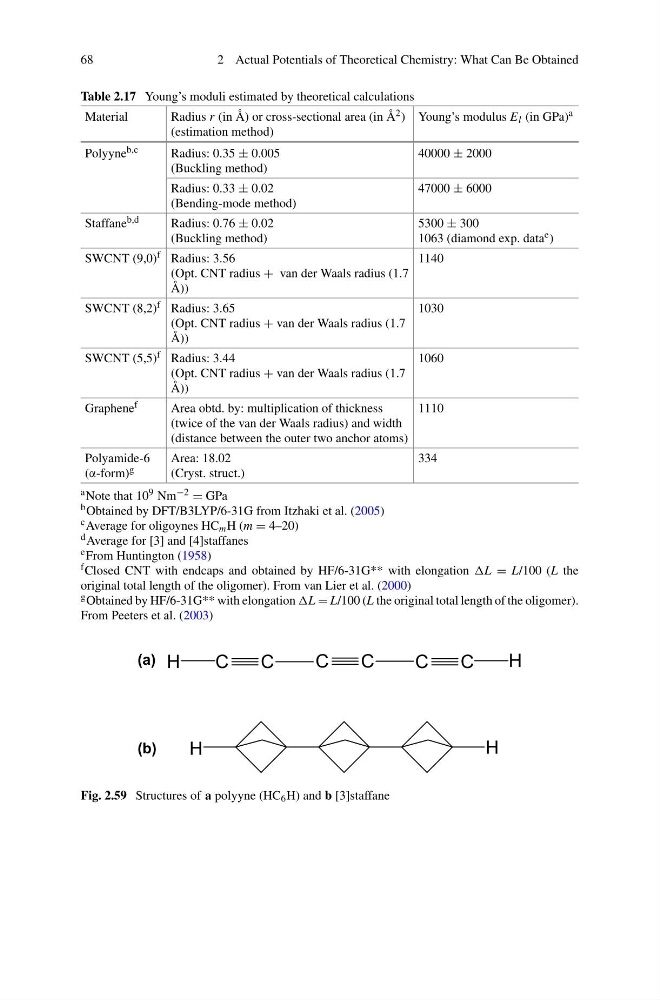
Fig. 2.59 Structures of a polyyne (HC 6 H) and b [3]staffane
2 Actual Potentials of Theoretical Chemistry: What Can Be Obtained
Table 2.17 Young’s moduli estimated by theoretical calculations
Material
Radius r (in Å) or cross-sectional area (in Å 2 )
(estimation method)
Young’s modulus E l (in GPa) a
Polyyne b,c
Radius: 0.35 ± 0.005
(Buckling method)
40000 ± 2000
Radius: 0.33 ± 0.02
(Bending-mode method)
47000 ± 6000
Staffane b,d
Radius: 0.76 ± 0.02
(Buckling method)
5300 ± 300
1063 (diamond exp. data e )
SWCNT (9,0) f Radius: 3.56
(Opt. CNT radius + van der Waals radius (1.7
Å))
1140
SWCNT (8,2) f Radius: 3.65
(Opt. CNT radius + van der Waals radius (1.7
Å))
1030
SWCNT (5,5) f Radius: 3.44
(Opt. CNT radius + van der Waals radius (1.7
Å))
1060
Graphene f
Area obtd. by: multiplication of thickness
(twice of the van der Waals radius) and width
(distance between the outer two anchor atoms)
1110
Polyamide-6
(α-form) g
Area: 18.02
(Cryst. struct.)
334
a Note that 10 9 Nm −2 = GPa
b Obtained by DFT/B3LYP/6-31G from Itzhaki et al. (2005)
c Average for oligoynes HC m H (m = 4–20)
d Average for [3] and [4]staffanes
e From Huntington (1958)
f Closed CNT with endcaps and obtained by HF/6-31G** with elongation = L/100 (L the
original total length of the oligomer). From van Lier et al. (2000)
g Obtained by HF/6-31G** with elongation = L/100 (L the original total length of the oligomer).
From Peeters et al. (2003)
(a)
(b)
Fig. 2.59 Structures of a polyyne (HC 6 H) and b [3]staffane