

2.6 Mechanical Properties
69
(a)
(b)
(c)
n
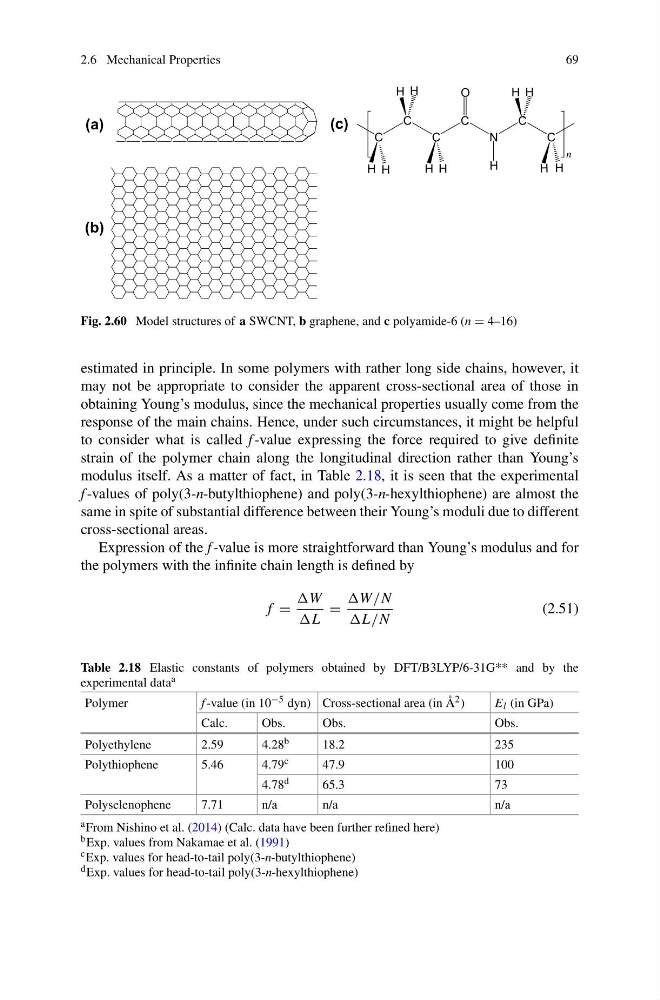
Fig. 2.60 Model structures of a SWCNT, b graphene, and c polyamide-6 (n = 4–16)
estimated in principle. In some polymers with rather long side chains, however, it
may not be appropriate to consider the apparent cross-sectional area of those in
obtaining Young’s modulus, since the mechanical properties usually come from the
response of the main chains. Hence, under such circumstances, it might be helpful
to consider what is called f -value expressing the force required to give definite
strain of the polymer chain along the longitudinal direction rather than Young’s
modulus itself. As a matter of fact, in Table 2.18, it is seen that the experimental
f -values of poly(3-n-butylthiophene) and poly(3-n-hexylthiophene) are almost the
same in spite of substantial difference between their Young’s moduli due to different
cross-sectional areas.
Expression of the f -value is more straightforward than Young’s modulus and for
the polymers with the infinite chain length is defined by
f =
=
(2.51)
Table 2.18 Elastic constants of polymers obtained by DFT/B3LYP/6-31G** and by the
experimental data a
Polymer
f -value (in 10 −5 dyn) Cross-sectional area (in Å 2 )
E l (in GPa)
Calc.
Obs.
Obs.
Obs.
Polyethylene
2.59
4.28 b
18.2
235
Polythiophene
5.46
4.79 c
47.9
100
4.78 d
65.3
73
Polyselenophene
7.71
n/a
n/a
n/a
a From Nishino et al. (2014) (Calc. data have been further refined here)
b Exp. values from Nakamae et al. (1991)
c Exp. values for head-to-tail poly(3-n-butylthiophene)
d Exp. values for head-to-tail poly(3-n-hexylthiophene)
69
(a)
(b)
(c)
n
Fig. 2.60 Model structures of a SWCNT, b graphene, and c polyamide-6 (n = 4–16)
estimated in principle. In some polymers with rather long side chains, however, it
may not be appropriate to consider the apparent cross-sectional area of those in
obtaining Young’s modulus, since the mechanical properties usually come from the
response of the main chains. Hence, under such circumstances, it might be helpful
to consider what is called f -value expressing the force required to give definite
strain of the polymer chain along the longitudinal direction rather than Young’s
modulus itself. As a matter of fact, in Table 2.18, it is seen that the experimental
f -values of poly(3-n-butylthiophene) and poly(3-n-hexylthiophene) are almost the
same in spite of substantial difference between their Young’s moduli due to different
cross-sectional areas.
Expression of the f -value is more straightforward than Young’s modulus and for
the polymers with the infinite chain length is defined by
f =
=
(2.51)
Table 2.18 Elastic constants of polymers obtained by DFT/B3LYP/6-31G** and by the
experimental data a
Polymer
f -value (in 10 −5 dyn) Cross-sectional area (in Å 2 )
E l (in GPa)
Calc.
Obs.
Obs.
Obs.
Polyethylene
2.59
4.28 b
18.2
235
Polythiophene
5.46
4.79 c
47.9
100
4.78 d
65.3
73
Polyselenophene
7.71
n/a
n/a
n/a
a From Nishino et al. (2014) (Calc. data have been further refined here)
b Exp. values from Nakamae et al. (1991)
c Exp. values for head-to-tail poly(3-n-butylthiophene)
d Exp. values for head-to-tail poly(3-n-hexylthiophene)