

2.6 Mechanical Properties
67
S
L
F
F
ΔL
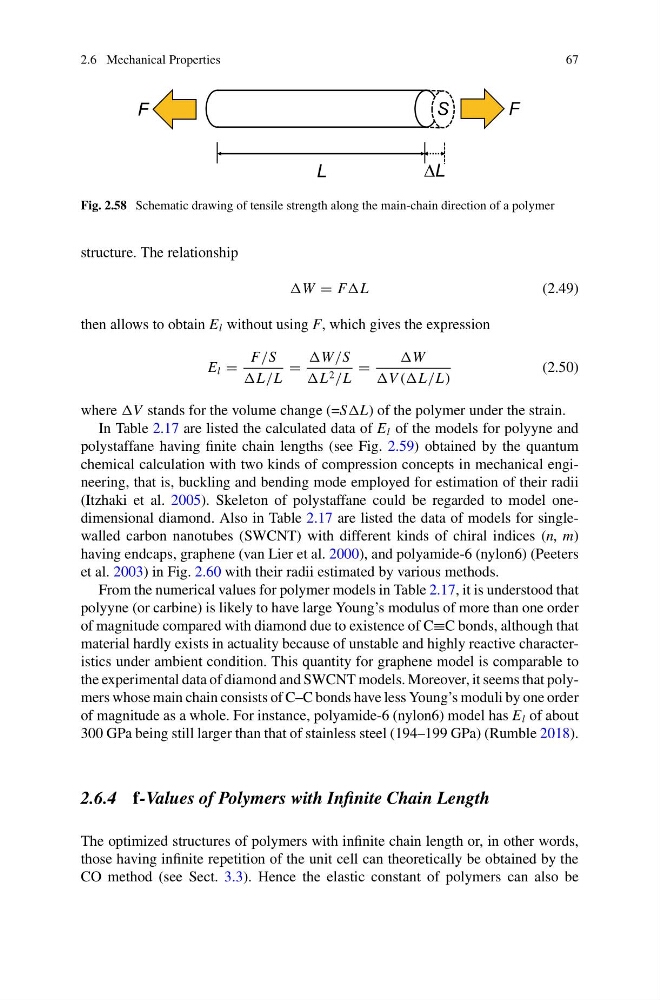
Fig. 2.58 Schematic drawing of tensile strength along the main-chain direction of a polymer
structure. The relationship
= F
(2.49)
then allows to obtain E l without using F, which gives the expression
E l =
F/S
=
2 /L
=
(
(2.50)
where stands for the volume change (=S of the polymer under the strain.
In Table 2.17 are listed the calculated data of E l of the models for polyyne and
polystaffane having finite chain lengths (see Fig. 2.59) obtained by the quantum
chemical calculation with two kinds of compression concepts in mechanical engineering, that is, buckling and bending mode employed for estimation of their radii
(Itzhaki et al. 2005). Skeleton of polystaffane could be regarded to model onedimensional diamond. Also in Table 2.17 are listed the data of models for singlewalled carbon nanotubes (SWCNT) with different kinds of chiral indices (n, m)
having endcaps, graphene (van Lier et al. 2000), and polyamide-6 (nylon6) (Peeters
et al. 2003) in Fig. 2.60 with their radii estimated by various methods.
From the numerical values for polymer models in Table 2.17, it is understood that
polyyne (or carbine) is likely to have large Young’s modulus of more than one order
of magnitude compared with diamond due to existence of C≡C bonds, although that
material hardly exists in actuality because of unstable and highly reactive characteristics under ambient condition. This quantity for graphene model is comparable to
the experimental data of diamond and SWCNT models. Moreover, it seems that polymers whose main chain consists of C–C bonds have less Young’s moduli by one order
of magnitude as a whole. For instance, polyamide-6 (nylon6) model has E l of about
300 GPa being still larger than that of stainless steel (194–199 GPa) (Rumble 2018).
2.6.4 f-Values of Polymers with Infinite Chain Length
The optimized structures of polymers with infinite chain length or, in other words,
those having infinite repetition of the unit cell can theoretically be obtained by the
CO method (see Sect. 3.3). Hence the elastic constant of polymers can also be
67
S
L
F
F
ΔL
Fig. 2.58 Schematic drawing of tensile strength along the main-chain direction of a polymer
structure. The relationship
= F
(2.49)
then allows to obtain E l without using F, which gives the expression
E l =
F/S
=
2 /L
=
(
(2.50)
where stands for the volume change (=S of the polymer under the strain.
In Table 2.17 are listed the calculated data of E l of the models for polyyne and
polystaffane having finite chain lengths (see Fig. 2.59) obtained by the quantum
chemical calculation with two kinds of compression concepts in mechanical engineering, that is, buckling and bending mode employed for estimation of their radii
(Itzhaki et al. 2005). Skeleton of polystaffane could be regarded to model onedimensional diamond. Also in Table 2.17 are listed the data of models for singlewalled carbon nanotubes (SWCNT) with different kinds of chiral indices (n, m)
having endcaps, graphene (van Lier et al. 2000), and polyamide-6 (nylon6) (Peeters
et al. 2003) in Fig. 2.60 with their radii estimated by various methods.
From the numerical values for polymer models in Table 2.17, it is understood that
polyyne (or carbine) is likely to have large Young’s modulus of more than one order
of magnitude compared with diamond due to existence of C≡C bonds, although that
material hardly exists in actuality because of unstable and highly reactive characteristics under ambient condition. This quantity for graphene model is comparable to
the experimental data of diamond and SWCNT models. Moreover, it seems that polymers whose main chain consists of C–C bonds have less Young’s moduli by one order
of magnitude as a whole. For instance, polyamide-6 (nylon6) model has E l of about
300 GPa being still larger than that of stainless steel (194–199 GPa) (Rumble 2018).
2.6.4 f-Values of Polymers with Infinite Chain Length
The optimized structures of polymers with infinite chain length or, in other words,
those having infinite repetition of the unit cell can theoretically be obtained by the
CO method (see Sect. 3.3). Hence the elastic constant of polymers can also be