

2.4 Electronic Properties
43
moment is actually represented as a vector μ and stands for the overall distribution of
the positive and negative charges in a molecule. This quantity relates to intermolecular
force as follows: the larger |μ| gives the higher boiling point, the larger mass density,
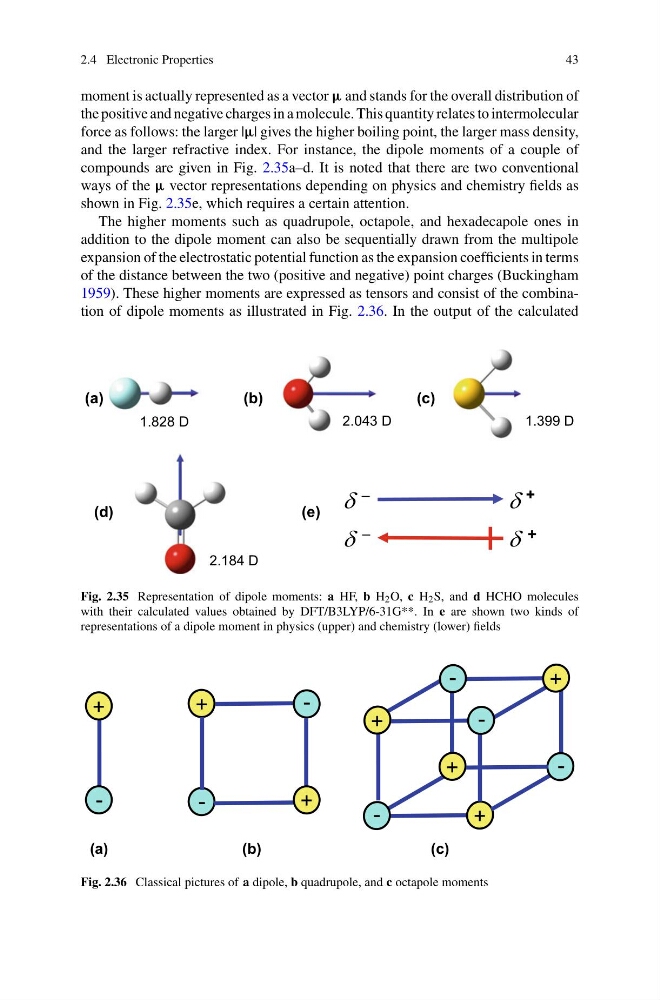
and the larger refractive index. For instance, the dipole moments of a couple of
compounds are given in Fig. 2.35a–d. It is noted that there are two conventional
ways of the μ vector representations depending on physics and chemistry fields as
shown in Fig. 2.35e, which requires a certain attention.
The higher moments such as quadrupole, octapole, and hexadecapole ones in
addition to the dipole moment can also be sequentially drawn from the multipole
expansion of the electrostatic potential function as the expansion coefficients in terms
of the distance between the two (positive and negative) point charges (Buckingham
1959). These higher moments are expressed as tensors and consist of the combination of dipole moments as illustrated in Fig. 2.36. In the output of the calculated
+
+
(b)
(c)
(e)
(a)
(d)
1.828 D
2.043 D
1.399 D
2.184 D
Fig. 2.35 Representation of dipole moments: a HF, b H 2 O, c H 2 S, and d HCHO molecules
with their calculated values obtained by DFT/B3LYP/6-31G**. In e are shown two kinds of
representations of a dipole moment in physics (upper) and chemistry (lower) fields
-
+
-
+
+
-
-
+
+
-
-
+
(a)
(b)
(c)
+
-
Fig. 2.36 Classical pictures of a dipole, b quadrupole, and c octapole moments
43
moment is actually represented as a vector μ and stands for the overall distribution of
the positive and negative charges in a molecule. This quantity relates to intermolecular
force as follows: the larger |μ| gives the higher boiling point, the larger mass density,
and the larger refractive index. For instance, the dipole moments of a couple of
compounds are given in Fig. 2.35a–d. It is noted that there are two conventional
ways of the μ vector representations depending on physics and chemistry fields as
shown in Fig. 2.35e, which requires a certain attention.
The higher moments such as quadrupole, octapole, and hexadecapole ones in
addition to the dipole moment can also be sequentially drawn from the multipole
expansion of the electrostatic potential function as the expansion coefficients in terms
of the distance between the two (positive and negative) point charges (Buckingham
1959). These higher moments are expressed as tensors and consist of the combination of dipole moments as illustrated in Fig. 2.36. In the output of the calculated
+
+
(b)
(c)
(e)
(a)
(d)
1.828 D
2.043 D
1.399 D
2.184 D
Fig. 2.35 Representation of dipole moments: a HF, b H 2 O, c H 2 S, and d HCHO molecules
with their calculated values obtained by DFT/B3LYP/6-31G**. In e are shown two kinds of
representations of a dipole moment in physics (upper) and chemistry (lower) fields
-
+
-
+
+
-
-
+
+
-
-
+
(a)
(b)
(c)
+
-
Fig. 2.36 Classical pictures of a dipole, b quadrupole, and c octapole moments