

42
2 Actual Potentials of Theoretical Chemistry: What Can Be Obtained
χ −
ε HOMO + ε LUMO
2
(2.27)
η
ε LUMO − ε HOMO
2
(2.28)
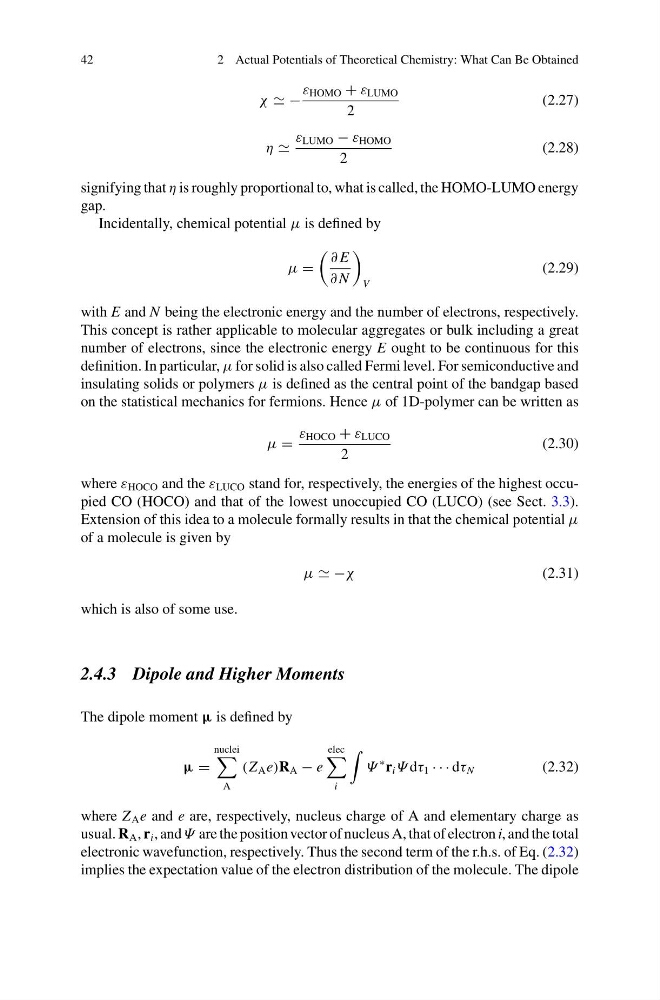
signifying that η is roughly proportional to, what is called, the HOMO-LUMO energy
gap.
Incidentally, chemical potential μ is defined by
μ =
∂ E
∂ N
V
(2.29)
with E and N being the electronic energy and the number of electrons, respectively.
This concept is rather applicable to molecular aggregates or bulk including a great
number of electrons, since the electronic energy E ought to be continuous for this
definition. In particular, μ for solid is also called Fermi level. For semiconductive and
insulating solids or polymers μ is defined as the central point of the bandgap based
on the statistical mechanics for fermions. Hence μ of 1D-polymer can be written as
μ =
ε HOCO + ε LUCO
2
(2.30)
where ε HOCO and the ε LUCO stand for, respectively, the energies of the highest occupied CO (HOCO) and that of the lowest unoccupied CO (LUCO) (see Sect. 3.3).
Extension of this idea to a molecule formally results in that the chemical potential μ
of a molecule is given by
μ −χ
(2.31)
which is also of some use.
2.4.3 Dipole and Higher Moments
The dipole moment μ is defined by
μ =
nuclei
A
(Z A e)R A − e
elec
i
Ψ
∗ r i Ψ dτ 1 · · · dτ N
(2.32)
where Z A e and e are, respectively, nucleus charge of A and elementary charge as
usual. R A , r i , and Ψ are the position vector of nucleus A, that of electron i, and the total
electronic wavefunction, respectively. Thus the second term of the r.h.s. of Eq. (2.32)
implies the expectation value of the electron distribution of the molecule. The dipole
2 Actual Potentials of Theoretical Chemistry: What Can Be Obtained
χ −
ε HOMO + ε LUMO
2
(2.27)
η
ε LUMO − ε HOMO
2
(2.28)
signifying that η is roughly proportional to, what is called, the HOMO-LUMO energy
gap.
Incidentally, chemical potential μ is defined by
μ =
∂ E
∂ N
V
(2.29)
with E and N being the electronic energy and the number of electrons, respectively.
This concept is rather applicable to molecular aggregates or bulk including a great
number of electrons, since the electronic energy E ought to be continuous for this
definition. In particular, μ for solid is also called Fermi level. For semiconductive and
insulating solids or polymers μ is defined as the central point of the bandgap based
on the statistical mechanics for fermions. Hence μ of 1D-polymer can be written as
μ =
ε HOCO + ε LUCO
2
(2.30)
where ε HOCO and the ε LUCO stand for, respectively, the energies of the highest occupied CO (HOCO) and that of the lowest unoccupied CO (LUCO) (see Sect. 3.3).
Extension of this idea to a molecule formally results in that the chemical potential μ
of a molecule is given by
μ −χ
(2.31)
which is also of some use.
2.4.3 Dipole and Higher Moments
The dipole moment μ is defined by
μ =
nuclei
A
(Z A e)R A − e
elec
i
Ψ
∗ r i Ψ dτ 1 · · · dτ N
(2.32)
where Z A e and e are, respectively, nucleus charge of A and elementary charge as
usual. R A , r i , and Ψ are the position vector of nucleus A, that of electron i, and the total
electronic wavefunction, respectively. Thus the second term of the r.h.s. of Eq. (2.32)
implies the expectation value of the electron distribution of the molecule. The dipole