

2.4 Electronic Properties
41
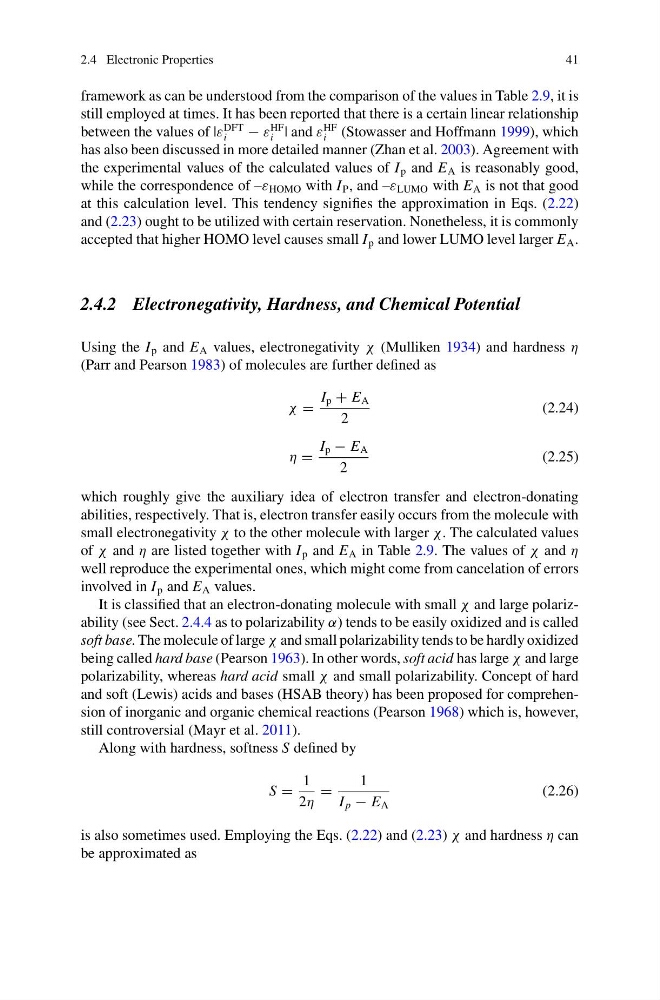
framework as can be understood from the comparison of the values in Table 2.9, it is
still employed at times. It has been reported that there is a certain linear relationship
between the values of |ε
DFT
i
− ε
HF
i | and ε
HF
i (Stowasser and Hoffmann 1999), which
has also been discussed in more detailed manner (Zhan et al. 2003). Agreement with
the experimental values of the calculated values of I p and E A is reasonably good,
while the correspondence of –ε HOMO with I P , and –ε LUMO with E A is not that good
at this calculation level. This tendency signifies the approximation in Eqs. (2.22)
and (2.23) ought to be utilized with certain reservation. Nonetheless, it is commonly
accepted that higher HOMO level causes small I p and lower LUMO level larger E A .
2.4.2 Electronegativity, Hardness, and Chemical Potential
Using the I p and E A values, electronegativity χ (Mulliken 1934) and hardness η
(Parr and Pearson 1983) of molecules are further defined as
χ =
I p + E A
2
(2.24)
η =
I p − E A
2
(2.25)
which roughly give the auxiliary idea of electron transfer and electron-donating
abilities, respectively. That is, electron transfer easily occurs from the molecule with
small electronegativity χ to the other molecule with larger χ. The calculated values
of χ and η are listed together with I p and E A in Table 2.9. The values of χ and η
well reproduce the experimental ones, which might come from cancelation of errors
involved in I p and E A values.
It is classified that an electron-donating molecule with small χ and large polarizability (see Sect. 2.4.4 as to polarizability α) tends to be easily oxidized and is called
soft base. The molecule of large χ and small polarizability tends to be hardly oxidized
being called hard base (Pearson 1963). In other words, soft acid has large χ and large
polarizability, whereas hard acid small χ and small polarizability. Concept of hard
and soft (Lewis) acids and bases (HSAB theory) has been proposed for comprehension of inorganic and organic chemical reactions (Pearson 1968) which is, however,
still controversial (Mayr et al. 2011).
Along with hardness, softness S defined by
S =
1
2η
=
1
I p − E A
(2.26)
is also sometimes used. Employing the Eqs. (2.22) and (2.23) χ and hardness η can
be approximated as
41
framework as can be understood from the comparison of the values in Table 2.9, it is
still employed at times. It has been reported that there is a certain linear relationship
between the values of |ε
DFT
i
− ε
HF
i | and ε
HF
i (Stowasser and Hoffmann 1999), which
has also been discussed in more detailed manner (Zhan et al. 2003). Agreement with
the experimental values of the calculated values of I p and E A is reasonably good,
while the correspondence of –ε HOMO with I P , and –ε LUMO with E A is not that good
at this calculation level. This tendency signifies the approximation in Eqs. (2.22)
and (2.23) ought to be utilized with certain reservation. Nonetheless, it is commonly
accepted that higher HOMO level causes small I p and lower LUMO level larger E A .
2.4.2 Electronegativity, Hardness, and Chemical Potential
Using the I p and E A values, electronegativity χ (Mulliken 1934) and hardness η
(Parr and Pearson 1983) of molecules are further defined as
χ =
I p + E A
2
(2.24)
η =
I p − E A
2
(2.25)
which roughly give the auxiliary idea of electron transfer and electron-donating
abilities, respectively. That is, electron transfer easily occurs from the molecule with
small electronegativity χ to the other molecule with larger χ. The calculated values
of χ and η are listed together with I p and E A in Table 2.9. The values of χ and η
well reproduce the experimental ones, which might come from cancelation of errors
involved in I p and E A values.
It is classified that an electron-donating molecule with small χ and large polarizability (see Sect. 2.4.4 as to polarizability α) tends to be easily oxidized and is called
soft base. The molecule of large χ and small polarizability tends to be hardly oxidized
being called hard base (Pearson 1963). In other words, soft acid has large χ and large
polarizability, whereas hard acid small χ and small polarizability. Concept of hard
and soft (Lewis) acids and bases (HSAB theory) has been proposed for comprehension of inorganic and organic chemical reactions (Pearson 1968) which is, however,
still controversial (Mayr et al. 2011).
Along with hardness, softness S defined by
S =
1
2η
=
1
I p − E A
(2.26)
is also sometimes used. Employing the Eqs. (2.22) and (2.23) χ and hardness η can
be approximated as