

44
2 Actual Potentials of Theoretical Chemistry: What Can Be Obtained
results of the quadrupole moment, two kinds of the representations are often seen
as the primitive and the traceless versions, which comes from the different kinds
of expansions. For the traceless case the spherical components are waivered, which
makes the summation of xx and yy components becomes just the negative of the
zz component. Then this traceless value corresponds to the experimentally obtained
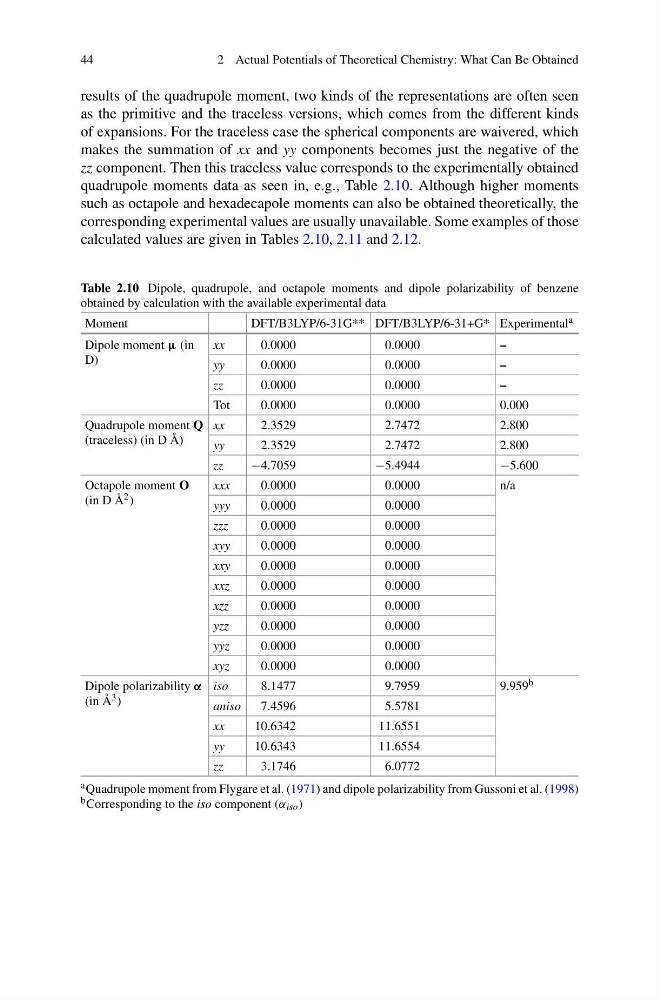
quadrupole moments data as seen in, e.g., Table 2.10. Although higher moments
such as octapole and hexadecapole moments can also be obtained theoretically, the
corresponding experimental values are usually unavailable. Some examples of those
calculated values are given in Tables 2.10, 2.11 and 2.12.
Table 2.10 Dipole, quadrupole, and octapole moments and dipole polarizability of benzene
obtained by calculation with the available experimental data
Moment
DFT/B3LYP/6-31G** DFT/B3LYP/6-31+G* Experimental a
Dipole moment μ (in
D)
xx
0.0000
0.0000
–
yy
0.0000
0.0000
–
zz
0.0000
0.0000
–
Tot
0.0000
0.0000
0.000
Quadrupole moment Q
(traceless) (in D Å)
xx
2.3529
2.7472
2.800
yy
2.3529
2.7472
2.800
zz
−4.7059
−5.4944
−5.600
Octapole moment O
(in D Å 2 )
xxx
0.0000
0.0000
n/a
yyy
0.0000
0.0000
zzz
0.0000
0.0000
xyy
0.0000
0.0000
xxy
0.0000
0.0000
xxz
0.0000
0.0000
xzz
0.0000
0.0000
yzz
0.0000
0.0000
yyz
0.0000
0.0000
xyz
0.0000
0.0000
Dipole polarizability α
(in Å 3 )
iso
8.1477
9.7959
9.959 b
aniso
7.4596
5.5781
xx
10.6342
11.6551
yy
10.6343
11.6554
zz
3.1746
6.0772
a Quadrupole moment from Flygare et al. (1971) and dipole polarizability from Gussoni et al. (1998)
b Corresponding to the iso component (α iso )
2 Actual Potentials of Theoretical Chemistry: What Can Be Obtained
results of the quadrupole moment, two kinds of the representations are often seen
as the primitive and the traceless versions, which comes from the different kinds
of expansions. For the traceless case the spherical components are waivered, which
makes the summation of xx and yy components becomes just the negative of the
zz component. Then this traceless value corresponds to the experimentally obtained
quadrupole moments data as seen in, e.g., Table 2.10. Although higher moments
such as octapole and hexadecapole moments can also be obtained theoretically, the
corresponding experimental values are usually unavailable. Some examples of those
calculated values are given in Tables 2.10, 2.11 and 2.12.
Table 2.10 Dipole, quadrupole, and octapole moments and dipole polarizability of benzene
obtained by calculation with the available experimental data
Moment
DFT/B3LYP/6-31G** DFT/B3LYP/6-31+G* Experimental a
Dipole moment μ (in
D)
xx
0.0000
0.0000
–
yy
0.0000
0.0000
–
zz
0.0000
0.0000
–
Tot
0.0000
0.0000
0.000
Quadrupole moment Q
(traceless) (in D Å)
xx
2.3529
2.7472
2.800
yy
2.3529
2.7472
2.800
zz
−4.7059
−5.4944
−5.600
Octapole moment O
(in D Å 2 )
xxx
0.0000
0.0000
n/a
yyy
0.0000
0.0000
zzz
0.0000
0.0000
xyy
0.0000
0.0000
xxy
0.0000
0.0000
xxz
0.0000
0.0000
xzz
0.0000
0.0000
yzz
0.0000
0.0000
yyz
0.0000
0.0000
xyz
0.0000
0.0000
Dipole polarizability α
(in Å 3 )
iso
8.1477
9.7959
9.959 b
aniso
7.4596
5.5781
xx
10.6342
11.6551
yy
10.6343
11.6554
zz
3.1746
6.0772
a Quadrupole moment from Flygare et al. (1971) and dipole polarizability from Gussoni et al. (1998)
b Corresponding to the iso component (α iso )