

36
2 Actual Potentials of Theoretical Chemistry: What Can Be Obtained
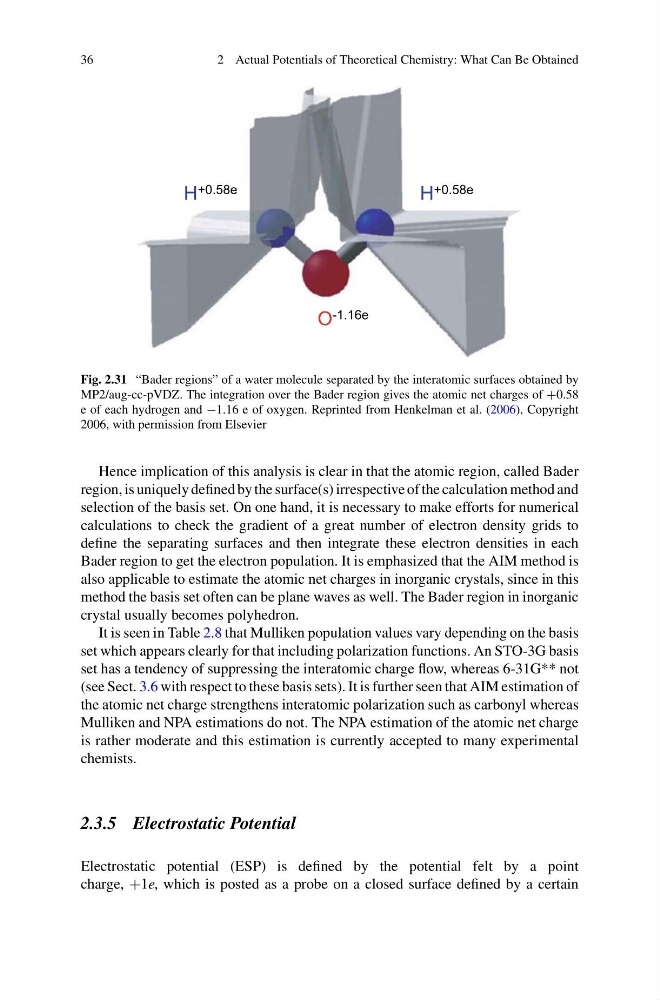
H +0.58e
H +0.58e
O -1.16e
Fig. 2.31 “Bader regions” of a water molecule separated by the interatomic surfaces obtained by
MP2/aug-cc-pVDZ. The integration over the Bader region gives the atomic net charges of +0.58
e of each hydrogen and −1.16 e of oxygen. Reprinted from Henkelman et al. (2006), Copyright
2006, with permission from Elsevier
Hence implication of this analysis is clear in that the atomic region, called Bader
region, is uniquely defined by the surface(s) irrespective of the calculation method and
selection of the basis set. On one hand, it is necessary to make efforts for numerical
calculations to check the gradient of a great number of electron density grids to
define the separating surfaces and then integrate these electron densities in each
Bader region to get the electron population. It is emphasized that the AIM method is
also applicable to estimate the atomic net charges in inorganic crystals, since in this
method the basis set often can be plane waves as well. The Bader region in inorganic
crystal usually becomes polyhedron.
It is seen in Table 2.8 that Mulliken population values vary depending on the basis
set which appears clearly for that including polarization functions. An STO-3G basis
set has a tendency of suppressing the interatomic charge flow, whereas 6-31G** not
(see Sect. 3.6 with respect to these basis sets). It is further seen that AIM estimation of
the atomic net charge strengthens interatomic polarization such as carbonyl whereas
Mulliken and NPA estimations do not. The NPA estimation of the atomic net charge
is rather moderate and this estimation is currently accepted to many experimental
chemists.
2.3.5 Electrostatic Potential
Electrostatic potential (ESP) is defined by the potential felt by a point
charge, +1e, which is posted as a probe on a closed surface defined by a certain
2 Actual Potentials of Theoretical Chemistry: What Can Be Obtained
H +0.58e
H +0.58e
O -1.16e
Fig. 2.31 “Bader regions” of a water molecule separated by the interatomic surfaces obtained by
MP2/aug-cc-pVDZ. The integration over the Bader region gives the atomic net charges of +0.58
e of each hydrogen and −1.16 e of oxygen. Reprinted from Henkelman et al. (2006), Copyright
2006, with permission from Elsevier
Hence implication of this analysis is clear in that the atomic region, called Bader
region, is uniquely defined by the surface(s) irrespective of the calculation method and
selection of the basis set. On one hand, it is necessary to make efforts for numerical
calculations to check the gradient of a great number of electron density grids to
define the separating surfaces and then integrate these electron densities in each
Bader region to get the electron population. It is emphasized that the AIM method is
also applicable to estimate the atomic net charges in inorganic crystals, since in this
method the basis set often can be plane waves as well. The Bader region in inorganic
crystal usually becomes polyhedron.
It is seen in Table 2.8 that Mulliken population values vary depending on the basis
set which appears clearly for that including polarization functions. An STO-3G basis
set has a tendency of suppressing the interatomic charge flow, whereas 6-31G** not
(see Sect. 3.6 with respect to these basis sets). It is further seen that AIM estimation of
the atomic net charge strengthens interatomic polarization such as carbonyl whereas
Mulliken and NPA estimations do not. The NPA estimation of the atomic net charge
is rather moderate and this estimation is currently accepted to many experimental
chemists.
2.3.5 Electrostatic Potential
Electrostatic potential (ESP) is defined by the potential felt by a point
charge, +1e, which is posted as a probe on a closed surface defined by a certain