

2.3 Electronic Structures
35
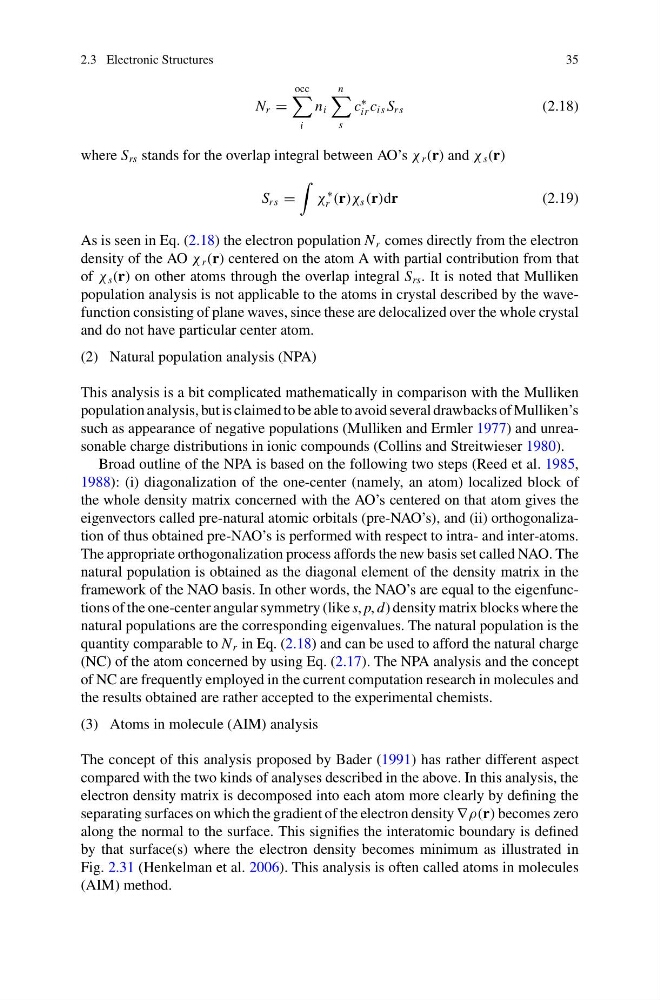
N r =
occ
i
n i
n
s
c
∗
ir c is S rs
(2.18)
where S rs stands for the overlap integral between AO’s χ r (r) and χ s (r)
S rs =
χ
∗
r (r)χ s (r)dr
(2.19)
As is seen in Eq. (2.18) the electron population N r comes directly from the electron
density of the AO χ r (r) centered on the atom A with partial contribution from that
of χ s (r) on other atoms through the overlap integral S rs . It is noted that Mulliken
population analysis is not applicable to the atoms in crystal described by the wavefunction consisting of plane waves, since these are delocalized over the whole crystal
and do not have particular center atom.
(2) Natural population analysis (NPA)
This analysis is a bit complicated mathematically in comparison with the Mulliken
population analysis, but is claimed to be able to avoid several drawbacks of Mulliken’s
such as appearance of negative populations (Mulliken and Ermler 1977) and unreasonable charge distributions in ionic compounds (Collins and Streitwieser 1980).
Broad outline of the NPA is based on the following two steps (Reed et al. 1985,
1988): (i) diagonalization of the one-center (namely, an atom) localized block of
the whole density matrix concerned with the AO’s centered on that atom gives the
eigenvectors called pre-natural atomic orbitals (pre-NAO’s), and (ii) orthogonalization of thus obtained pre-NAO’s is performed with respect to intra- and inter-atoms.
The appropriate orthogonalization process affords the new basis set called NAO. The
natural population is obtained as the diagonal element of the density matrix in the
framework of the NAO basis. In other words, the NAO’s are equal to the eigenfunctions of the one-center angular symmetry (like s, p, d) density matrix blocks where the
natural populations are the corresponding eigenvalues. The natural population is the
quantity comparable to N r in Eq. (2.18) and can be used to afford the natural charge
(NC) of the atom concerned by using Eq. (2.17). The NPA analysis and the concept
of NC are frequently employed in the current computation research in molecules and
the results obtained are rather accepted to the experimental chemists.
(3) Atoms in molecule (AIM) analysis
The concept of this analysis proposed by Bader (1991) has rather different aspect
compared with the two kinds of analyses described in the above. In this analysis, the
electron density matrix is decomposed into each atom more clearly by defining the
separating surfaces on which the gradient of the electron density ∇ρ(r) becomes zero
along the normal to the surface. This signifies the interatomic boundary is defined
by that surface(s) where the electron density becomes minimum as illustrated in
Fig. 2.31 (Henkelman et al. 2006). This analysis is often called atoms in molecules
(AIM) method.
35
N r =
occ
i
n i
n
s
c
∗
ir c is S rs
(2.18)
where S rs stands for the overlap integral between AO’s χ r (r) and χ s (r)
S rs =
χ
∗
r (r)χ s (r)dr
(2.19)
As is seen in Eq. (2.18) the electron population N r comes directly from the electron
density of the AO χ r (r) centered on the atom A with partial contribution from that
of χ s (r) on other atoms through the overlap integral S rs . It is noted that Mulliken
population analysis is not applicable to the atoms in crystal described by the wavefunction consisting of plane waves, since these are delocalized over the whole crystal
and do not have particular center atom.
(2) Natural population analysis (NPA)
This analysis is a bit complicated mathematically in comparison with the Mulliken
population analysis, but is claimed to be able to avoid several drawbacks of Mulliken’s
such as appearance of negative populations (Mulliken and Ermler 1977) and unreasonable charge distributions in ionic compounds (Collins and Streitwieser 1980).
Broad outline of the NPA is based on the following two steps (Reed et al. 1985,
1988): (i) diagonalization of the one-center (namely, an atom) localized block of
the whole density matrix concerned with the AO’s centered on that atom gives the
eigenvectors called pre-natural atomic orbitals (pre-NAO’s), and (ii) orthogonalization of thus obtained pre-NAO’s is performed with respect to intra- and inter-atoms.
The appropriate orthogonalization process affords the new basis set called NAO. The
natural population is obtained as the diagonal element of the density matrix in the
framework of the NAO basis. In other words, the NAO’s are equal to the eigenfunctions of the one-center angular symmetry (like s, p, d) density matrix blocks where the
natural populations are the corresponding eigenvalues. The natural population is the
quantity comparable to N r in Eq. (2.18) and can be used to afford the natural charge
(NC) of the atom concerned by using Eq. (2.17). The NPA analysis and the concept
of NC are frequently employed in the current computation research in molecules and
the results obtained are rather accepted to the experimental chemists.
(3) Atoms in molecule (AIM) analysis
The concept of this analysis proposed by Bader (1991) has rather different aspect
compared with the two kinds of analyses described in the above. In this analysis, the
electron density matrix is decomposed into each atom more clearly by defining the
separating surfaces on which the gradient of the electron density ∇ρ(r) becomes zero
along the normal to the surface. This signifies the interatomic boundary is defined
by that surface(s) where the electron density becomes minimum as illustrated in
Fig. 2.31 (Henkelman et al. 2006). This analysis is often called atoms in molecules
(AIM) method.