

2.1 Molecular Structure
11
Lowest Singlet
Excited State (S 1 )
Photoexcitation
Ground State (S 0 )
Structural Relaxation
(radiationless transition)
E
R (Nuclear Coordinates)
R(S 0 ) opt
R(S 1 ) opt
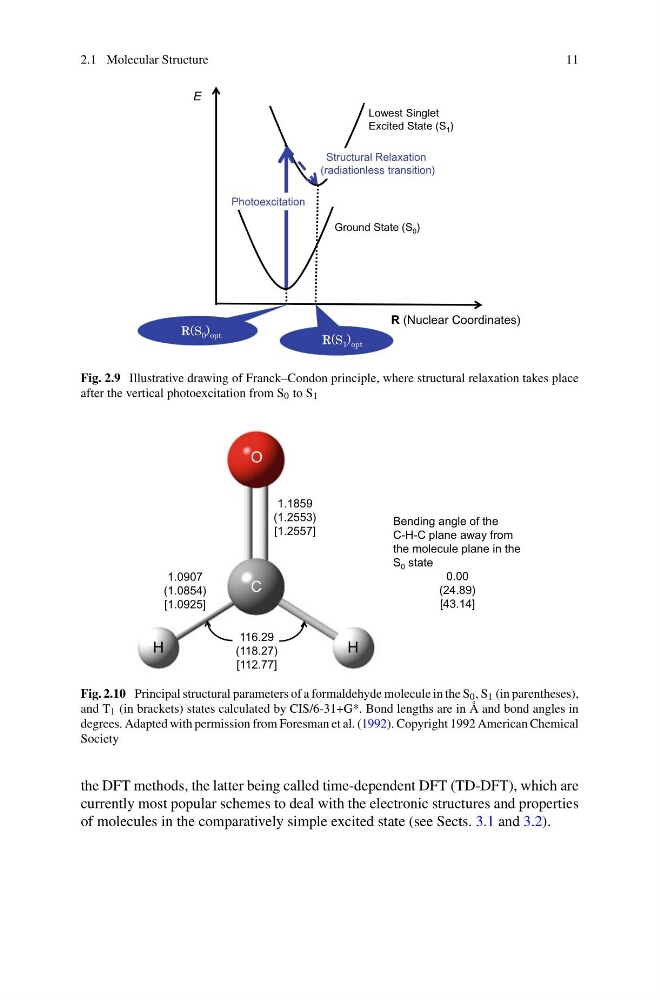
Fig. 2.9 Illustrative drawing of Franck–Condon principle, where structural relaxation takes place
after the vertical photoexcitation from S 0 to S 1
1.1859
(1.2553)
[1.2557]
1.0907
(1.0854)
[1.0925]
116.29
(118.27)
[112.77]
Bending angle of the
C-H-C plane away from
the molecule plane in the
S 0 state
0.00
(24.89)
[43.14]
O
C
H
H
Fig. 2.10 Principal structural parameters of a formaldehyde molecule in the S 0 , S 1 (in parentheses),
and T 1 (in brackets) states calculated by CIS/6-31+G*. Bond lengths are in Å and bond angles in
degrees. Adapted with permission from Foresman et al. (1992). Copyright 1992 American Chemical
Society
the DFT methods, the latter being called time-dependent DFT (TD-DFT), which are
currently most popular schemes to deal with the electronic structures and properties
of molecules in the comparatively simple excited state (see Sects. 3.1 and 3.2).
11
Lowest Singlet
Excited State (S 1 )
Photoexcitation
Ground State (S 0 )
Structural Relaxation
(radiationless transition)
E
R (Nuclear Coordinates)
R(S 0 ) opt
R(S 1 ) opt
Fig. 2.9 Illustrative drawing of Franck–Condon principle, where structural relaxation takes place
after the vertical photoexcitation from S 0 to S 1
1.1859
(1.2553)
[1.2557]
1.0907
(1.0854)
[1.0925]
116.29
(118.27)
[112.77]
Bending angle of the
C-H-C plane away from
the molecule plane in the
S 0 state
0.00
(24.89)
[43.14]
O
C
H
H
Fig. 2.10 Principal structural parameters of a formaldehyde molecule in the S 0 , S 1 (in parentheses),
and T 1 (in brackets) states calculated by CIS/6-31+G*. Bond lengths are in Å and bond angles in
degrees. Adapted with permission from Foresman et al. (1992). Copyright 1992 American Chemical
Society
the DFT methods, the latter being called time-dependent DFT (TD-DFT), which are
currently most popular schemes to deal with the electronic structures and properties
of molecules in the comparatively simple excited state (see Sects. 3.1 and 3.2).