

12
2 Actual Potentials of Theoretical Chemistry: What Can Be Obtained
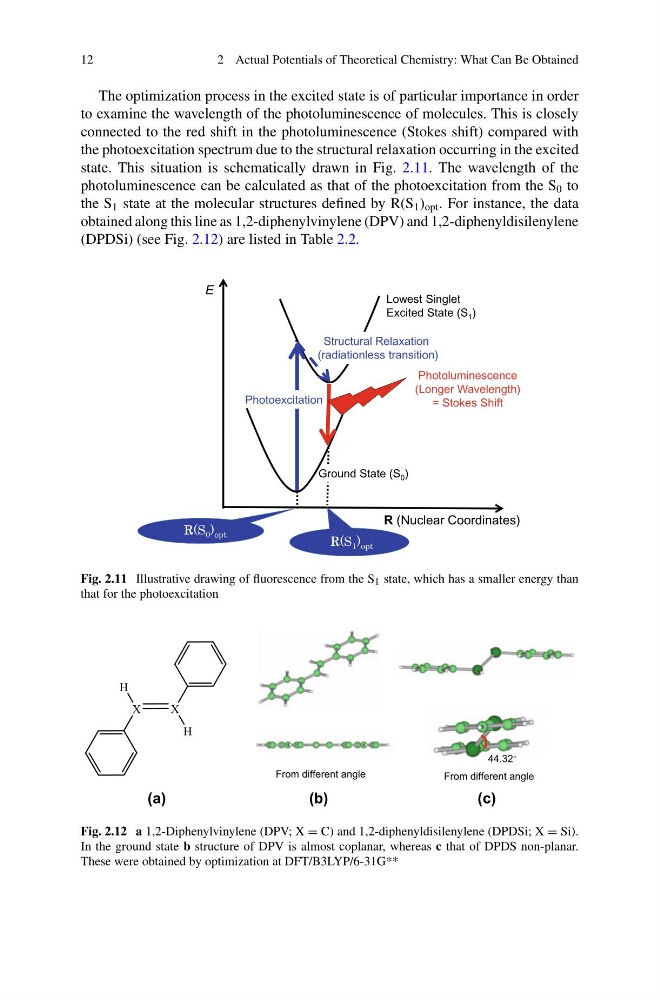
The optimization process in the excited state is of particular importance in order
to examine the wavelength of the photoluminescence of molecules. This is closely
connected to the red shift in the photoluminescence (Stokes shift) compared with
the photoexcitation spectrum due to the structural relaxation occurring in the excited
state. This situation is schematically drawn in Fig. 2.11. The wavelength of the
photoluminescence can be calculated as that of the photoexcitation from the S 0 to
the S 1 state at the molecular structures defined by R(S 1 ) opt . For instance, the data
obtained along this line as 1,2-diphenylvinylene (DPV) and 1,2-diphenyldisilenylene
(DPDSi) (see Fig. 2.12) are listed in Table 2.2.
Lowest Singlet
Excited State (S 1 )
Photoexcitation
Ground State (S 0 )
E
R (Nuclear Coordinates)
R(S 0 ) opt
R(S 1 ) opt
Photoluminescence
(Longer Wavelength)
= Stokes Shift
Structural Relaxation
(radiationless transition)
Fig. 2.11 Illustrative drawing of fluorescence from the S 1 state, which has a smaller energy than
that for the photoexcitation
X
X
H
H
(a)
(b)
(c)
44.32
From different angle
From different angle
Fig. 2.12 a 1,2-Diphenylvinylene (DPV; X = C) and 1,2-diphenyldisilenylene (DPDSi; X = Si).
In the ground state b structure of DPV is almost coplanar, whereas c that of DPDS non-planar.
These were obtained by optimization at DFT/B3LYP/6-31G**
2 Actual Potentials of Theoretical Chemistry: What Can Be Obtained
The optimization process in the excited state is of particular importance in order
to examine the wavelength of the photoluminescence of molecules. This is closely
connected to the red shift in the photoluminescence (Stokes shift) compared with
the photoexcitation spectrum due to the structural relaxation occurring in the excited
state. This situation is schematically drawn in Fig. 2.11. The wavelength of the
photoluminescence can be calculated as that of the photoexcitation from the S 0 to
the S 1 state at the molecular structures defined by R(S 1 ) opt . For instance, the data
obtained along this line as 1,2-diphenylvinylene (DPV) and 1,2-diphenyldisilenylene
(DPDSi) (see Fig. 2.12) are listed in Table 2.2.
Lowest Singlet
Excited State (S 1 )
Photoexcitation
Ground State (S 0 )
E
R (Nuclear Coordinates)
R(S 0 ) opt
R(S 1 ) opt
Photoluminescence
(Longer Wavelength)
= Stokes Shift
Structural Relaxation
(radiationless transition)
Fig. 2.11 Illustrative drawing of fluorescence from the S 1 state, which has a smaller energy than
that for the photoexcitation
X
X
H
H
(a)
(b)
(c)
44.32
From different angle
From different angle
Fig. 2.12 a 1,2-Diphenylvinylene (DPV; X = C) and 1,2-diphenyldisilenylene (DPDSi; X = Si).
In the ground state b structure of DPV is almost coplanar, whereas c that of DPDS non-planar.
These were obtained by optimization at DFT/B3LYP/6-31G**