

10
2 Actual Potentials of Theoretical Chemistry: What Can Be Obtained
2.1.2 Molecular Structure in the Excited State
The most popular excited state dealt with by the experimental chemists would be the
first singlet or the first triplet state represented as S 1 or T 1 . In contrast, the singlet
ground state mentioned in the above is expressed as S 0 . Simple cross sections of
these states have been shown in Fig. 2.1. Schematic drawings of these states are
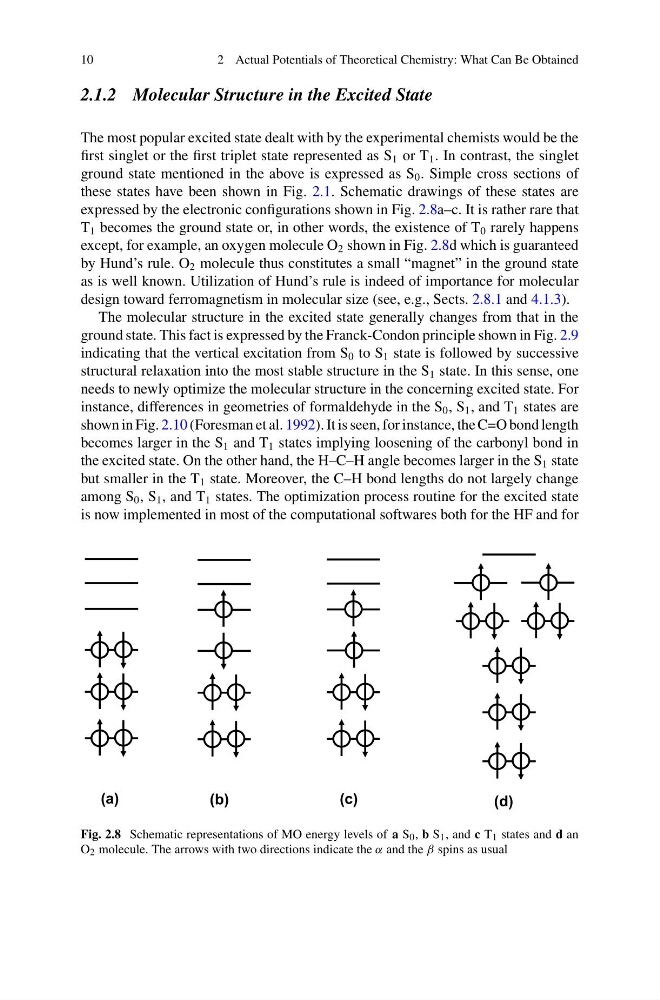
expressed by the electronic configurations shown in Fig. 2.8a–c. It is rather rare that
T 1 becomes the ground state or, in other words, the existence of T 0 rarely happens
except, for example, an oxygen molecule O 2 shown in Fig. 2.8d which is guaranteed
by Hund’s rule. O 2 molecule thus constitutes a small “magnet” in the ground state
as is well known. Utilization of Hund’s rule is indeed of importance for molecular
design toward ferromagnetism in molecular size (see, e.g., Sects. 2.8.1 and 4.1.3).
The molecular structure in the excited state generally changes from that in the
ground state. This fact is expressed by the Franck-Condon principle shown in Fig. 2.9
indicating that the vertical excitation from S 0 to S 1 state is followed by successive
structural relaxation into the most stable structure in the S 1 state. In this sense, one
needs to newly optimize the molecular structure in the concerning excited state. For
instance, differences in geometries of formaldehyde in the S 0 , S 1 , and T 1 states are
shown in Fig. 2.10 (Foresman et al. 1992). It is seen, for instance, the C=O bond length
becomes larger in the S 1 and T 1 states implying loosening of the carbonyl bond in
the excited state. On the other hand, the H–C–H angle becomes larger in the S 1 state
but smaller in the T 1 state. Moreover, the C–H bond lengths do not largely change
among S 0 , S 1 , and T 1 states. The optimization process routine for the excited state
is now implemented in most of the computational softwares both for the HF and for
(a)
(b)
(c)
(d)
Fig. 2.8 Schematic representations of MO energy levels of a S 0 , b S 1 , and c T 1 states and d an
O 2 molecule. The arrows with two directions indicate the α and the β spins as usual
2 Actual Potentials of Theoretical Chemistry: What Can Be Obtained
2.1.2 Molecular Structure in the Excited State
The most popular excited state dealt with by the experimental chemists would be the
first singlet or the first triplet state represented as S 1 or T 1 . In contrast, the singlet
ground state mentioned in the above is expressed as S 0 . Simple cross sections of
these states have been shown in Fig. 2.1. Schematic drawings of these states are
expressed by the electronic configurations shown in Fig. 2.8a–c. It is rather rare that
T 1 becomes the ground state or, in other words, the existence of T 0 rarely happens
except, for example, an oxygen molecule O 2 shown in Fig. 2.8d which is guaranteed
by Hund’s rule. O 2 molecule thus constitutes a small “magnet” in the ground state
as is well known. Utilization of Hund’s rule is indeed of importance for molecular
design toward ferromagnetism in molecular size (see, e.g., Sects. 2.8.1 and 4.1.3).
The molecular structure in the excited state generally changes from that in the
ground state. This fact is expressed by the Franck-Condon principle shown in Fig. 2.9
indicating that the vertical excitation from S 0 to S 1 state is followed by successive
structural relaxation into the most stable structure in the S 1 state. In this sense, one
needs to newly optimize the molecular structure in the concerning excited state. For
instance, differences in geometries of formaldehyde in the S 0 , S 1 , and T 1 states are
shown in Fig. 2.10 (Foresman et al. 1992). It is seen, for instance, the C=O bond length
becomes larger in the S 1 and T 1 states implying loosening of the carbonyl bond in
the excited state. On the other hand, the H–C–H angle becomes larger in the S 1 state
but smaller in the T 1 state. Moreover, the C–H bond lengths do not largely change
among S 0 , S 1 , and T 1 states. The optimization process routine for the excited state
is now implemented in most of the computational softwares both for the HF and for
(a)
(b)
(c)
(d)
Fig. 2.8 Schematic representations of MO energy levels of a S 0 , b S 1 , and c T 1 states and d an
O 2 molecule. The arrows with two directions indicate the α and the β spins as usual