

184
4 Toward More Sophisticated Problems
HOMO
HOMO-4
HOMO-5
HOMO-6
LUMO
LUMO+2
LUMO+3
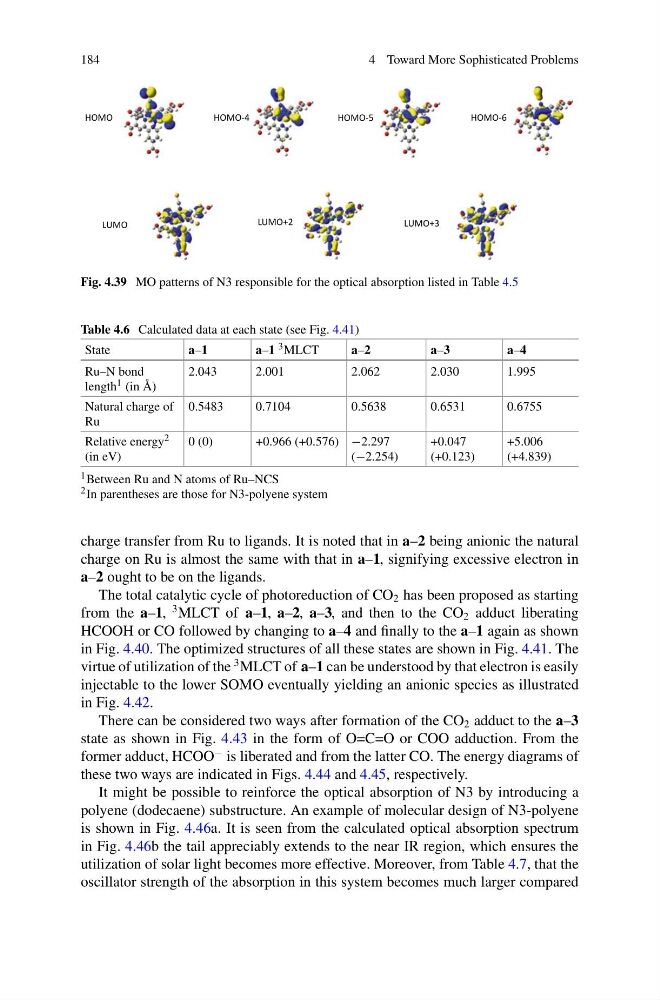
Fig. 4.39 MO patterns of N3 responsible for the optical absorption listed in Table 4.5
Table 4.6 Calculated data at each state (see Fig. 4.41)
State
a–1
a–1 3 MLCT
a–2
a–3
a–4
Ru–N bond
length 1 (in Å)
2.043
2.001
2.062
2.030
1.995
Natural charge of
Ru
0.5483
0.7104
0.5638
0.6531
0.6755
Relative energy 2
(in eV)
0 (0)
+0.966 (+0.576) −2.297
(−2.254)
+0.047
(+0.123)
+5.006
(+4.839)
1 Between Ru and N atoms of Ru–NCS
2 In parentheses are those for N3-polyene system
charge transfer from Ru to ligands. It is noted that in a–2 being anionic the natural
charge on Ru is almost the same with that in a–1, signifying excessive electron in
a–2 ought to be on the ligands.
The total catalytic cycle of photoreduction of CO 2 has been proposed as starting
from the a–1,
3 MLCT of a–1, a–2, a–3, and then to the CO 2 adduct liberating
HCOOH or CO followed by changing to a–4 and finally to the a–1 again as shown
in Fig. 4.40. The optimized structures of all these states are shown in Fig. 4.41. The
virtue of utilization of the
3 MLCT of a–1 can be understood by that electron is easily
injectable to the lower SOMO eventually yielding an anionic species as illustrated
in Fig. 4.42.
There can be considered two ways after formation of the CO 2 adduct to the a–3
state as shown in Fig. 4.43 in the form of O=C=O or COO adduction. From the
former adduct, HCOO
− is liberated and from the latter CO. The energy diagrams of
these two ways are indicated in Figs. 4.44 and 4.45, respectively.
It might be possible to reinforce the optical absorption of N3 by introducing a
polyene (dodecaene) substructure. An example of molecular design of N3-polyene
is shown in Fig. 4.46a. It is seen from the calculated optical absorption spectrum
in Fig. 4.46b the tail appreciably extends to the near IR region, which ensures the
utilization of solar light becomes more effective. Moreover, from Table 4.7, that the
oscillator strength of the absorption in this system becomes much larger compared
4 Toward More Sophisticated Problems
HOMO
HOMO-4
HOMO-5
HOMO-6
LUMO
LUMO+2
LUMO+3
Fig. 4.39 MO patterns of N3 responsible for the optical absorption listed in Table 4.5
Table 4.6 Calculated data at each state (see Fig. 4.41)
State
a–1
a–1 3 MLCT
a–2
a–3
a–4
Ru–N bond
length 1 (in Å)
2.043
2.001
2.062
2.030
1.995
Natural charge of
Ru
0.5483
0.7104
0.5638
0.6531
0.6755
Relative energy 2
(in eV)
0 (0)
+0.966 (+0.576) −2.297
(−2.254)
+0.047
(+0.123)
+5.006
(+4.839)
1 Between Ru and N atoms of Ru–NCS
2 In parentheses are those for N3-polyene system
charge transfer from Ru to ligands. It is noted that in a–2 being anionic the natural
charge on Ru is almost the same with that in a–1, signifying excessive electron in
a–2 ought to be on the ligands.
The total catalytic cycle of photoreduction of CO 2 has been proposed as starting
from the a–1,
3 MLCT of a–1, a–2, a–3, and then to the CO 2 adduct liberating
HCOOH or CO followed by changing to a–4 and finally to the a–1 again as shown
in Fig. 4.40. The optimized structures of all these states are shown in Fig. 4.41. The
virtue of utilization of the
3 MLCT of a–1 can be understood by that electron is easily
injectable to the lower SOMO eventually yielding an anionic species as illustrated
in Fig. 4.42.
There can be considered two ways after formation of the CO 2 adduct to the a–3
state as shown in Fig. 4.43 in the form of O=C=O or COO adduction. From the
former adduct, HCOO
− is liberated and from the latter CO. The energy diagrams of
these two ways are indicated in Figs. 4.44 and 4.45, respectively.
It might be possible to reinforce the optical absorption of N3 by introducing a
polyene (dodecaene) substructure. An example of molecular design of N3-polyene
is shown in Fig. 4.46a. It is seen from the calculated optical absorption spectrum
in Fig. 4.46b the tail appreciably extends to the near IR region, which ensures the
utilization of solar light becomes more effective. Moreover, from Table 4.7, that the
oscillator strength of the absorption in this system becomes much larger compared