

4.3 Catalytic Chemistry
185
3 MLCT
Excited state
TEOA
TEOA +
NCS -
Elimination
NCS -
Re-coordination
[CO 2 adduct]
-
+
CO 2
HCOOH or CO
-
Related to CO 2 adduct
(a-1)
)
2
-
a
(
)
3
-
a
(
(a-4)
Another (a-2):
(a-1)
TEOA: Triethanolamine
Reduction of CO 2 of the adduct
by electron injection
ia 1 MLCT
Excited state
hν
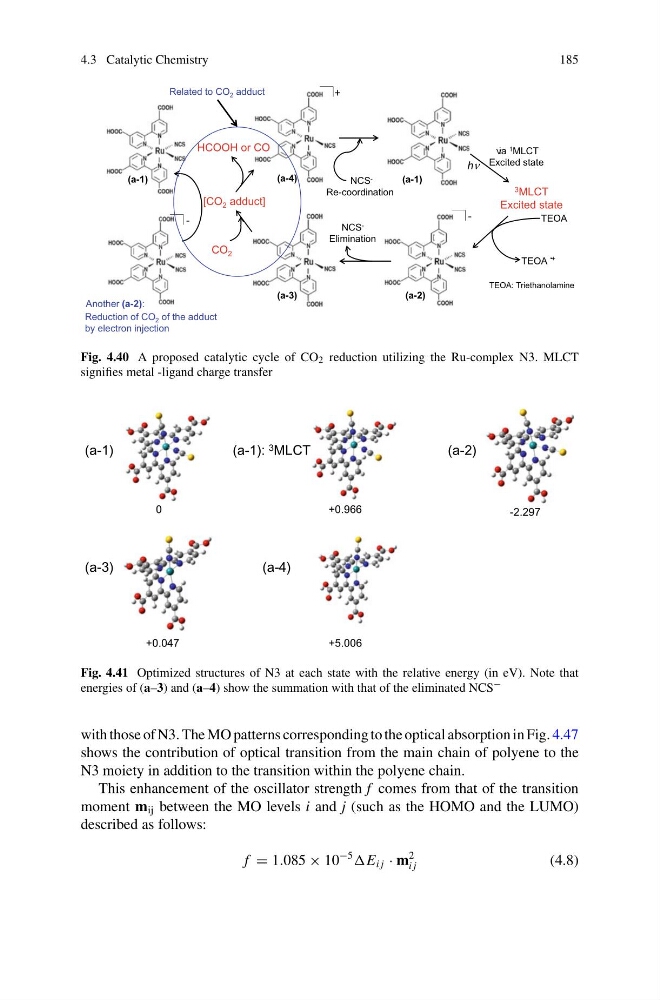
Fig. 4.40 A proposed catalytic cycle of CO 2 reduction utilizing the Ru-complex N3. MLCT
signifies metal -ligand charge transfer
(a-1)
(a-1): 3 MLCT
(a-2)
(a-3)
(a-4)
0
+0.966
-2.297
+0.047
+5.006
Fig. 4.41 Optimized structures of N3 at each state with the relative energy (in eV). Note that
energies of (a–3) and (a–4) show the summation with that of the eliminated NCS −
with those of N3. The MO patterns corresponding to the optical absorption in Fig. 4.47
shows the contribution of optical transition from the main chain of polyene to the
N3 moiety in addition to the transition within the polyene chain.
This enhancement of the oscillator strength f comes from that of the transition
moment m ij between the MO levels i and j (such as the HOMO and the LUMO)
described as follows:
f = 1.085 × 10
−5
i j · m
2
i j
(4.8)
185
3 MLCT
Excited state
TEOA
TEOA +
NCS -
Elimination
NCS -
Re-coordination
[CO 2 adduct]
-
+
CO 2
HCOOH or CO
-
Related to CO 2 adduct
(a-1)
)
2
-
a
(
)
3
-
a
(
(a-4)
Another (a-2):
(a-1)
TEOA: Triethanolamine
Reduction of CO 2 of the adduct
by electron injection
ia 1 MLCT
Excited state
hν
Fig. 4.40 A proposed catalytic cycle of CO 2 reduction utilizing the Ru-complex N3. MLCT
signifies metal -ligand charge transfer
(a-1)
(a-1): 3 MLCT
(a-2)
(a-3)
(a-4)
0
+0.966
-2.297
+0.047
+5.006
Fig. 4.41 Optimized structures of N3 at each state with the relative energy (in eV). Note that
energies of (a–3) and (a–4) show the summation with that of the eliminated NCS −
with those of N3. The MO patterns corresponding to the optical absorption in Fig. 4.47
shows the contribution of optical transition from the main chain of polyene to the
N3 moiety in addition to the transition within the polyene chain.
This enhancement of the oscillator strength f comes from that of the transition
moment m ij between the MO levels i and j (such as the HOMO and the LUMO)
described as follows:
f = 1.085 × 10
−5
i j · m
2
i j
(4.8)