

182
4 Toward More Sophisticated Problems
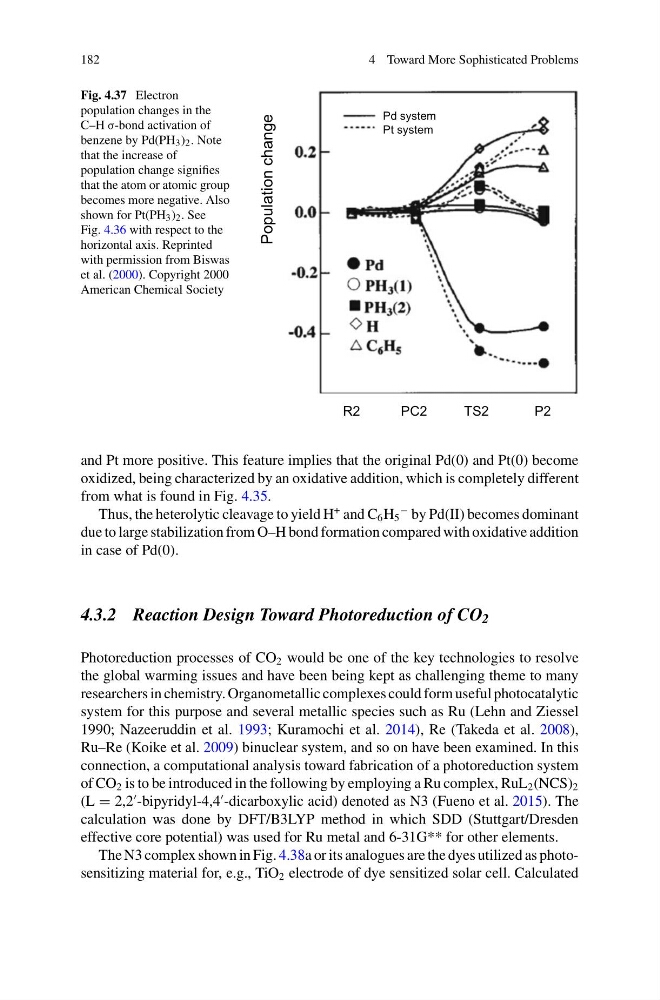
Fig. 4.37 Electron
population changes in the
C–H σ-bond activation of
benzene by Pd(PH 3 ) 2 . Note
that the increase of
population change signifies
that the atom or atomic group
becomes more negative. Also
shown for Pt(PH 3 ) 2 . See
Fig. 4.36 with respect to the
horizontal axis. Reprinted
with permission from Biswas
et al. (2000). Copyright 2000
American Chemical Society
Population change
R2
PC2
TS2
P2
Pd system
Pt system
and Pt more positive. This feature implies that the original Pd(0) and Pt(0) become
oxidized, being characterized by an oxidative addition, which is completely different
from what is found in Fig. 4.35.
Thus, the heterolytic cleavage to yield H
+ and C 6 H 5
− by Pd(II) becomes dominant
due to large stabilization from O–H bond formation compared with oxidative addition
in case of Pd(0).
4.3.2 Reaction Design Toward Photoreduction of CO 2
Photoreduction processes of CO 2 would be one of the key technologies to resolve
the global warming issues and have been being kept as challenging theme to many
researchers in chemistry. Organometallic complexes could form useful photocatalytic
system for this purpose and several metallic species such as Ru (Lehn and Ziessel
1990; Nazeeruddin et al. 1993; Kuramochi et al. 2014), Re (Takeda et al. 2008),
Ru–Re (Koike et al. 2009) binuclear system, and so on have been examined. In this
connection, a computational analysis toward fabrication of a photoreduction system
of CO 2 is to be introduced in the following by employing a Ru complex, RuL 2 (NCS) 2
(L = 2,2
-bipyridyl-4,4
-dicarboxylic acid) denoted as N3 (Fueno et al. 2015). The
calculation was done by DFT/B3LYP method in which SDD (Stuttgart/Dresden
effective core potential) was used for Ru metal and 6-31G** for other elements.
The N3 complex shown in Fig. 4.38a or its analogues are the dyes utilized as photosensitizing material for, e.g., TiO 2 electrode of dye sensitized solar cell. Calculated
4 Toward More Sophisticated Problems
Fig. 4.37 Electron
population changes in the
C–H σ-bond activation of
benzene by Pd(PH 3 ) 2 . Note
that the increase of
population change signifies
that the atom or atomic group
becomes more negative. Also
shown for Pt(PH 3 ) 2 . See
Fig. 4.36 with respect to the
horizontal axis. Reprinted
with permission from Biswas
et al. (2000). Copyright 2000
American Chemical Society
Population change
R2
PC2
TS2
P2
Pd system
Pt system
and Pt more positive. This feature implies that the original Pd(0) and Pt(0) become
oxidized, being characterized by an oxidative addition, which is completely different
from what is found in Fig. 4.35.
Thus, the heterolytic cleavage to yield H
+ and C 6 H 5
− by Pd(II) becomes dominant
due to large stabilization from O–H bond formation compared with oxidative addition
in case of Pd(0).
4.3.2 Reaction Design Toward Photoreduction of CO 2
Photoreduction processes of CO 2 would be one of the key technologies to resolve
the global warming issues and have been being kept as challenging theme to many
researchers in chemistry. Organometallic complexes could form useful photocatalytic
system for this purpose and several metallic species such as Ru (Lehn and Ziessel
1990; Nazeeruddin et al. 1993; Kuramochi et al. 2014), Re (Takeda et al. 2008),
Ru–Re (Koike et al. 2009) binuclear system, and so on have been examined. In this
connection, a computational analysis toward fabrication of a photoreduction system
of CO 2 is to be introduced in the following by employing a Ru complex, RuL 2 (NCS) 2
(L = 2,2
-bipyridyl-4,4
-dicarboxylic acid) denoted as N3 (Fueno et al. 2015). The
calculation was done by DFT/B3LYP method in which SDD (Stuttgart/Dresden
effective core potential) was used for Ru metal and 6-31G** for other elements.
The N3 complex shown in Fig. 4.38a or its analogues are the dyes utilized as photosensitizing material for, e.g., TiO 2 electrode of dye sensitized solar cell. Calculated