

4.3 Catalytic Chemistry
179
in (i) the metal oxidation state increases by 2, and that in (ii) the metal oxidation
state does not change.
In the following are to be mentioned theoretical analyses with respect to catalytic
behavior of organometallic complexes (Biswas et al. 2000; Sakaki et al. 2010). All the
molecular geometries including the transition states were obtained by the calculation
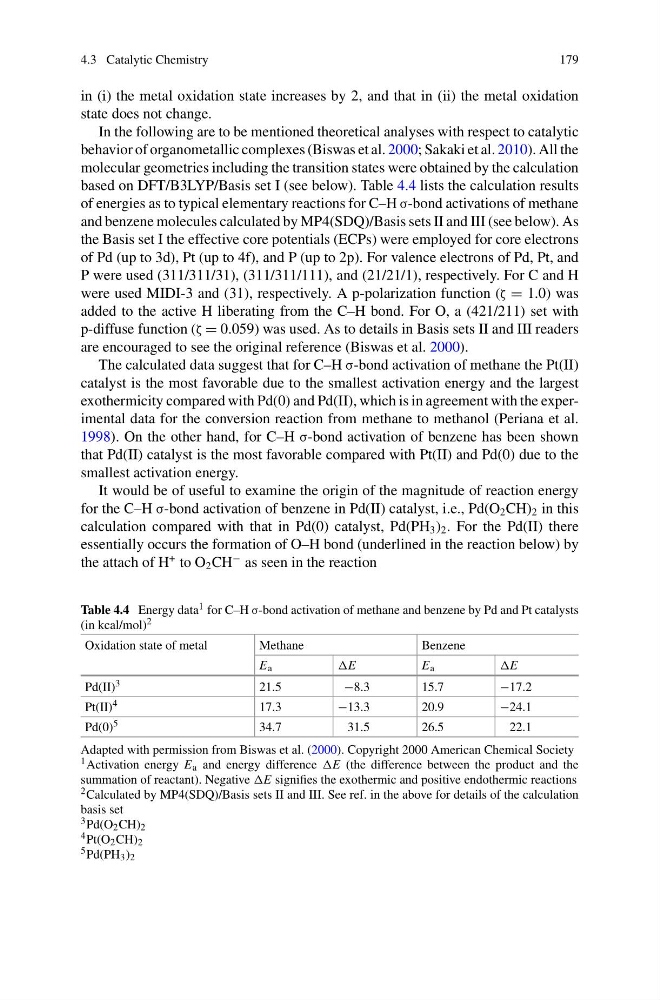
based on DFT/B3LYP/Basis set I (see below). Table 4.4 lists the calculation results
of energies as to typical elementary reactions for C–H σ-bond activations of methane
and benzene molecules calculated by MP4(SDQ)/Basis sets II and III (see below). As
the Basis set I the effective core potentials (ECPs) were employed for core electrons
of Pd (up to 3d), Pt (up to 4f), and P (up to 2p). For valence electrons of Pd, Pt, and
P were used (311/311/31), (311/311/111), and (21/21/1), respectively. For C and H
were used MIDI-3 and (31), respectively. A p-polarization function (ζ = 1.0) was
added to the active H liberating from the C–H bond. For O, a (421/211) set with
p-diffuse function (ζ = 0.059) was used. As to details in Basis sets II and III readers
are encouraged to see the original reference (Biswas et al. 2000).
The calculated data suggest that for C–H σ-bond activation of methane the Pt(II)
catalyst is the most favorable due to the smallest activation energy and the largest
exothermicity compared with Pd(0) and Pd(II), which is in agreement with the experimental data for the conversion reaction from methane to methanol (Periana et al.
1998). On the other hand, for C–H σ-bond activation of benzene has been shown
that Pd(II) catalyst is the most favorable compared with Pt(II) and Pd(0) due to the
smallest activation energy.
It would be of useful to examine the origin of the magnitude of reaction energy
for the C–H σ-bond activation of benzene in Pd(II) catalyst, i.e., Pd(O 2 CH) 2 in this
calculation compared with that in Pd(0) catalyst, Pd(PH 3 ) 2 . For the Pd(II) there
essentially occurs the formation of O–H bond (underlined in the reaction below) by
the attach of H
+ to O 2 CH
− as seen in the reaction
Table 4.4 Energy data 1 for C–H σ-bond activation of methane and benzene by Pd and Pt catalysts
(in kcal/mol) 2
Oxidation state of metal
Methane
Benzene
E a
E
E a
E
Pd(II) 3
21.5
−8.3
15.7
−17.2
Pt(II) 4
17.3
−13.3
20.9
−24.1
Pd(0) 5
34.7
31.5
26.5
22.1
Adapted with permission from Biswas et al. (2000). Copyright 2000 American Chemical Society
1 Activation energy E a and energy difference E (the difference between the product and the
summation of reactant). Negative E signifies the exothermic and positive endothermic reactions
2 Calculated by MP4(SDQ)/Basis sets II and III. See ref. in the above for details of the calculation
basis set
3 Pd(O 2 CH) 2
4 Pt(O 2 CH) 2
5 Pd(PH 3 ) 2
179
in (i) the metal oxidation state increases by 2, and that in (ii) the metal oxidation
state does not change.
In the following are to be mentioned theoretical analyses with respect to catalytic
behavior of organometallic complexes (Biswas et al. 2000; Sakaki et al. 2010). All the
molecular geometries including the transition states were obtained by the calculation
based on DFT/B3LYP/Basis set I (see below). Table 4.4 lists the calculation results
of energies as to typical elementary reactions for C–H σ-bond activations of methane
and benzene molecules calculated by MP4(SDQ)/Basis sets II and III (see below). As
the Basis set I the effective core potentials (ECPs) were employed for core electrons
of Pd (up to 3d), Pt (up to 4f), and P (up to 2p). For valence electrons of Pd, Pt, and
P were used (311/311/31), (311/311/111), and (21/21/1), respectively. For C and H
were used MIDI-3 and (31), respectively. A p-polarization function (ζ = 1.0) was
added to the active H liberating from the C–H bond. For O, a (421/211) set with
p-diffuse function (ζ = 0.059) was used. As to details in Basis sets II and III readers
are encouraged to see the original reference (Biswas et al. 2000).
The calculated data suggest that for C–H σ-bond activation of methane the Pt(II)
catalyst is the most favorable due to the smallest activation energy and the largest
exothermicity compared with Pd(0) and Pd(II), which is in agreement with the experimental data for the conversion reaction from methane to methanol (Periana et al.
1998). On the other hand, for C–H σ-bond activation of benzene has been shown
that Pd(II) catalyst is the most favorable compared with Pt(II) and Pd(0) due to the
smallest activation energy.
It would be of useful to examine the origin of the magnitude of reaction energy
for the C–H σ-bond activation of benzene in Pd(II) catalyst, i.e., Pd(O 2 CH) 2 in this
calculation compared with that in Pd(0) catalyst, Pd(PH 3 ) 2 . For the Pd(II) there
essentially occurs the formation of O–H bond (underlined in the reaction below) by
the attach of H
+ to O 2 CH
− as seen in the reaction
Table 4.4 Energy data 1 for C–H σ-bond activation of methane and benzene by Pd and Pt catalysts
(in kcal/mol) 2
Oxidation state of metal
Methane
Benzene
E a
E
E a
E
Pd(II) 3
21.5
−8.3
15.7
−17.2
Pt(II) 4
17.3
−13.3
20.9
−24.1
Pd(0) 5
34.7
31.5
26.5
22.1
Adapted with permission from Biswas et al. (2000). Copyright 2000 American Chemical Society
1 Activation energy E a and energy difference E (the difference between the product and the
summation of reactant). Negative E signifies the exothermic and positive endothermic reactions
2 Calculated by MP4(SDQ)/Basis sets II and III. See ref. in the above for details of the calculation
basis set
3 Pd(O 2 CH) 2
4 Pt(O 2 CH) 2
5 Pd(PH 3 ) 2