

178
4 Toward More Sophisticated Problems
R1 and R2 signifying, e.g., hydrogen atom, alkyl, vinyl, phenyl, or aryl group and
X and Y anionic species. When R1 = R2 and X = Y, it is particularly called homocoupling reaction. A typical example of Eq. (4.3) is Suzuki-Miyaura cross-coupling
reaction (Miyaura et al. 1979) expressed as
R1-Br + R2-B(OH) 2
Pd(PPh 3 ) 4
→
Base
R1-R2
(4.4)
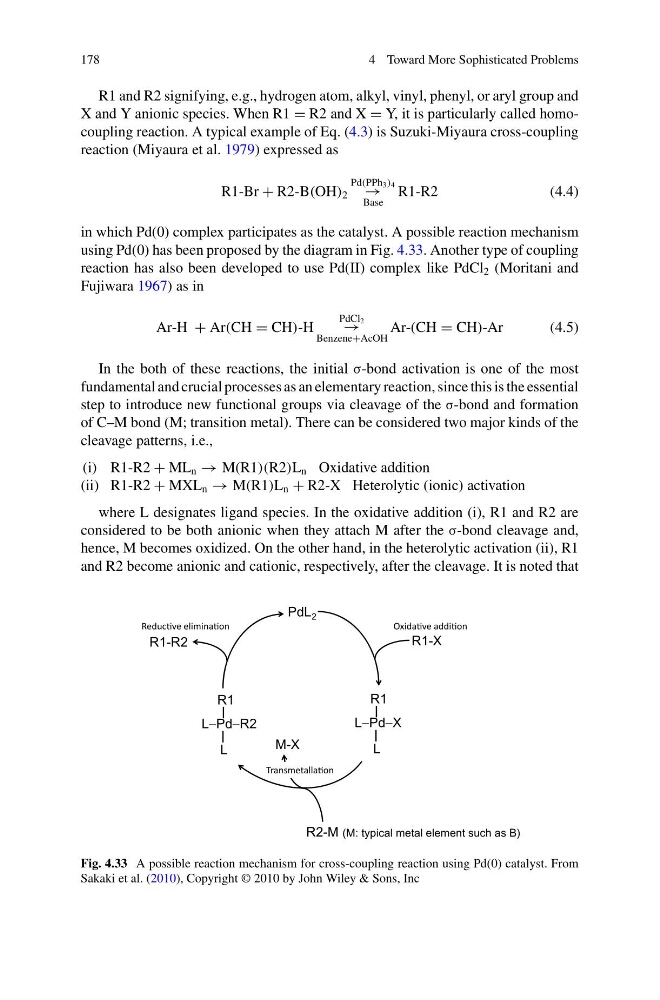
in which Pd(0) complex participates as the catalyst. A possible reaction mechanism
using Pd(0) has been proposed by the diagram in Fig. 4.33. Another type of coupling
reaction has also been developed to use Pd(II) complex like PdCl 2 (Moritani and
Fujiwara 1967) as in
Ar-H + Ar(CH = CH)-H
PdCl 2
→
Benzene+AcOH
Ar-(CH = CH)-Ar
(4.5)
In the both of these reactions, the initial σ-bond activation is one of the most
fundamental and crucial processes as an elementary reaction, since this is the essential
step to introduce new functional groups via cleavage of the σ-bond and formation
of C–M bond (M; transition metal). There can be considered two major kinds of the
cleavage patterns, i.e.,
(i) R1-R2 + ML n → M(R1)(R2)L n Oxidative addition
(ii) R1-R2 + MXL n → M(R1)L n + R2-X Heterolytic (ionic) activation
where L designates ligand species. In the oxidative addition (i), R1 and R2 are
considered to be both anionic when they attach M after the σ-bond cleavage and,
hence, M becomes oxidized. On the other hand, in the heterolytic activation (ii), R1
and R2 become anionic and cationic, respectively, after the cleavage. It is noted that
PdL 2
L−Pd−X
L
R1
L−Pd−R2
L
R1
R1-X
R1-R2
R2-M (M: typical metal element such as B)
M-X
TransmetallaƟon
OxidaƟve addiƟon
ReducƟve eliminaƟon
Fig. 4.33 A possible reaction mechanism for cross-coupling reaction using Pd(0) catalyst. From
Sakaki et al. (2010), Copyright © 2010 by John Wiley & Sons, Inc
4 Toward More Sophisticated Problems
R1 and R2 signifying, e.g., hydrogen atom, alkyl, vinyl, phenyl, or aryl group and
X and Y anionic species. When R1 = R2 and X = Y, it is particularly called homocoupling reaction. A typical example of Eq. (4.3) is Suzuki-Miyaura cross-coupling
reaction (Miyaura et al. 1979) expressed as
R1-Br + R2-B(OH) 2
Pd(PPh 3 ) 4
→
Base
R1-R2
(4.4)
in which Pd(0) complex participates as the catalyst. A possible reaction mechanism
using Pd(0) has been proposed by the diagram in Fig. 4.33. Another type of coupling
reaction has also been developed to use Pd(II) complex like PdCl 2 (Moritani and
Fujiwara 1967) as in
Ar-H + Ar(CH = CH)-H
PdCl 2
→
Benzene+AcOH
Ar-(CH = CH)-Ar
(4.5)
In the both of these reactions, the initial σ-bond activation is one of the most
fundamental and crucial processes as an elementary reaction, since this is the essential
step to introduce new functional groups via cleavage of the σ-bond and formation
of C–M bond (M; transition metal). There can be considered two major kinds of the
cleavage patterns, i.e.,
(i) R1-R2 + ML n → M(R1)(R2)L n Oxidative addition
(ii) R1-R2 + MXL n → M(R1)L n + R2-X Heterolytic (ionic) activation
where L designates ligand species. In the oxidative addition (i), R1 and R2 are
considered to be both anionic when they attach M after the σ-bond cleavage and,
hence, M becomes oxidized. On the other hand, in the heterolytic activation (ii), R1
and R2 become anionic and cationic, respectively, after the cleavage. It is noted that
PdL 2
L−Pd−X
L
R1
L−Pd−R2
L
R1
R1-X
R1-R2
R2-M (M: typical metal element such as B)
M-X
TransmetallaƟon
OxidaƟve addiƟon
ReducƟve eliminaƟon
Fig. 4.33 A possible reaction mechanism for cross-coupling reaction using Pd(0) catalyst. From
Sakaki et al. (2010), Copyright © 2010 by John Wiley & Sons, Inc