

4.3 Catalytic Chemistry
177
(a)
(b)
(c)
Potential (V) vs Fc/Fc +
Potential (V) vs Fc/Fc +
Potential (V) vs Fc/Fc +
I (μA s -1/2
)
I (μA s -1/2
)
I (μA s -1/2
)
2 2
2
2
2
2 2 2
1 1
1 1
1 1
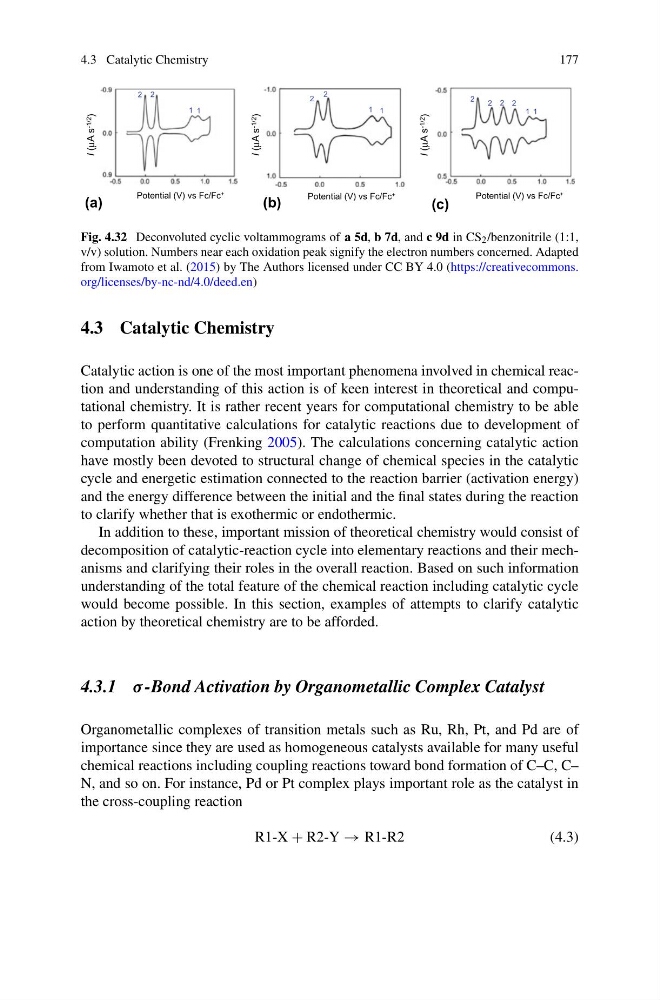
Fig. 4.32 Deconvoluted cyclic voltammograms of a 5d, b 7d, and c 9d in CS 2 /benzonitrile (1:1,
v/v) solution. Numbers near each oxidation peak signify the electron numbers concerned. Adapted
from Iwamoto et al. (2015) by The Authors licensed under CC BY 4.0 (https://creativecommons.
org/licenses/by-nc-nd/4.0/deed.en)
4.3 Catalytic Chemistry
Catalytic action is one of the most important phenomena involved in chemical reaction and understanding of this action is of keen interest in theoretical and computational chemistry. It is rather recent years for computational chemistry to be able
to perform quantitative calculations for catalytic reactions due to development of
computation ability (Frenking 2005). The calculations concerning catalytic action
have mostly been devoted to structural change of chemical species in the catalytic
cycle and energetic estimation connected to the reaction barrier (activation energy)
and the energy difference between the initial and the final states during the reaction
to clarify whether that is exothermic or endothermic.
In addition to these, important mission of theoretical chemistry would consist of
decomposition of catalytic-reaction cycle into elementary reactions and their mechanisms and clarifying their roles in the overall reaction. Based on such information
understanding of the total feature of the chemical reaction including catalytic cycle
would become possible. In this section, examples of attempts to clarify catalytic
action by theoretical chemistry are to be afforded.
4.3.1 σ -Bond Activation by Organometallic Complex Catalyst
Organometallic complexes of transition metals such as Ru, Rh, Pt, and Pd are of
importance since they are used as homogeneous catalysts available for many useful
chemical reactions including coupling reactions toward bond formation of C–C, C–
N, and so on. For instance, Pd or Pt complex plays important role as the catalyst in
the cross-coupling reaction
R1-X + R2-Y → R1-R2
(4.3)
177
(a)
(b)
(c)
Potential (V) vs Fc/Fc +
Potential (V) vs Fc/Fc +
Potential (V) vs Fc/Fc +
I (μA s -1/2
)
I (μA s -1/2
)
I (μA s -1/2
)
2 2
2
2
2
2 2 2
1 1
1 1
1 1
Fig. 4.32 Deconvoluted cyclic voltammograms of a 5d, b 7d, and c 9d in CS 2 /benzonitrile (1:1,
v/v) solution. Numbers near each oxidation peak signify the electron numbers concerned. Adapted
from Iwamoto et al. (2015) by The Authors licensed under CC BY 4.0 (https://creativecommons.
org/licenses/by-nc-nd/4.0/deed.en)
4.3 Catalytic Chemistry
Catalytic action is one of the most important phenomena involved in chemical reaction and understanding of this action is of keen interest in theoretical and computational chemistry. It is rather recent years for computational chemistry to be able
to perform quantitative calculations for catalytic reactions due to development of
computation ability (Frenking 2005). The calculations concerning catalytic action
have mostly been devoted to structural change of chemical species in the catalytic
cycle and energetic estimation connected to the reaction barrier (activation energy)
and the energy difference between the initial and the final states during the reaction
to clarify whether that is exothermic or endothermic.
In addition to these, important mission of theoretical chemistry would consist of
decomposition of catalytic-reaction cycle into elementary reactions and their mechanisms and clarifying their roles in the overall reaction. Based on such information
understanding of the total feature of the chemical reaction including catalytic cycle
would become possible. In this section, examples of attempts to clarify catalytic
action by theoretical chemistry are to be afforded.
4.3.1 σ -Bond Activation by Organometallic Complex Catalyst
Organometallic complexes of transition metals such as Ru, Rh, Pt, and Pd are of
importance since they are used as homogeneous catalysts available for many useful
chemical reactions including coupling reactions toward bond formation of C–C, C–
N, and so on. For instance, Pd or Pt complex plays important role as the catalyst in
the cross-coupling reaction
R1-X + R2-Y → R1-R2
(4.3)