

176
4 Toward More Sophisticated Problems
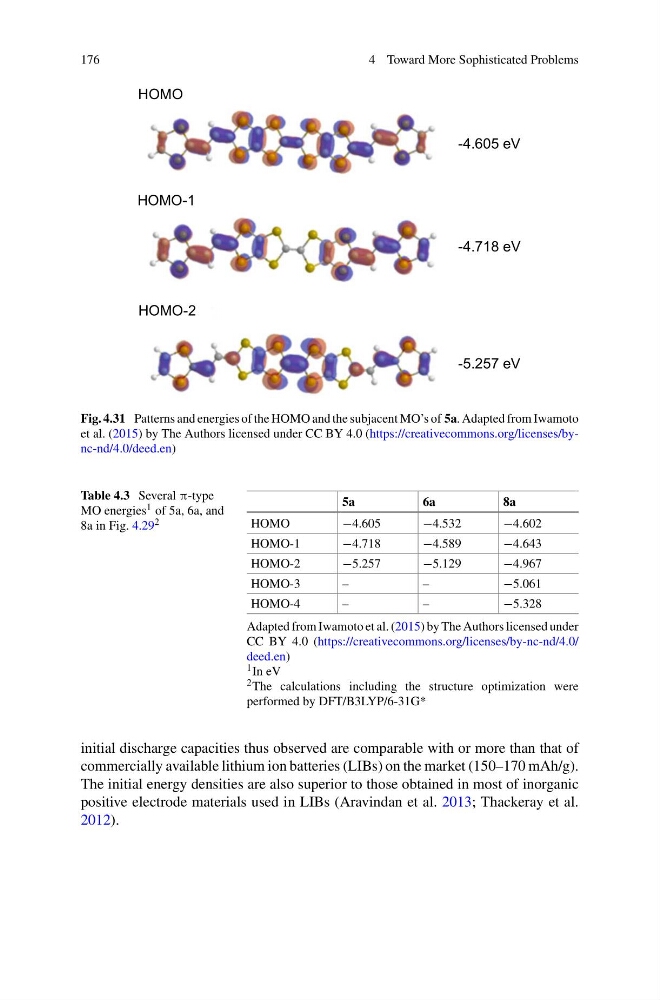
HOMO
HOMO-1
HOMO-2
-4.605 eV
-4.718 eV
-5.257 eV
Fig. 4.31 Patterns and energies of the HOMO and the subjacent MO’s of 5a. Adapted from Iwamoto
et al. (2015) by The Authors licensed under CC BY 4.0 (https://creativecommons.org/licenses/bync-nd/4.0/deed.en)
Table 4.3 Several π-type
MO energies 1 of 5a, 6a, and
8a in Fig. 4.29 2
5a
6a
8a
HOMO
−4.605
−4.532
−4.602
HOMO-1
−4.718
−4.589
−4.643
HOMO-2
−5.257
−5.129
−4.967
HOMO-3
–
–
−5.061
HOMO-4
–
–
−5.328
Adapted from Iwamoto et al. (2015) by The Authors licensed under
CC BY 4.0 (https://creativecommons.org/licenses/by-nc-nd/4.0/
deed.en)
1 In eV
2 The calculations including the structure optimization were
performed by DFT/B3LYP/6-31G*
initial discharge capacities thus observed are comparable with or more than that of
commercially available lithium ion batteries (LIBs) on the market (150–170 mAh/g).
The initial energy densities are also superior to those obtained in most of inorganic
positive electrode materials used in LIBs (Aravindan et al. 2013; Thackeray et al.
2012).
4 Toward More Sophisticated Problems
HOMO
HOMO-1
HOMO-2
-4.605 eV
-4.718 eV
-5.257 eV
Fig. 4.31 Patterns and energies of the HOMO and the subjacent MO’s of 5a. Adapted from Iwamoto
et al. (2015) by The Authors licensed under CC BY 4.0 (https://creativecommons.org/licenses/bync-nd/4.0/deed.en)
Table 4.3 Several π-type
MO energies 1 of 5a, 6a, and
8a in Fig. 4.29 2
5a
6a
8a
HOMO
−4.605
−4.532
−4.602
HOMO-1
−4.718
−4.589
−4.643
HOMO-2
−5.257
−5.129
−4.967
HOMO-3
–
–
−5.061
HOMO-4
–
–
−5.328
Adapted from Iwamoto et al. (2015) by The Authors licensed under
CC BY 4.0 (https://creativecommons.org/licenses/by-nc-nd/4.0/
deed.en)
1 In eV
2 The calculations including the structure optimization were
performed by DFT/B3LYP/6-31G*
initial discharge capacities thus observed are comparable with or more than that of
commercially available lithium ion batteries (LIBs) on the market (150–170 mAh/g).
The initial energy densities are also superior to those obtained in most of inorganic
positive electrode materials used in LIBs (Aravindan et al. 2013; Thackeray et al.
2012).