

174
4 Toward More Sophisticated Problems
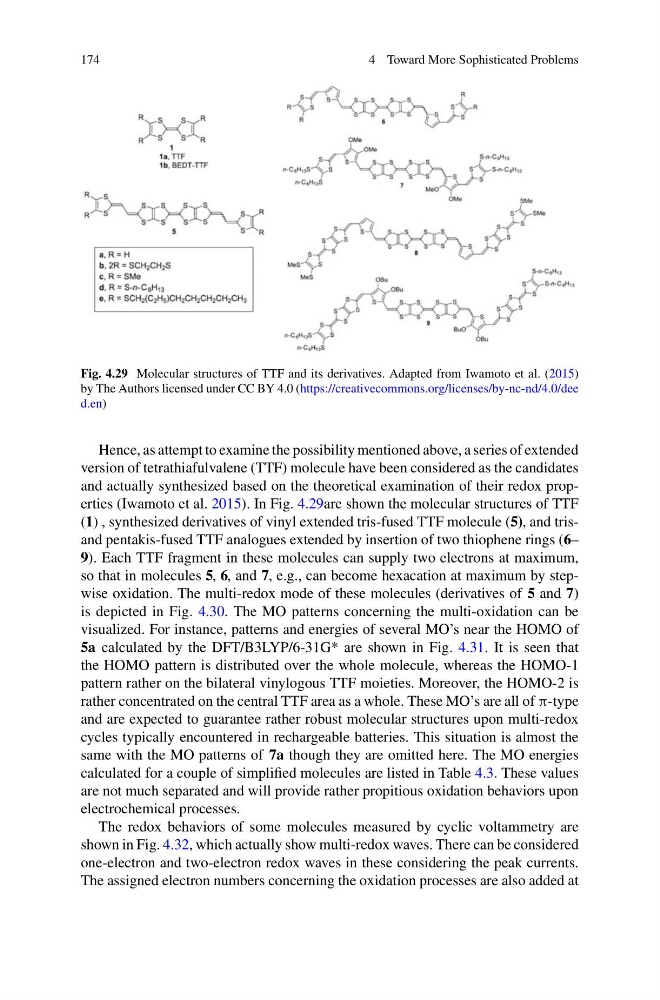
Fig. 4.29 Molecular structures of TTF and its derivatives. Adapted from Iwamoto et al. (2015)
by The Authors licensed under CC BY 4.0 (https://creativecommons.org/licenses/by-nc-nd/4.0/dee
d.en)
Hence, as attempt to examine the possibility mentioned above, a series of extended
version of tetrathiafulvalene (TTF) molecule have been considered as the candidates
and actually synthesized based on the theoretical examination of their redox properties (Iwamoto et al. 2015). In Fig. 4.29are shown the molecular structures of TTF
(1) , synthesized derivatives of vinyl extended tris-fused TTF molecule (5), and trisand pentakis-fused TTF analogues extended by insertion of two thiophene rings (6–
9). Each TTF fragment in these molecules can supply two electrons at maximum,
so that in molecules 5, 6, and 7, e.g., can become hexacation at maximum by stepwise oxidation. The multi-redox mode of these molecules (derivatives of 5 and 7)
is depicted in Fig. 4.30. The MO patterns concerning the multi-oxidation can be
visualized. For instance, patterns and energies of several MO’s near the HOMO of
5a calculated by the DFT/B3LYP/6-31G* are shown in Fig. 4.31. It is seen that
the HOMO pattern is distributed over the whole molecule, whereas the HOMO-1
pattern rather on the bilateral vinylogous TTF moieties. Moreover, the HOMO-2 is
rather concentrated on the central TTF area as a whole. These MO’s are all of π-type
and are expected to guarantee rather robust molecular structures upon multi-redox
cycles typically encountered in rechargeable batteries. This situation is almost the
same with the MO patterns of 7a though they are omitted here. The MO energies
calculated for a couple of simplified molecules are listed in Table 4.3. These values
are not much separated and will provide rather propitious oxidation behaviors upon
electrochemical processes.
The redox behaviors of some molecules measured by cyclic voltammetry are
shown in Fig. 4.32, which actually show multi-redox waves. There can be considered
one-electron and two-electron redox waves in these considering the peak currents.
The assigned electron numbers concerning the oxidation processes are also added at
4 Toward More Sophisticated Problems
Fig. 4.29 Molecular structures of TTF and its derivatives. Adapted from Iwamoto et al. (2015)
by The Authors licensed under CC BY 4.0 (https://creativecommons.org/licenses/by-nc-nd/4.0/dee
d.en)
Hence, as attempt to examine the possibility mentioned above, a series of extended
version of tetrathiafulvalene (TTF) molecule have been considered as the candidates
and actually synthesized based on the theoretical examination of their redox properties (Iwamoto et al. 2015). In Fig. 4.29are shown the molecular structures of TTF
(1) , synthesized derivatives of vinyl extended tris-fused TTF molecule (5), and trisand pentakis-fused TTF analogues extended by insertion of two thiophene rings (6–
9). Each TTF fragment in these molecules can supply two electrons at maximum,
so that in molecules 5, 6, and 7, e.g., can become hexacation at maximum by stepwise oxidation. The multi-redox mode of these molecules (derivatives of 5 and 7)
is depicted in Fig. 4.30. The MO patterns concerning the multi-oxidation can be
visualized. For instance, patterns and energies of several MO’s near the HOMO of
5a calculated by the DFT/B3LYP/6-31G* are shown in Fig. 4.31. It is seen that
the HOMO pattern is distributed over the whole molecule, whereas the HOMO-1
pattern rather on the bilateral vinylogous TTF moieties. Moreover, the HOMO-2 is
rather concentrated on the central TTF area as a whole. These MO’s are all of π-type
and are expected to guarantee rather robust molecular structures upon multi-redox
cycles typically encountered in rechargeable batteries. This situation is almost the
same with the MO patterns of 7a though they are omitted here. The MO energies
calculated for a couple of simplified molecules are listed in Table 4.3. These values
are not much separated and will provide rather propitious oxidation behaviors upon
electrochemical processes.
The redox behaviors of some molecules measured by cyclic voltammetry are
shown in Fig. 4.32, which actually show multi-redox waves. There can be considered
one-electron and two-electron redox waves in these considering the peak currents.
The assigned electron numbers concerning the oxidation processes are also added at