

4.2 Electrochemistry
173
Frontier MO energy (eV)
Li 2 CO 3
LEDC
LPDC
LPDC-L
LiF
Top view
Side view
HOMO
HOMO
HOMO
HOMO
HOMO
LUMO
LUMO
LUMO
LUMO
LUMO
ΔE=5.938
ΔE=6.569
ΔE=6.562
ΔE=6.581
ΔE=7.771
4
2
0
−2
−4
−6
−8
−10
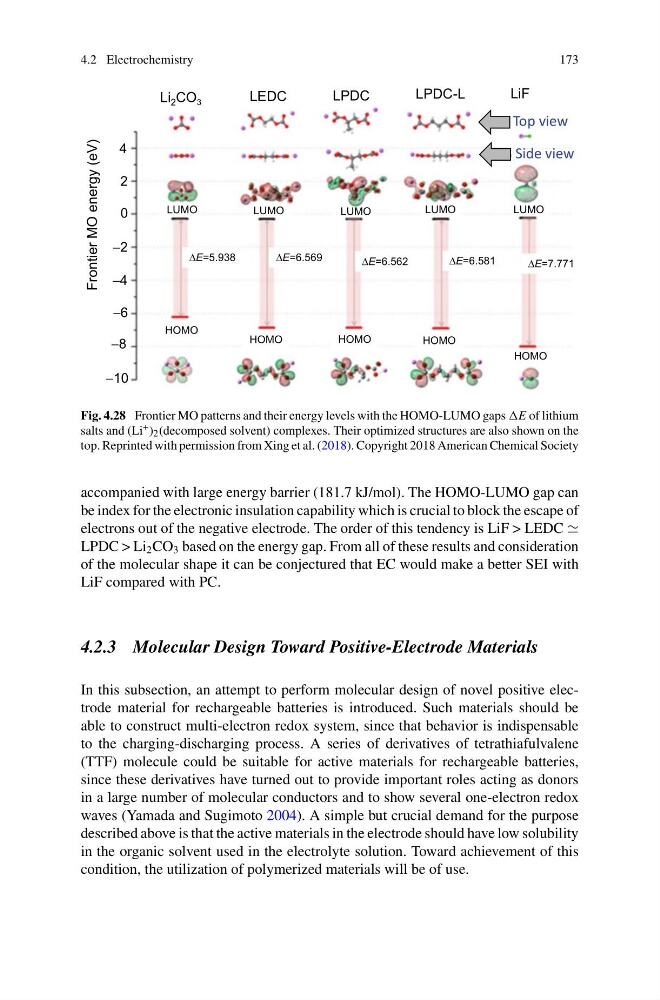
Fig. 4.28 Frontier MO patterns and their energy levels with the HOMO-LUMO gaps of lithium
salts and (Li + ) 2 (decomposed solvent) complexes. Their optimized structures are also shown on the
top. Reprinted with permission from Xing et al. (2018). Copyright 2018 American Chemical Society
accompanied with large energy barrier (181.7 kJ/mol). The HOMO-LUMO gap can
be index for the electronic insulation capability which is crucial to block the escape of
electrons out of the negative electrode. The order of this tendency is LiF > LEDC
LPDC > Li 2 CO 3 based on the energy gap. From all of these results and consideration
of the molecular shape it can be conjectured that EC would make a better SEI with
LiF compared with PC.
4.2.3 Molecular Design Toward Positive-Electrode Materials
In this subsection, an attempt to perform molecular design of novel positive electrode material for rechargeable batteries is introduced. Such materials should be
able to construct multi-electron redox system, since that behavior is indispensable
to the charging-discharging process. A series of derivatives of tetrathiafulvalene
(TTF) molecule could be suitable for active materials for rechargeable batteries,
since these derivatives have turned out to provide important roles acting as donors
in a large number of molecular conductors and to show several one-electron redox
waves (Yamada and Sugimoto 2004). A simple but crucial demand for the purpose
described above is that the active materials in the electrode should have low solubility
in the organic solvent used in the electrolyte solution. Toward achievement of this
condition, the utilization of polymerized materials will be of use.
173
Frontier MO energy (eV)
Li 2 CO 3
LEDC
LPDC
LPDC-L
LiF
Top view
Side view
HOMO
HOMO
HOMO
HOMO
HOMO
LUMO
LUMO
LUMO
LUMO
LUMO
ΔE=5.938
ΔE=6.569
ΔE=6.562
ΔE=6.581
ΔE=7.771
4
2
0
−2
−4
−6
−8
−10
Fig. 4.28 Frontier MO patterns and their energy levels with the HOMO-LUMO gaps of lithium
salts and (Li + ) 2 (decomposed solvent) complexes. Their optimized structures are also shown on the
top. Reprinted with permission from Xing et al. (2018). Copyright 2018 American Chemical Society
accompanied with large energy barrier (181.7 kJ/mol). The HOMO-LUMO gap can
be index for the electronic insulation capability which is crucial to block the escape of
electrons out of the negative electrode. The order of this tendency is LiF > LEDC
LPDC > Li 2 CO 3 based on the energy gap. From all of these results and consideration
of the molecular shape it can be conjectured that EC would make a better SEI with
LiF compared with PC.
4.2.3 Molecular Design Toward Positive-Electrode Materials
In this subsection, an attempt to perform molecular design of novel positive electrode material for rechargeable batteries is introduced. Such materials should be
able to construct multi-electron redox system, since that behavior is indispensable
to the charging-discharging process. A series of derivatives of tetrathiafulvalene
(TTF) molecule could be suitable for active materials for rechargeable batteries,
since these derivatives have turned out to provide important roles acting as donors
in a large number of molecular conductors and to show several one-electron redox
waves (Yamada and Sugimoto 2004). A simple but crucial demand for the purpose
described above is that the active materials in the electrode should have low solubility
in the organic solvent used in the electrolyte solution. Toward achievement of this
condition, the utilization of polymerized materials will be of use.