

170
4 Toward More Sophisticated Problems
(a)
(b)
(c)
3.35 Å
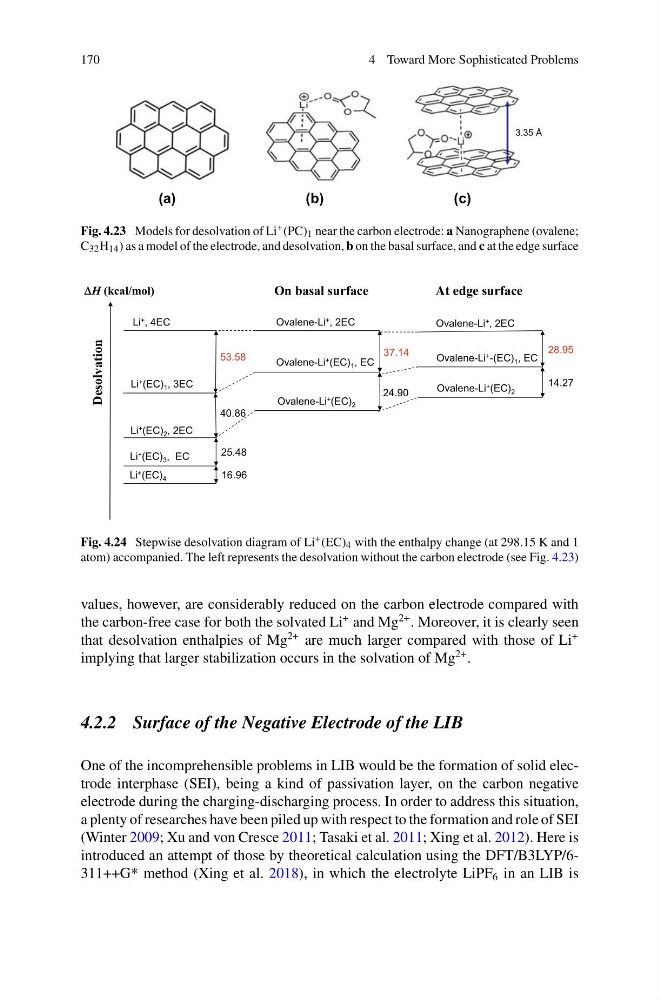
Fig. 4.23 Models for desolvation of Li + (PC) 1 near the carbon electrode: a Nanographene (ovalene;
C 32 H 14 ) as a model of the electrode, and desolvation, b on the basal surface, and c at the edge surface
25.48
40.86
Ovalene-Li + (EC) 1 , EC
Ovalene-Li + , 2EC
Ovalene-Li + (EC) 2
Li + , 4EC
Li + (EC) 1 , 3EC
53.58
16.96
Li + (EC) 2 , 2EC
Li + (EC) 3 , EC
Li + (EC) 4
24.90
37.14
ΔH (kcal/mol)
Desolvation
Ovalene-Li + , 2EC
Ovalene-Li + -(EC) 1 , EC
Ovalene-Li + (EC) 2
On basal surface
At edge surface
28.95
14.27
Fig. 4.24 Stepwise desolvation diagram of Li + (EC) 4 with the enthalpy change (at 298.15 K and 1
atom) accompanied. The left represents the desolvation without the carbon electrode (see Fig. 4.23)
values, however, are considerably reduced on the carbon electrode compared with
the carbon-free case for both the solvated Li
+ and Mg
2+ . Moreover, it is clearly seen
that desolvation enthalpies of Mg
2+ are much larger compared with those of Li
+
implying that larger stabilization occurs in the solvation of Mg
2+ .
4.2.2 Surface of the Negative Electrode of the LIB
One of the incomprehensible problems in LIB would be the formation of solid electrode interphase (SEI), being a kind of passivation layer, on the carbon negative
electrode during the charging-discharging process. In order to address this situation,
a plenty of researches have been piled up with respect to the formation and role of SEI
(Winter 2009; Xu and von Cresce 2011; Tasaki et al. 2011; Xing et al. 2012). Here is
introduced an attempt of those by theoretical calculation using the DFT/B3LYP/6311++G* method (Xing et al. 2018), in which the electrolyte LiPF 6 in an LIB is
4 Toward More Sophisticated Problems
(a)
(b)
(c)
3.35 Å
Fig. 4.23 Models for desolvation of Li + (PC) 1 near the carbon electrode: a Nanographene (ovalene;
C 32 H 14 ) as a model of the electrode, and desolvation, b on the basal surface, and c at the edge surface
25.48
40.86
Ovalene-Li + (EC) 1 , EC
Ovalene-Li + , 2EC
Ovalene-Li + (EC) 2
Li + , 4EC
Li + (EC) 1 , 3EC
53.58
16.96
Li + (EC) 2 , 2EC
Li + (EC) 3 , EC
Li + (EC) 4
24.90
37.14
ΔH (kcal/mol)
Desolvation
Ovalene-Li + , 2EC
Ovalene-Li + -(EC) 1 , EC
Ovalene-Li + (EC) 2
On basal surface
At edge surface
28.95
14.27
Fig. 4.24 Stepwise desolvation diagram of Li + (EC) 4 with the enthalpy change (at 298.15 K and 1
atom) accompanied. The left represents the desolvation without the carbon electrode (see Fig. 4.23)
values, however, are considerably reduced on the carbon electrode compared with
the carbon-free case for both the solvated Li
+ and Mg
2+ . Moreover, it is clearly seen
that desolvation enthalpies of Mg
2+ are much larger compared with those of Li
+
implying that larger stabilization occurs in the solvation of Mg
2+ .
4.2.2 Surface of the Negative Electrode of the LIB
One of the incomprehensible problems in LIB would be the formation of solid electrode interphase (SEI), being a kind of passivation layer, on the carbon negative
electrode during the charging-discharging process. In order to address this situation,
a plenty of researches have been piled up with respect to the formation and role of SEI
(Winter 2009; Xu and von Cresce 2011; Tasaki et al. 2011; Xing et al. 2012). Here is
introduced an attempt of those by theoretical calculation using the DFT/B3LYP/6311++G* method (Xing et al. 2018), in which the electrolyte LiPF 6 in an LIB is