

4.2 Electrochemistry
169
ca 6.0 Å
ca. 5.9 Å
ca. 6.7 Å
ca. 7.0 Å
(a)
(b)
(c)
(d)
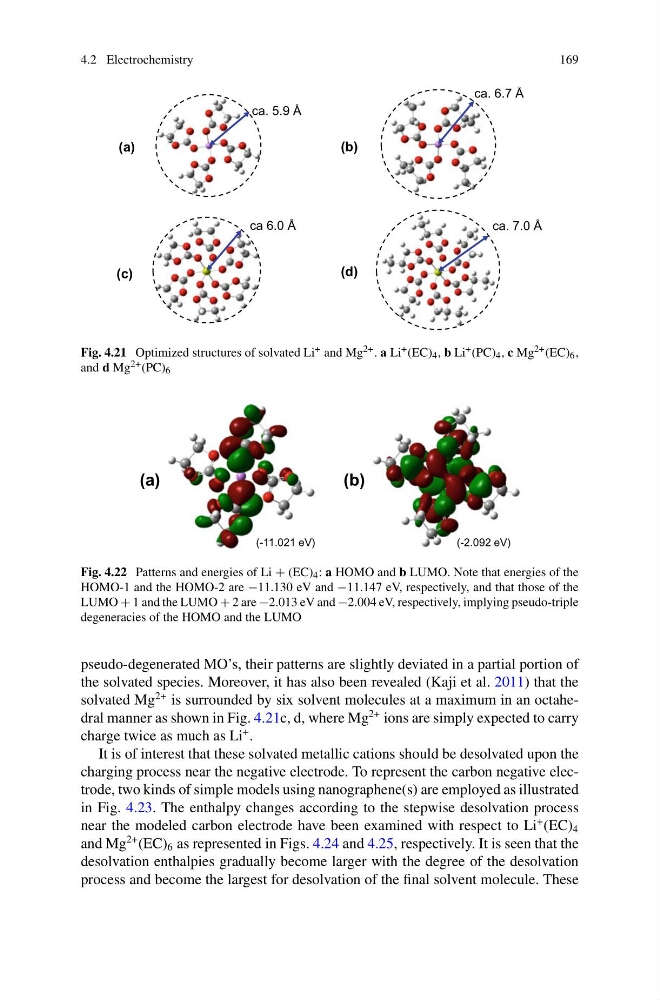
Fig. 4.21 Optimized structures of solvated Li + and Mg 2+ . a Li + (EC) 4 , b Li + (PC) 4 , c Mg 2+ (EC) 6 ,
and d Mg 2+ (PC) 6
(-11.021 eV)
(-2.092 eV)
(a)
(b)
Fig. 4.22 Patterns and energies of Li + (EC) 4 : a HOMO and b LUMO. Note that energies of the
HOMO-1 and the HOMO-2 are −11.130 eV and −11.147 eV, respectively, and that those of the
LUMO + 1 and the LUMO + 2 are −2.013 eV and −2.004 eV, respectively, implying pseudo-triple
degeneracies of the HOMO and the LUMO
pseudo-degenerated MO’s, their patterns are slightly deviated in a partial portion of
the solvated species. Moreover, it has also been revealed (Kaji et al. 2011) that the
solvated Mg
2+ is surrounded by six solvent molecules at a maximum in an octahedral manner as shown in Fig. 4.21c, d, where Mg
2+ ions are simply expected to carry
charge twice as much as Li
+ .
It is of interest that these solvated metallic cations should be desolvated upon the
charging process near the negative electrode. To represent the carbon negative electrode, two kinds of simple models using nanographene(s) are employed as illustrated
in Fig. 4.23. The enthalpy changes according to the stepwise desolvation process
near the modeled carbon electrode have been examined with respect to Li
+ (EC) 4
and Mg
2+ (EC) 6 as represented in Figs. 4.24 and 4.25, respectively. It is seen that the
desolvation enthalpies gradually become larger with the degree of the desolvation
process and become the largest for desolvation of the final solvent molecule. These
169
ca 6.0 Å
ca. 5.9 Å
ca. 6.7 Å
ca. 7.0 Å
(a)
(b)
(c)
(d)
Fig. 4.21 Optimized structures of solvated Li + and Mg 2+ . a Li + (EC) 4 , b Li + (PC) 4 , c Mg 2+ (EC) 6 ,
and d Mg 2+ (PC) 6
(-11.021 eV)
(-2.092 eV)
(a)
(b)
Fig. 4.22 Patterns and energies of Li + (EC) 4 : a HOMO and b LUMO. Note that energies of the
HOMO-1 and the HOMO-2 are −11.130 eV and −11.147 eV, respectively, and that those of the
LUMO + 1 and the LUMO + 2 are −2.013 eV and −2.004 eV, respectively, implying pseudo-triple
degeneracies of the HOMO and the LUMO
pseudo-degenerated MO’s, their patterns are slightly deviated in a partial portion of
the solvated species. Moreover, it has also been revealed (Kaji et al. 2011) that the
solvated Mg
2+ is surrounded by six solvent molecules at a maximum in an octahedral manner as shown in Fig. 4.21c, d, where Mg
2+ ions are simply expected to carry
charge twice as much as Li
+ .
It is of interest that these solvated metallic cations should be desolvated upon the
charging process near the negative electrode. To represent the carbon negative electrode, two kinds of simple models using nanographene(s) are employed as illustrated
in Fig. 4.23. The enthalpy changes according to the stepwise desolvation process
near the modeled carbon electrode have been examined with respect to Li
+ (EC) 4
and Mg
2+ (EC) 6 as represented in Figs. 4.24 and 4.25, respectively. It is seen that the
desolvation enthalpies gradually become larger with the degree of the desolvation
process and become the largest for desolvation of the final solvent molecule. These