

168
4 Toward More Sophisticated Problems
Load
Li +
Li +
Li +
Li +
Li +
Li +
Li +
Separator
Negative electrode
Positive electrode
discharge
charge
Doped Li + ion
Solvated Li + ion
Electrolyte solution
(Organic solvent and
supporting electrolyte)
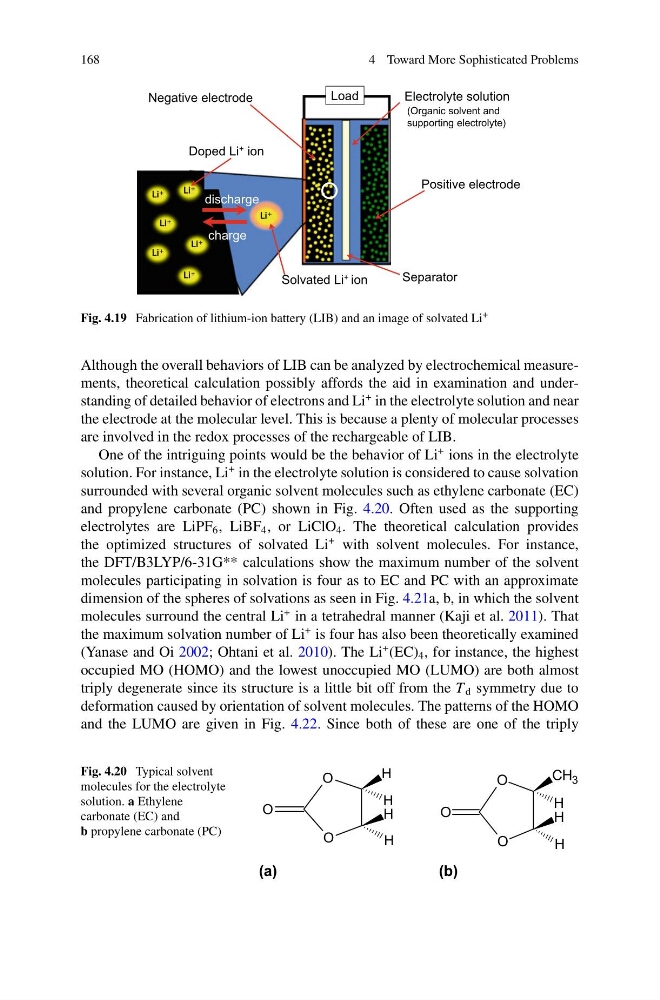
Fig. 4.19 Fabrication of lithium-ion battery (LIB) and an image of solvated Li +
Although the overall behaviors of LIB can be analyzed by electrochemical measurements, theoretical calculation possibly affords the aid in examination and understanding of detailed behavior of electrons and Li
+ in the electrolyte solution and near
the electrode at the molecular level. This is because a plenty of molecular processes
are involved in the redox processes of the rechargeable of LIB.
One of the intriguing points would be the behavior of Li
+ ions in the electrolyte
solution. For instance, Li
+ in the electrolyte solution is considered to cause solvation
surrounded with several organic solvent molecules such as ethylene carbonate (EC)
and propylene carbonate (PC) shown in Fig. 4.20. Often used as the supporting
electrolytes are LiPF 6 , LiBF 4 , or LiClO 4 . The theoretical calculation provides
the optimized structures of solvated Li
+ with solvent molecules. For instance,
the DFT/B3LYP/6-31G** calculations show the maximum number of the solvent
molecules participating in solvation is four as to EC and PC with an approximate
dimension of the spheres of solvations as seen in Fig. 4.21a, b, in which the solvent
molecules surround the central Li
+ in a tetrahedral manner (Kaji et al. 2011). That
the maximum solvation number of Li
+ is four has also been theoretically examined
(Yanase and Oi 2002; Ohtani et al. 2010). The Li
+ (EC) 4 , for instance, the highest
occupied MO (HOMO) and the lowest unoccupied MO (LUMO) are both almost
triply degenerate since its structure is a little bit off from the T d symmetry due to
deformation caused by orientation of solvent molecules. The patterns of the HOMO
and the LUMO are given in Fig. 4.22. Since both of these are one of the triply
Fig. 4.20 Typical solvent
molecules for the electrolyte
solution. a Ethylene
carbonate (EC) and
b propylene carbonate (PC)
H
H
H
O
O
O
CH 3
H
H
H
O
O
O
H
(a)
(b)
4 Toward More Sophisticated Problems
Load
Li +
Li +
Li +
Li +
Li +
Li +
Li +
Separator
Negative electrode
Positive electrode
discharge
charge
Doped Li + ion
Solvated Li + ion
Electrolyte solution
(Organic solvent and
supporting electrolyte)
Fig. 4.19 Fabrication of lithium-ion battery (LIB) and an image of solvated Li +
Although the overall behaviors of LIB can be analyzed by electrochemical measurements, theoretical calculation possibly affords the aid in examination and understanding of detailed behavior of electrons and Li
+ in the electrolyte solution and near
the electrode at the molecular level. This is because a plenty of molecular processes
are involved in the redox processes of the rechargeable of LIB.
One of the intriguing points would be the behavior of Li
+ ions in the electrolyte
solution. For instance, Li
+ in the electrolyte solution is considered to cause solvation
surrounded with several organic solvent molecules such as ethylene carbonate (EC)
and propylene carbonate (PC) shown in Fig. 4.20. Often used as the supporting
electrolytes are LiPF 6 , LiBF 4 , or LiClO 4 . The theoretical calculation provides
the optimized structures of solvated Li
+ with solvent molecules. For instance,
the DFT/B3LYP/6-31G** calculations show the maximum number of the solvent
molecules participating in solvation is four as to EC and PC with an approximate
dimension of the spheres of solvations as seen in Fig. 4.21a, b, in which the solvent
molecules surround the central Li
+ in a tetrahedral manner (Kaji et al. 2011). That
the maximum solvation number of Li
+ is four has also been theoretically examined
(Yanase and Oi 2002; Ohtani et al. 2010). The Li
+ (EC) 4 , for instance, the highest
occupied MO (HOMO) and the lowest unoccupied MO (LUMO) are both almost
triply degenerate since its structure is a little bit off from the T d symmetry due to
deformation caused by orientation of solvent molecules. The patterns of the HOMO
and the LUMO are given in Fig. 4.22. Since both of these are one of the triply
Fig. 4.20 Typical solvent
molecules for the electrolyte
solution. a Ethylene
carbonate (EC) and
b propylene carbonate (PC)
H
H
H
O
O
O
CH 3
H
H
H
O
O
O
H
(a)
(b)