

4.2 Electrochemistry
171
ΔH (kcal/mol)
On basal surface
60.30
At edge surface
Desolvation
Mg 2+ , 6EC
Mg 2+ (EC) 1 , 5EC
Mg 2+ (EC) 2 , 4EC
Mg 2+ (EC) 3 , 3EC
Mg 2+ (EC) 4 , 2EC
Mg 2+ (EC) 5 , EC
Mg 2+ (EC) 6
134.73
70.17
50.29
27.59
23.53
Ovalene-Mg 2+ , 2EC
Ovalene-Mg 2+ (EC) 1 , EC
Ovalene-Mg 2+ (EC) 2
77.08
51.58
Ovalene-Mg 2+ , 2EC
Ovalene-Mg 2+ (EC) 1 , EC
Ovalene-Mg 2+ (EC) 2
28.42
104.78
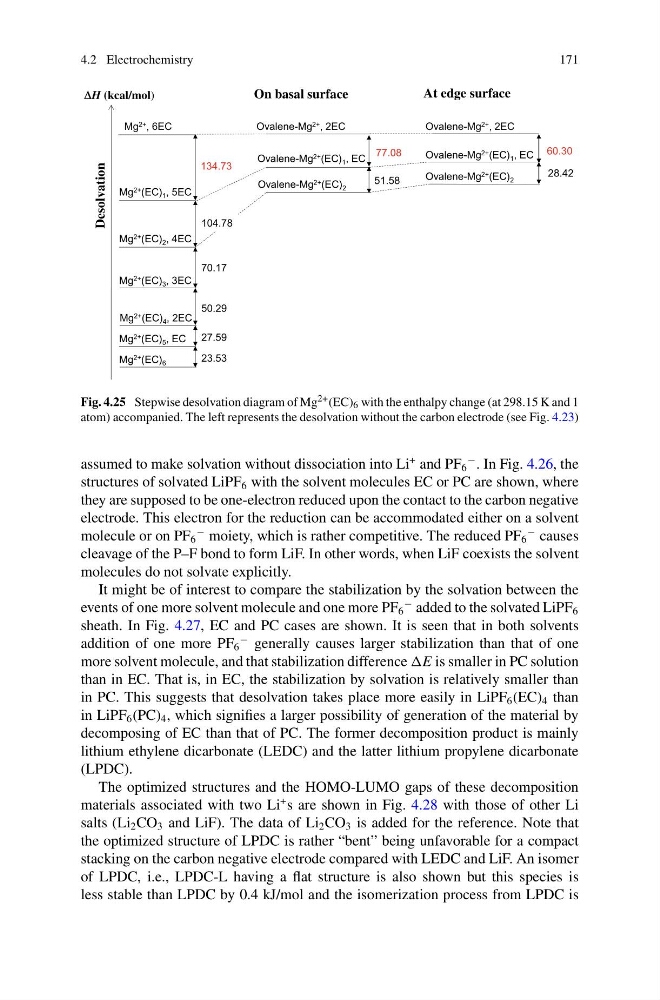
Fig. 4.25 Stepwise desolvation diagram of Mg 2+ (EC) 6 with the enthalpy change (at 298.15 K and 1
atom) accompanied. The left represents the desolvation without the carbon electrode (see Fig. 4.23)
assumed to make solvation without dissociation into Li
+ and PF 6
− . In Fig. 4.26, the
structures of solvated LiPF 6 with the solvent molecules EC or PC are shown, where
they are supposed to be one-electron reduced upon the contact to the carbon negative
electrode. This electron for the reduction can be accommodated either on a solvent
molecule or on PF 6
− moiety, which is rather competitive. The reduced PF 6
− causes
cleavage of the P–F bond to form LiF. In other words, when LiF coexists the solvent
molecules do not solvate explicitly.
It might be of interest to compare the stabilization by the solvation between the
events of one more solvent molecule and one more PF 6
− added to the solvated LiPF 6
sheath. In Fig. 4.27, EC and PC cases are shown. It is seen that in both solvents
addition of one more PF 6
− generally causes larger stabilization than that of one
more solvent molecule, and that stabilization difference is smaller in PC solution
than in EC. That is, in EC, the stabilization by solvation is relatively smaller than
in PC. This suggests that desolvation takes place more easily in LiPF 6 (EC) 4 than
in LiPF 6 (PC) 4 , which signifies a larger possibility of generation of the material by
decomposing of EC than that of PC. The former decomposition product is mainly
lithium ethylene dicarbonate (LEDC) and the latter lithium propylene dicarbonate
(LPDC).
The optimized structures and the HOMO-LUMO gaps of these decomposition
materials associated with two Li
+ s are shown in Fig. 4.28 with those of other Li
salts (Li 2 CO 3 and LiF). The data of Li 2 CO 3 is added for the reference. Note that
the optimized structure of LPDC is rather “bent” being unfavorable for a compact
stacking on the carbon negative electrode compared with LEDC and LiF. An isomer
of LPDC, i.e., LPDC-L having a flat structure is also shown but this species is
less stable than LPDC by 0.4 kJ/mol and the isomerization process from LPDC is
171
ΔH (kcal/mol)
On basal surface
60.30
At edge surface
Desolvation
Mg 2+ , 6EC
Mg 2+ (EC) 1 , 5EC
Mg 2+ (EC) 2 , 4EC
Mg 2+ (EC) 3 , 3EC
Mg 2+ (EC) 4 , 2EC
Mg 2+ (EC) 5 , EC
Mg 2+ (EC) 6
134.73
70.17
50.29
27.59
23.53
Ovalene-Mg 2+ , 2EC
Ovalene-Mg 2+ (EC) 1 , EC
Ovalene-Mg 2+ (EC) 2
77.08
51.58
Ovalene-Mg 2+ , 2EC
Ovalene-Mg 2+ (EC) 1 , EC
Ovalene-Mg 2+ (EC) 2
28.42
104.78
Fig. 4.25 Stepwise desolvation diagram of Mg 2+ (EC) 6 with the enthalpy change (at 298.15 K and 1
atom) accompanied. The left represents the desolvation without the carbon electrode (see Fig. 4.23)
assumed to make solvation without dissociation into Li
+ and PF 6
− . In Fig. 4.26, the
structures of solvated LiPF 6 with the solvent molecules EC or PC are shown, where
they are supposed to be one-electron reduced upon the contact to the carbon negative
electrode. This electron for the reduction can be accommodated either on a solvent
molecule or on PF 6
− moiety, which is rather competitive. The reduced PF 6
− causes
cleavage of the P–F bond to form LiF. In other words, when LiF coexists the solvent
molecules do not solvate explicitly.
It might be of interest to compare the stabilization by the solvation between the
events of one more solvent molecule and one more PF 6
− added to the solvated LiPF 6
sheath. In Fig. 4.27, EC and PC cases are shown. It is seen that in both solvents
addition of one more PF 6
− generally causes larger stabilization than that of one
more solvent molecule, and that stabilization difference is smaller in PC solution
than in EC. That is, in EC, the stabilization by solvation is relatively smaller than
in PC. This suggests that desolvation takes place more easily in LiPF 6 (EC) 4 than
in LiPF 6 (PC) 4 , which signifies a larger possibility of generation of the material by
decomposing of EC than that of PC. The former decomposition product is mainly
lithium ethylene dicarbonate (LEDC) and the latter lithium propylene dicarbonate
(LPDC).
The optimized structures and the HOMO-LUMO gaps of these decomposition
materials associated with two Li
+ s are shown in Fig. 4.28 with those of other Li
salts (Li 2 CO 3 and LiF). The data of Li 2 CO 3 is added for the reference. Note that
the optimized structure of LPDC is rather “bent” being unfavorable for a compact
stacking on the carbon negative electrode compared with LEDC and LiF. An isomer
of LPDC, i.e., LPDC-L having a flat structure is also shown but this species is
less stable than LPDC by 0.4 kJ/mol and the isomerization process from LPDC is