

160
4 Toward More Sophisticated Problems
(a)
(b)
Z H = 4.9 Å
13.6 Å
6.2 Å
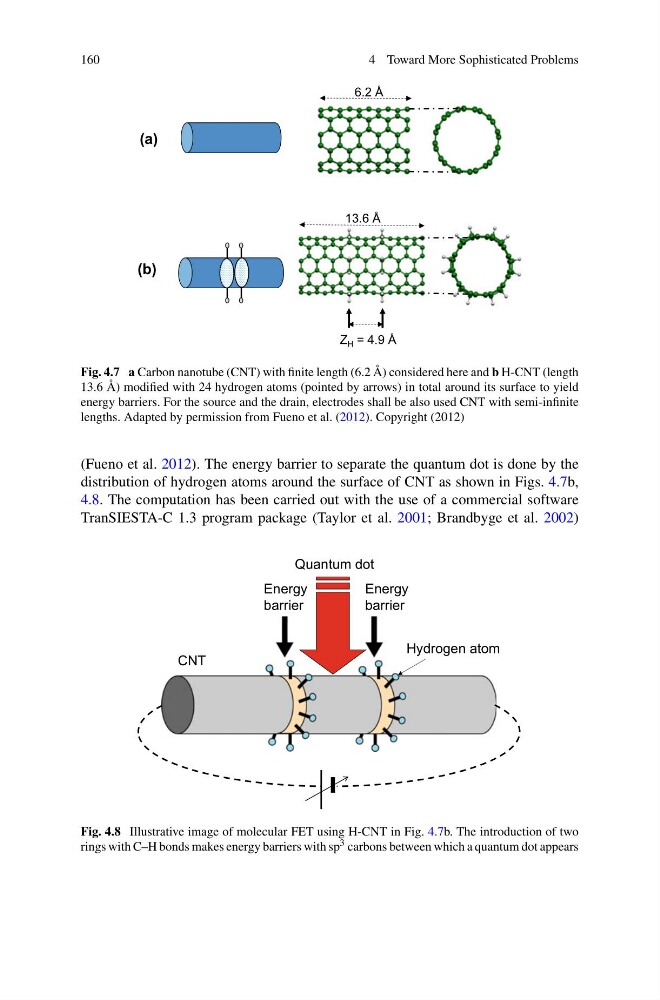
Fig. 4.7 a Carbon nanotube (CNT) with finite length (6.2 Å) considered here and b H-CNT (length
13.6 Å) modified with 24 hydrogen atoms (pointed by arrows) in total around its surface to yield
energy barriers. For the source and the drain, electrodes shall be also used CNT with semi-infinite
lengths. Adapted by permission from Fueno et al. (2012). Copyright (2012)
(Fueno et al. 2012). The energy barrier to separate the quantum dot is done by the
distribution of hydrogen atoms around the surface of CNT as shown in Figs. 4.7b,
4.8. The computation has been carried out with the use of a commercial software
TranSIESTA-C 1.3 program package (Taylor et al. 2001; Brandbyge et al. 2002)
Quantum dot
Energy
barrier
Energy
barrier
CNT
Hydrogen atom
Fig. 4.8 Illustrative image of molecular FET using H-CNT in Fig. 4.7b. The introduction of two
rings with C–H bonds makes energy barriers with sp 3 carbons between which a quantum dot appears
4 Toward More Sophisticated Problems
(a)
(b)
Z H = 4.9 Å
13.6 Å
6.2 Å
Fig. 4.7 a Carbon nanotube (CNT) with finite length (6.2 Å) considered here and b H-CNT (length
13.6 Å) modified with 24 hydrogen atoms (pointed by arrows) in total around its surface to yield
energy barriers. For the source and the drain, electrodes shall be also used CNT with semi-infinite
lengths. Adapted by permission from Fueno et al. (2012). Copyright (2012)
(Fueno et al. 2012). The energy barrier to separate the quantum dot is done by the
distribution of hydrogen atoms around the surface of CNT as shown in Figs. 4.7b,
4.8. The computation has been carried out with the use of a commercial software
TranSIESTA-C 1.3 program package (Taylor et al. 2001; Brandbyge et al. 2002)
Quantum dot
Energy
barrier
Energy
barrier
CNT
Hydrogen atom
Fig. 4.8 Illustrative image of molecular FET using H-CNT in Fig. 4.7b. The introduction of two
rings with C–H bonds makes energy barriers with sp 3 carbons between which a quantum dot appears