

132
3 Fundamentals of the Analysis Tools
(a)
(b)
(c)
(d)
(e)
r
θ
ϕ
ρ
r ij
i
j
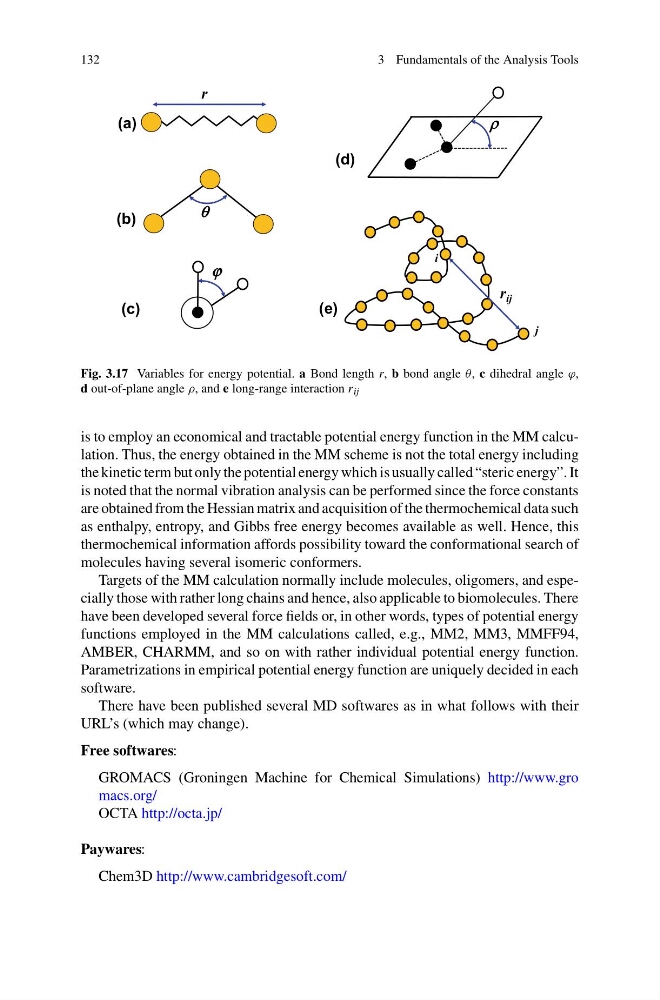
Fig. 3.17 Variables for energy potential. a Bond length r, b bond angle θ, c dihedral angle ϕ,
d out-of-plane angle ρ, and e long-range interaction r ij
is to employ an economical and tractable potential energy function in the MM calculation. Thus, the energy obtained in the MM scheme is not the total energy including
the kinetic term but only the potential energy which is usually called “steric energy”. It
is noted that the normal vibration analysis can be performed since the force constants
are obtained from the Hessian matrix and acquisition of the thermochemical data such
as enthalpy, entropy, and Gibbs free energy becomes available as well. Hence, this
thermochemical information affords possibility toward the conformational search of
molecules having several isomeric conformers.
Targets of the MM calculation normally include molecules, oligomers, and especially those with rather long chains and hence, also applicable to biomolecules. There
have been developed several force fields or, in other words, types of potential energy
functions employed in the MM calculations called, e.g., MM2, MM3, MMFF94,
AMBER, CHARMM, and so on with rather individual potential energy function.
Parametrizations in empirical potential energy function are uniquely decided in each
software.
There have been published several MD softwares as in what follows with their
URL’s (which may change).
Free softwares:
GROMACS (Groningen Machine for Chemical Simulations) http://www.gro
macs.org/
OCTA http://octa.jp/
Paywares:
Chem3D http://www.cambridgesoft.com/
3 Fundamentals of the Analysis Tools
(a)
(b)
(c)
(d)
(e)
r
θ
ϕ
ρ
r ij
i
j
Fig. 3.17 Variables for energy potential. a Bond length r, b bond angle θ, c dihedral angle ϕ,
d out-of-plane angle ρ, and e long-range interaction r ij
is to employ an economical and tractable potential energy function in the MM calculation. Thus, the energy obtained in the MM scheme is not the total energy including
the kinetic term but only the potential energy which is usually called “steric energy”. It
is noted that the normal vibration analysis can be performed since the force constants
are obtained from the Hessian matrix and acquisition of the thermochemical data such
as enthalpy, entropy, and Gibbs free energy becomes available as well. Hence, this
thermochemical information affords possibility toward the conformational search of
molecules having several isomeric conformers.
Targets of the MM calculation normally include molecules, oligomers, and especially those with rather long chains and hence, also applicable to biomolecules. There
have been developed several force fields or, in other words, types of potential energy
functions employed in the MM calculations called, e.g., MM2, MM3, MMFF94,
AMBER, CHARMM, and so on with rather individual potential energy function.
Parametrizations in empirical potential energy function are uniquely decided in each
software.
There have been published several MD softwares as in what follows with their
URL’s (which may change).
Free softwares:
GROMACS (Groningen Machine for Chemical Simulations) http://www.gro
macs.org/
OCTA http://octa.jp/
Paywares:
Chem3D http://www.cambridgesoft.com/