

130
3 Fundamentals of the Analysis Tools
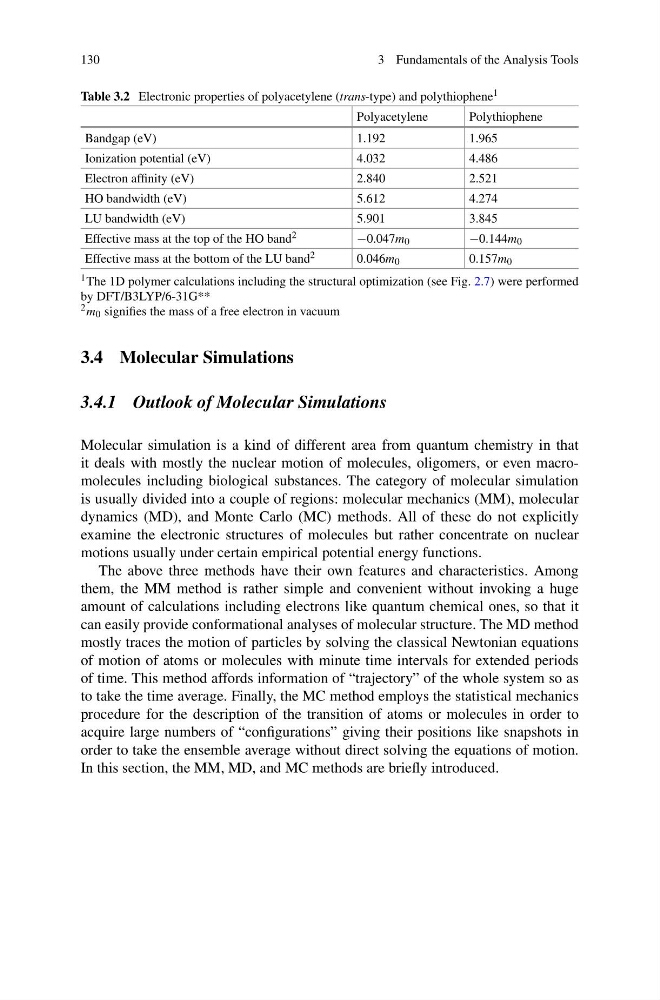
Table 3.2 Electronic properties of polyacetylene (trans-type) and polythiophene 1
Polyacetylene
Polythiophene
Bandgap (eV)
1.192
1.965
Ionization potential (eV)
4.032
4.486
Electron affinity (eV)
2.840
2.521
HO bandwidth (eV)
5.612
4.274
LU bandwidth (eV)
5.901
3.845
Effective mass at the top of the HO band 2
−0.047m 0
−0.144m 0
Effective mass at the bottom of the LU band 2
0.046m 0
0.157m 0
1 The 1D polymer calculations including the structural optimization (see Fig. 2.7) were performed
by DFT/B3LYP/6-31G**
2 m 0 signifies the mass of a free electron in vacuum
3.4 Molecular Simulations
3.4.1 Outlook of Molecular Simulations
Molecular simulation is a kind of different area from quantum chemistry in that
it deals with mostly the nuclear motion of molecules, oligomers, or even macromolecules including biological substances. The category of molecular simulation
is usually divided into a couple of regions: molecular mechanics (MM), molecular
dynamics (MD), and Monte Carlo (MC) methods. All of these do not explicitly
examine the electronic structures of molecules but rather concentrate on nuclear
motions usually under certain empirical potential energy functions.
The above three methods have their own features and characteristics. Among
them, the MM method is rather simple and convenient without invoking a huge
amount of calculations including electrons like quantum chemical ones, so that it
can easily provide conformational analyses of molecular structure. The MD method
mostly traces the motion of particles by solving the classical Newtonian equations
of motion of atoms or molecules with minute time intervals for extended periods
of time. This method affords information of “trajectory” of the whole system so as
to take the time average. Finally, the MC method employs the statistical mechanics
procedure for the description of the transition of atoms or molecules in order to
acquire large numbers of “configurations” giving their positions like snapshots in
order to take the ensemble average without direct solving the equations of motion.
In this section, the MM, MD, and MC methods are briefly introduced.
3 Fundamentals of the Analysis Tools
Table 3.2 Electronic properties of polyacetylene (trans-type) and polythiophene 1
Polyacetylene
Polythiophene
Bandgap (eV)
1.192
1.965
Ionization potential (eV)
4.032
4.486
Electron affinity (eV)
2.840
2.521
HO bandwidth (eV)
5.612
4.274
LU bandwidth (eV)
5.901
3.845
Effective mass at the top of the HO band 2
−0.047m 0
−0.144m 0
Effective mass at the bottom of the LU band 2
0.046m 0
0.157m 0
1 The 1D polymer calculations including the structural optimization (see Fig. 2.7) were performed
by DFT/B3LYP/6-31G**
2 m 0 signifies the mass of a free electron in vacuum
3.4 Molecular Simulations
3.4.1 Outlook of Molecular Simulations
Molecular simulation is a kind of different area from quantum chemistry in that
it deals with mostly the nuclear motion of molecules, oligomers, or even macromolecules including biological substances. The category of molecular simulation
is usually divided into a couple of regions: molecular mechanics (MM), molecular
dynamics (MD), and Monte Carlo (MC) methods. All of these do not explicitly
examine the electronic structures of molecules but rather concentrate on nuclear
motions usually under certain empirical potential energy functions.
The above three methods have their own features and characteristics. Among
them, the MM method is rather simple and convenient without invoking a huge
amount of calculations including electrons like quantum chemical ones, so that it
can easily provide conformational analyses of molecular structure. The MD method
mostly traces the motion of particles by solving the classical Newtonian equations
of motion of atoms or molecules with minute time intervals for extended periods
of time. This method affords information of “trajectory” of the whole system so as
to take the time average. Finally, the MC method employs the statistical mechanics
procedure for the description of the transition of atoms or molecules in order to
acquire large numbers of “configurations” giving their positions like snapshots in
order to take the ensemble average without direct solving the equations of motion.
In this section, the MM, MD, and MC methods are briefly introduced.