

3.3 Crystal Orbital (CO) Calculations
129
large delocalization of electrons accommodated in the CO has a tendency of
increase of the corresponding bandwidth. For instance, a large bandwidth of
the band with π nature signifies the extension of the π conjugation throughout
the polymer chain. This kind of extension is appropriate, e.g., for electrically
conductive polymers. On the other hand, CO’s accommodating σ electrons or
lone-pair electrons are associated with the bands having relatively small bandwidth, and these energy bands are almost flat due to the spatial localization of
those electrons.
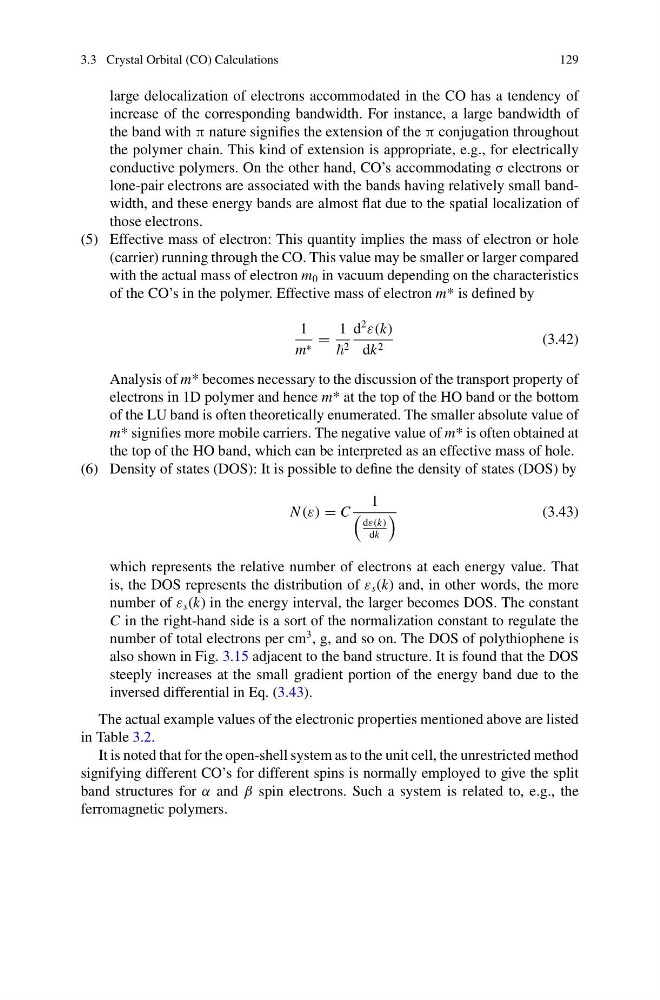
(5) Effective mass of electron: This quantity implies the mass of electron or hole
(carrier) running through the CO. This value may be smaller or larger compared
with the actual mass of electron m 0 in vacuum depending on the characteristics
of the CO’s in the polymer. Effective mass of electron m* is defined by
1
m ∗ =
1
2
d
2
ε(k)
dk 2
(3.42)
Analysis of m* becomes necessary to the discussion of the transport property of
electrons in 1D polymer and hence m* at the top of the HO band or the bottom
of the LU band is often theoretically enumerated. The smaller absolute value of
m* signifies more mobile carriers. The negative value of m* is often obtained at
the top of the HO band, which can be interpreted as an effective mass of hole.
(6) Density of states (DOS): It is possible to define the density of states (DOS) by
N (ε) = C
1
dε(k)
dk
(3.43)
which represents the relative number of electrons at each energy value. That
is, the DOS represents the distribution of ε s (k) and, in other words, the more
number of ε s (k) in the energy interval, the larger becomes DOS. The constant
C in the right-hand side is a sort of the normalization constant to regulate the
number of total electrons per cm
3 , g, and so on. The DOS of polythiophene is
also shown in Fig. 3.15 adjacent to the band structure. It is found that the DOS
steeply increases at the small gradient portion of the energy band due to the
inversed differential in Eq. (3.43).
The actual example values of the electronic properties mentioned above are listed
in Table 3.2.
It is noted that for the open-shell system as to the unit cell, the unrestricted method
signifying different CO’s for different spins is normally employed to give the split
band structures for α and β spin electrons. Such a system is related to, e.g., the
ferromagnetic polymers.
129
large delocalization of electrons accommodated in the CO has a tendency of
increase of the corresponding bandwidth. For instance, a large bandwidth of
the band with π nature signifies the extension of the π conjugation throughout
the polymer chain. This kind of extension is appropriate, e.g., for electrically
conductive polymers. On the other hand, CO’s accommodating σ electrons or
lone-pair electrons are associated with the bands having relatively small bandwidth, and these energy bands are almost flat due to the spatial localization of
those electrons.
(5) Effective mass of electron: This quantity implies the mass of electron or hole
(carrier) running through the CO. This value may be smaller or larger compared
with the actual mass of electron m 0 in vacuum depending on the characteristics
of the CO’s in the polymer. Effective mass of electron m* is defined by
1
m ∗ =
1
2
d
2
ε(k)
dk 2
(3.42)
Analysis of m* becomes necessary to the discussion of the transport property of
electrons in 1D polymer and hence m* at the top of the HO band or the bottom
of the LU band is often theoretically enumerated. The smaller absolute value of
m* signifies more mobile carriers. The negative value of m* is often obtained at
the top of the HO band, which can be interpreted as an effective mass of hole.
(6) Density of states (DOS): It is possible to define the density of states (DOS) by
N (ε) = C
1
dε(k)
dk
(3.43)
which represents the relative number of electrons at each energy value. That
is, the DOS represents the distribution of ε s (k) and, in other words, the more
number of ε s (k) in the energy interval, the larger becomes DOS. The constant
C in the right-hand side is a sort of the normalization constant to regulate the
number of total electrons per cm
3 , g, and so on. The DOS of polythiophene is
also shown in Fig. 3.15 adjacent to the band structure. It is found that the DOS
steeply increases at the small gradient portion of the energy band due to the
inversed differential in Eq. (3.43).
The actual example values of the electronic properties mentioned above are listed
in Table 3.2.
It is noted that for the open-shell system as to the unit cell, the unrestricted method
signifying different CO’s for different spins is normally employed to give the split
band structures for α and β spin electrons. Such a system is related to, e.g., the
ferromagnetic polymers.