

3.3 Crystal Orbital (CO) Calculations
119
3.3 Crystal Orbital (CO) Calculations
3.3.1 Basic Idea
For regular one-dimensional (1D) polymers, quantum chemical treatment is also
possible by the extension of the ordinary MO calculations. The 1D polymer treated
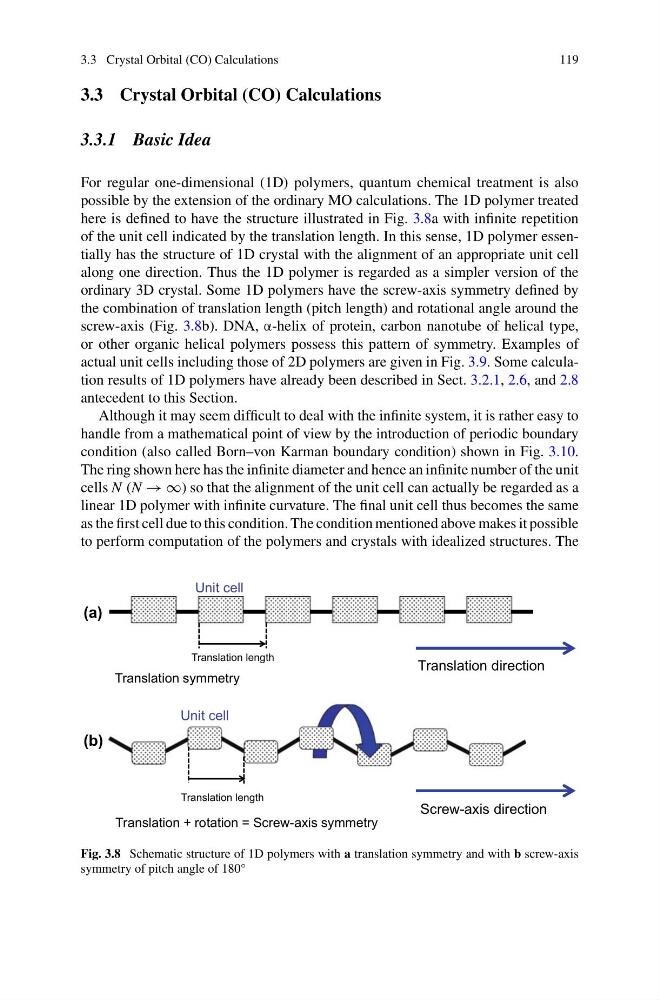
here is defined to have the structure illustrated in Fig. 3.8a with infinite repetition
of the unit cell indicated by the translation length. In this sense, 1D polymer essentially has the structure of 1D crystal with the alignment of an appropriate unit cell
along one direction. Thus the 1D polymer is regarded as a simpler version of the
ordinary 3D crystal. Some 1D polymers have the screw-axis symmetry defined by
the combination of translation length (pitch length) and rotational angle around the
screw-axis (Fig. 3.8b). DNA, α-helix of protein, carbon nanotube of helical type,
or other organic helical polymers possess this pattern of symmetry. Examples of
actual unit cells including those of 2D polymers are given in Fig. 3.9. Some calculation results of 1D polymers have already been described in Sect. 3.2.1, 2.6, and 2.8
antecedent to this Section.
Although it may seem difficult to deal with the infinite system, it is rather easy to
handle from a mathematical point of view by the introduction of periodic boundary
condition (also called Born–von Karman boundary condition) shown in Fig. 3.10.
The ring shown here has the infinite diameter and hence an infinite number of the unit
cells N (N → ∞) so that the alignment of the unit cell can actually be regarded as a
linear 1D polymer with infinite curvature. The final unit cell thus becomes the same
as the first cell due to this condition. The condition mentioned above makes it possible
to perform computation of the polymers and crystals with idealized structures. The
Unit cell
Translation + rotation = Screw-axis symmetry
Translation direction
(a)
(b)
Screw-axis direction
Unit cell
Translation symmetry
Translation length
Translation length
Fig. 3.8 Schematic structure of 1D polymers with a translation symmetry and with b screw-axis
symmetry of pitch angle of 180°
119
3.3 Crystal Orbital (CO) Calculations
3.3.1 Basic Idea
For regular one-dimensional (1D) polymers, quantum chemical treatment is also
possible by the extension of the ordinary MO calculations. The 1D polymer treated
here is defined to have the structure illustrated in Fig. 3.8a with infinite repetition
of the unit cell indicated by the translation length. In this sense, 1D polymer essentially has the structure of 1D crystal with the alignment of an appropriate unit cell
along one direction. Thus the 1D polymer is regarded as a simpler version of the
ordinary 3D crystal. Some 1D polymers have the screw-axis symmetry defined by
the combination of translation length (pitch length) and rotational angle around the
screw-axis (Fig. 3.8b). DNA, α-helix of protein, carbon nanotube of helical type,
or other organic helical polymers possess this pattern of symmetry. Examples of
actual unit cells including those of 2D polymers are given in Fig. 3.9. Some calculation results of 1D polymers have already been described in Sect. 3.2.1, 2.6, and 2.8
antecedent to this Section.
Although it may seem difficult to deal with the infinite system, it is rather easy to
handle from a mathematical point of view by the introduction of periodic boundary
condition (also called Born–von Karman boundary condition) shown in Fig. 3.10.
The ring shown here has the infinite diameter and hence an infinite number of the unit
cells N (N → ∞) so that the alignment of the unit cell can actually be regarded as a
linear 1D polymer with infinite curvature. The final unit cell thus becomes the same
as the first cell due to this condition. The condition mentioned above makes it possible
to perform computation of the polymers and crystals with idealized structures. The
Unit cell
Translation + rotation = Screw-axis symmetry
Translation direction
(a)
(b)
Screw-axis direction
Unit cell
Translation symmetry
Translation length
Translation length
Fig. 3.8 Schematic structure of 1D polymers with a translation symmetry and with b screw-axis
symmetry of pitch angle of 180°