

118
3 Fundamentals of the Analysis Tools
molecular structures and molecular properties in successful manners with chemical
accuracy.
3.2.2 Excited State in DFT
In order to obtain the excitation energies in the DFT method it is necessary to include
an additional technique based on the TD-DFT theorem (Runge and Gross 1984).
Hereinafter, a simple outline of the TD-DFT process is to be introduced. This theorem
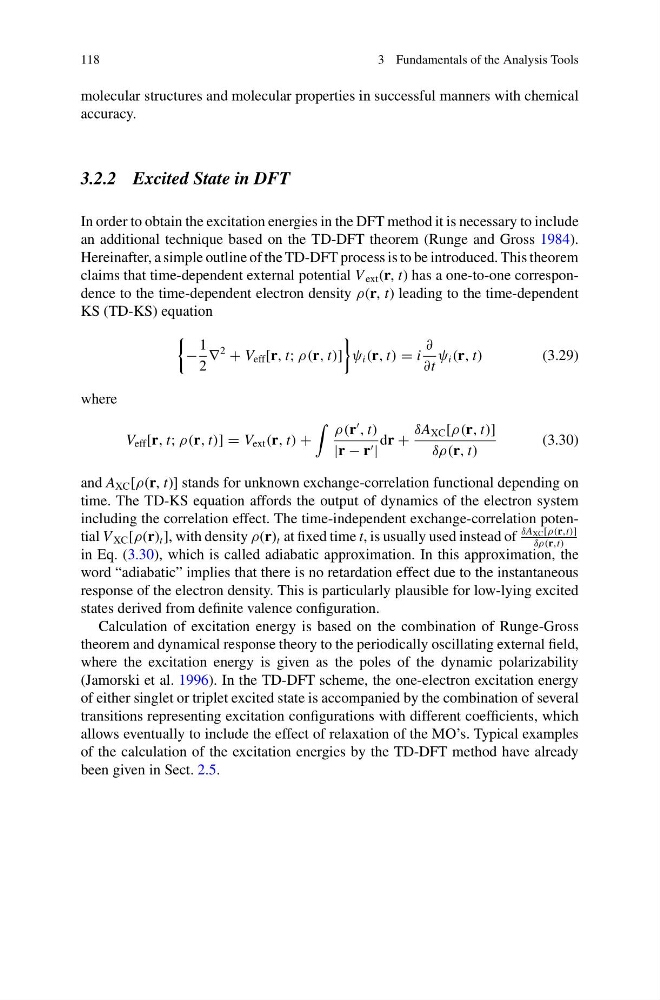
claims that time-dependent external potential V ext (r, t) has a one-to-one correspondence to the time-dependent electron density ρ(r, t) leading to the time-dependent
KS (TD-KS) equation
−
1
2
∇
2
+ V eff [r, t; ρ(r, t)]
ψ i (r, t) = i
∂
∂t
ψ i (r, t)
(3.29)
where
V eff [r, t; ρ(r, t)] = V ext (r, t) +
ρ(r
, t)
|r − r |
dr +
δA XC [ρ(r, t)]
δρ(r, t)
(3.30)
and A XC [ρ(r, t)] stands for unknown exchange-correlation functional depending on
time. The TD-KS equation affords the output of dynamics of the electron system
including the correlation effect. The time-independent exchange-correlation potential V XC [ρ(r) t ], with density ρ(r) t at fixed time t, is usually used instead of
δA XC [ρ(r,t)]
δρ(r,t)
in Eq. (3.30), which is called adiabatic approximation. In this approximation, the
word “adiabatic” implies that there is no retardation effect due to the instantaneous
response of the electron density. This is particularly plausible for low-lying excited
states derived from definite valence configuration.
Calculation of excitation energy is based on the combination of Runge-Gross
theorem and dynamical response theory to the periodically oscillating external field,
where the excitation energy is given as the poles of the dynamic polarizability
(Jamorski et al. 1996). In the TD-DFT scheme, the one-electron excitation energy
of either singlet or triplet excited state is accompanied by the combination of several
transitions representing excitation configurations with different coefficients, which
allows eventually to include the effect of relaxation of the MO’s. Typical examples
of the calculation of the excitation energies by the TD-DFT method have already
been given in Sect. 2.5.
3 Fundamentals of the Analysis Tools
molecular structures and molecular properties in successful manners with chemical
accuracy.
3.2.2 Excited State in DFT
In order to obtain the excitation energies in the DFT method it is necessary to include
an additional technique based on the TD-DFT theorem (Runge and Gross 1984).
Hereinafter, a simple outline of the TD-DFT process is to be introduced. This theorem
claims that time-dependent external potential V ext (r, t) has a one-to-one correspondence to the time-dependent electron density ρ(r, t) leading to the time-dependent
KS (TD-KS) equation
−
1
2
∇
2
+ V eff [r, t; ρ(r, t)]
ψ i (r, t) = i
∂
∂t
ψ i (r, t)
(3.29)
where
V eff [r, t; ρ(r, t)] = V ext (r, t) +
ρ(r
, t)
|r − r |
dr +
δA XC [ρ(r, t)]
δρ(r, t)
(3.30)
and A XC [ρ(r, t)] stands for unknown exchange-correlation functional depending on
time. The TD-KS equation affords the output of dynamics of the electron system
including the correlation effect. The time-independent exchange-correlation potential V XC [ρ(r) t ], with density ρ(r) t at fixed time t, is usually used instead of
δA XC [ρ(r,t)]
δρ(r,t)
in Eq. (3.30), which is called adiabatic approximation. In this approximation, the
word “adiabatic” implies that there is no retardation effect due to the instantaneous
response of the electron density. This is particularly plausible for low-lying excited
states derived from definite valence configuration.
Calculation of excitation energy is based on the combination of Runge-Gross
theorem and dynamical response theory to the periodically oscillating external field,
where the excitation energy is given as the poles of the dynamic polarizability
(Jamorski et al. 1996). In the TD-DFT scheme, the one-electron excitation energy
of either singlet or triplet excited state is accompanied by the combination of several
transitions representing excitation configurations with different coefficients, which
allows eventually to include the effect of relaxation of the MO’s. Typical examples
of the calculation of the excitation energies by the TD-DFT method have already
been given in Sect. 2.5.