

120
3 Fundamentals of the Analysis Tools
S
N
S
N
S
S
N
N
(a)
(d)
(e)
(f)
(b)
(c)
C
C
C
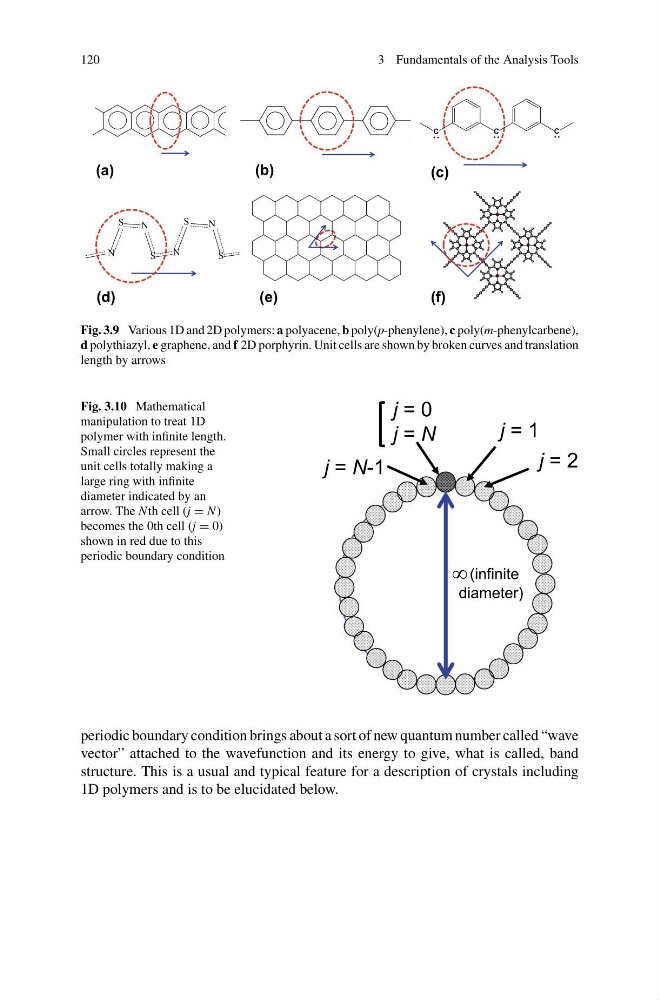
Fig. 3.9 Various 1D and 2D polymers: a polyacene, b poly(p-phenylene), c poly(m-phenylcarbene),
d polythiazyl, e graphene, and f 2D porphyrin. Unit cells are shown by broken curves and translation
length by arrows
Fig. 3.10 Mathematical
manipulation to treat 1D
polymer with infinite length.
Small circles represent the
unit cells totally making a
large ring with infinite
diameter indicated by an
arrow. The Nth cell (j = N)
becomes the 0th cell (j = 0)
shown in red due to this
periodic boundary condition
periodic boundary condition brings about a sort of new quantum number called “wave
vector” attached to the wavefunction and its energy to give, what is called, band
structure. This is a usual and typical feature for a description of crystals including
1D polymers and is to be elucidated below.
3 Fundamentals of the Analysis Tools
S
N
S
N
S
S
N
N
(a)
(d)
(e)
(f)
(b)
(c)
C
C
C
Fig. 3.9 Various 1D and 2D polymers: a polyacene, b poly(p-phenylene), c poly(m-phenylcarbene),
d polythiazyl, e graphene, and f 2D porphyrin. Unit cells are shown by broken curves and translation
length by arrows
Fig. 3.10 Mathematical
manipulation to treat 1D
polymer with infinite length.
Small circles represent the
unit cells totally making a
large ring with infinite
diameter indicated by an
arrow. The Nth cell (j = N)
becomes the 0th cell (j = 0)
shown in red due to this
periodic boundary condition
periodic boundary condition brings about a sort of new quantum number called “wave
vector” attached to the wavefunction and its energy to give, what is called, band
structure. This is a usual and typical feature for a description of crystals including
1D polymers and is to be elucidated below.