

114
3 Fundamentals of the Analysis Tools
E XC [ρ(r)] ≡
μ
Φ
∗
Exact
−
∇
2
μ
2
Φ Exact dr μ
−
μ
Ψ
∗
KS
−
∇
2
μ
2
Ψ KS dr μ
+
μ>ν
Φ
∗
Exact
1
r μν
Φ Exact dr μ dr ν
−
1
2
ρ(r)ρ
r
|r − r |
drdr
(3.25)
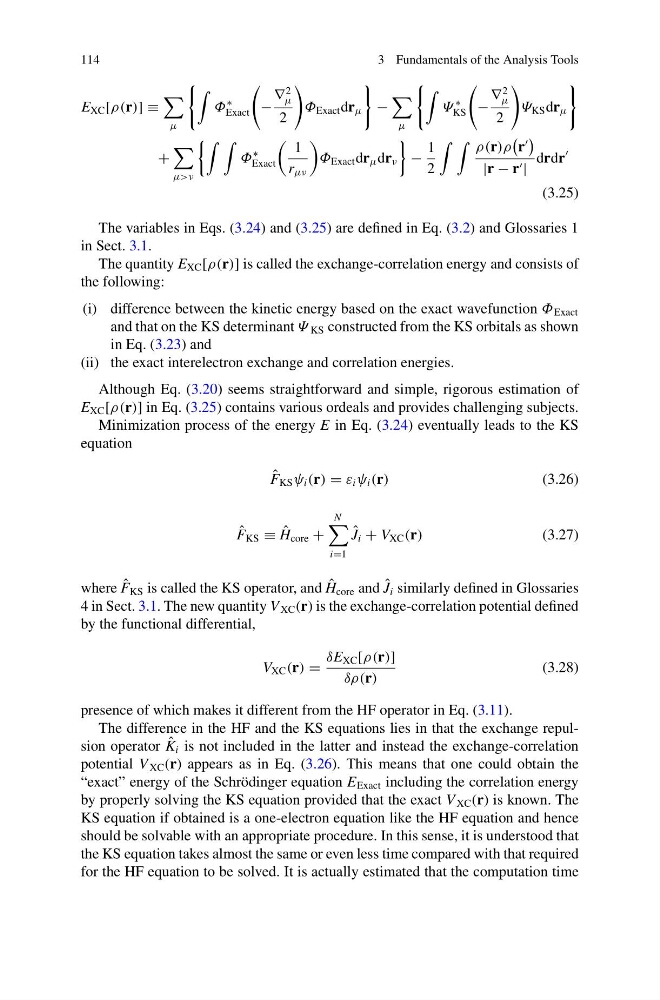
The variables in Eqs. (3.24) and (3.25) are defined in Eq. (3.2) and Glossaries 1
in Sect. 3.1.
The quantity E XC [ρ(r)] is called the exchange-correlation energy and consists of
the following:
(i) difference between the kinetic energy based on the exact wavefunction Φ Exact
and that on the KS determinant Ψ KS constructed from the KS orbitals as shown
in Eq. (3.23) and
(ii) the exact interelectron exchange and correlation energies.
Although Eq. (3.20) seems straightforward and simple, rigorous estimation of
E XC [ρ(r)] in Eq. (3.25) contains various ordeals and provides challenging subjects.
Minimization process of the energy E in Eq. (3.24) eventually leads to the KS
equation
ˆ
F KS ψ i (r) = ε i ψ i (r)
(3.26)
ˆ
F KS ≡ ˆ
H core +
N
i=1
ˆ
J i + V XC (r)
(3.27)
where ˆ
F KS is called the KS operator, and ˆ
H core and ˆ
J i similarly defined in Glossaries
4 in Sect. 3.1. The new quantity V XC (r) is the exchange-correlation potential defined
by the functional differential,
V XC (r) =
δE XC [ρ(r)]
δρ(r)
(3.28)
presence of which makes it different from the HF operator in Eq. (3.11).
The difference in the HF and the KS equations lies in that the exchange repulsion operator ˆ
K i is not included in the latter and instead the exchange-correlation
potential V XC (r) appears as in Eq. (3.26). This means that one could obtain the
“exact” energy of the Schrödinger equation E Exact including the correlation energy
by properly solving the KS equation provided that the exact V XC (r) is known. The
KS equation if obtained is a one-electron equation like the HF equation and hence
should be solvable with an appropriate procedure. In this sense, it is understood that
the KS equation takes almost the same or even less time compared with that required
for the HF equation to be solved. It is actually estimated that the computation time
3 Fundamentals of the Analysis Tools
E XC [ρ(r)] ≡
μ
Φ
∗
Exact
−
∇
2
μ
2
Φ Exact dr μ
−
μ
Ψ
∗
KS
−
∇
2
μ
2
Ψ KS dr μ
+
μ>ν
Φ
∗
Exact
1
r μν
Φ Exact dr μ dr ν
−
1
2
ρ(r)ρ
r
|r − r |
drdr
(3.25)
The variables in Eqs. (3.24) and (3.25) are defined in Eq. (3.2) and Glossaries 1
in Sect. 3.1.
The quantity E XC [ρ(r)] is called the exchange-correlation energy and consists of
the following:
(i) difference between the kinetic energy based on the exact wavefunction Φ Exact
and that on the KS determinant Ψ KS constructed from the KS orbitals as shown
in Eq. (3.23) and
(ii) the exact interelectron exchange and correlation energies.
Although Eq. (3.20) seems straightforward and simple, rigorous estimation of
E XC [ρ(r)] in Eq. (3.25) contains various ordeals and provides challenging subjects.
Minimization process of the energy E in Eq. (3.24) eventually leads to the KS
equation
ˆ
F KS ψ i (r) = ε i ψ i (r)
(3.26)
ˆ
F KS ≡ ˆ
H core +
N
i=1
ˆ
J i + V XC (r)
(3.27)
where ˆ
F KS is called the KS operator, and ˆ
H core and ˆ
J i similarly defined in Glossaries
4 in Sect. 3.1. The new quantity V XC (r) is the exchange-correlation potential defined
by the functional differential,
V XC (r) =
δE XC [ρ(r)]
δρ(r)
(3.28)
presence of which makes it different from the HF operator in Eq. (3.11).
The difference in the HF and the KS equations lies in that the exchange repulsion operator ˆ
K i is not included in the latter and instead the exchange-correlation
potential V XC (r) appears as in Eq. (3.26). This means that one could obtain the
“exact” energy of the Schrödinger equation E Exact including the correlation energy
by properly solving the KS equation provided that the exact V XC (r) is known. The
KS equation if obtained is a one-electron equation like the HF equation and hence
should be solvable with an appropriate procedure. In this sense, it is understood that
the KS equation takes almost the same or even less time compared with that required
for the HF equation to be solved. It is actually estimated that the computation time