

112
3 Fundamentals of the Analysis Tools
generalized valence bond (GVB) scheme (Goddard and Harding 1978) essentially
akin to CASSCF procedure.
More sophisticated CI and CC methods are also applicable to the improvement
of excitation energy. The CC method along with this line contains the symmetryadapted cluster (SAC)-CI method which effectively shortens the computation time
(Nakatsuji and Hirao 1978). Hence, when one requires more quantitative values of
excitation energies, it is encouraged to consider these elaborate calculations.
3.2 Density Functional Theory (DFT) Calculations
3.2.1 Ground-State DFT
The DFT method was first developed in the physics field particularly for dealing with
the inorganic or metal crystals and is often called the first-principles calculation by
physicists. This method has recently been much more refined to achieve chemical
accuracy when employed for the molecular systems. Therefore, it is now quite often
used in the chemistry field as well. The calculation method based on the DFT was
introduced into the category of theoretical chemistry after the 1990s since it can
provide plausible results with reasonably short computation time in contrast with the
HF method. In this section, a simple outlook of the DFT framework is to be given.
The theoretical background of DFT was established in the middle 1960s by the
Hohenberg-Kohn theorem (Hohenberg and Kohn 1964) claiming that there is a oneto-one correspondence between the external potential v(r) and the electron density
ρ(r) in the interactive electronic system. It is noted that the above external potential
signifies the summation of the nucleus-electron interactions in atoms or molecules
described by the second term in Eq. (3.2) and the potential due to the external electric,
magnetic, or electromagnetic field, if any. The Hohenberg-Kohn theorem also claims
that one can obtain the exact energy E of the Schrödinger equation if the exact ρ(r)
were to be employed. Hence, the concept of the DFT method starts from the electron
density for obtaining its functional in principle. This concept rather differs from
that of the conventional MO scheme including the HF method which starts from the
“actual” wavefunction.
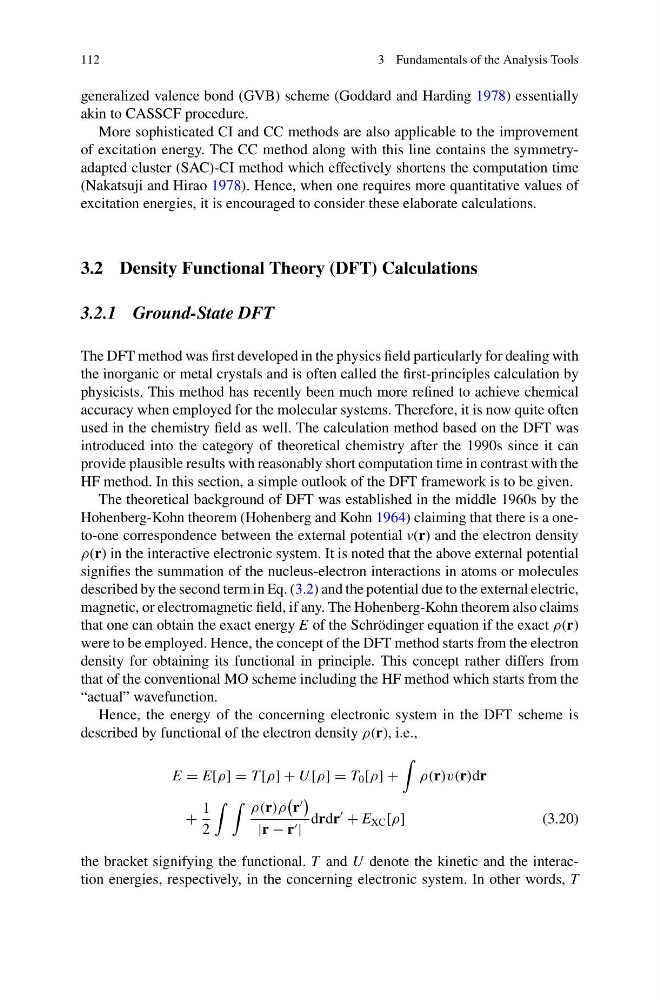
Hence, the energy of the concerning electronic system in the DFT scheme is
described by functional of the electron density ρ(r), i.e.,
E = E[ρ] = T [ρ] + U [ρ] = T 0 [ρ] +
ρ(r)v(r)dr
+
1
2
ρ(r)ρ
r
|r − r |
drdr
+ E XC [ρ]
(3.20)
the bracket signifying the functional. T and U denote the kinetic and the interaction energies, respectively, in the concerning electronic system. In other words, T
3 Fundamentals of the Analysis Tools
generalized valence bond (GVB) scheme (Goddard and Harding 1978) essentially
akin to CASSCF procedure.
More sophisticated CI and CC methods are also applicable to the improvement
of excitation energy. The CC method along with this line contains the symmetryadapted cluster (SAC)-CI method which effectively shortens the computation time
(Nakatsuji and Hirao 1978). Hence, when one requires more quantitative values of
excitation energies, it is encouraged to consider these elaborate calculations.
3.2 Density Functional Theory (DFT) Calculations
3.2.1 Ground-State DFT
The DFT method was first developed in the physics field particularly for dealing with
the inorganic or metal crystals and is often called the first-principles calculation by
physicists. This method has recently been much more refined to achieve chemical
accuracy when employed for the molecular systems. Therefore, it is now quite often
used in the chemistry field as well. The calculation method based on the DFT was
introduced into the category of theoretical chemistry after the 1990s since it can
provide plausible results with reasonably short computation time in contrast with the
HF method. In this section, a simple outlook of the DFT framework is to be given.
The theoretical background of DFT was established in the middle 1960s by the
Hohenberg-Kohn theorem (Hohenberg and Kohn 1964) claiming that there is a oneto-one correspondence between the external potential v(r) and the electron density
ρ(r) in the interactive electronic system. It is noted that the above external potential
signifies the summation of the nucleus-electron interactions in atoms or molecules
described by the second term in Eq. (3.2) and the potential due to the external electric,
magnetic, or electromagnetic field, if any. The Hohenberg-Kohn theorem also claims
that one can obtain the exact energy E of the Schrödinger equation if the exact ρ(r)
were to be employed. Hence, the concept of the DFT method starts from the electron
density for obtaining its functional in principle. This concept rather differs from
that of the conventional MO scheme including the HF method which starts from the
“actual” wavefunction.
Hence, the energy of the concerning electronic system in the DFT scheme is
described by functional of the electron density ρ(r), i.e.,
E = E[ρ] = T [ρ] + U [ρ] = T 0 [ρ] +
ρ(r)v(r)dr
+
1
2
ρ(r)ρ
r
|r − r |
drdr
+ E XC [ρ]
(3.20)
the bracket signifying the functional. T and U denote the kinetic and the interaction energies, respectively, in the concerning electronic system. In other words, T