

3.1 Molecular Orbital Calculations
111
It is noted that these restricted CI considerations do not satisfy size consistency,
i.e.,
E CI (M ) = ME CI (1)
(3.19)
where E CI (M) signifies the energy obtained for infinitely separated M-mers ( ˇ
Cížek
1966). The coupled-cluster (CC) method based on the selection of excitation configurations satisfying the size consistency has been developed for a reasonable approach.
Like the restricted CI method, there is also a similar classification in the CC method
such as CCSD, CCSDT, and so on.
For a molecule which has very small excitation energy, the ground-state configuration is energetically almost degenerate with that excitation configuration(s). In
such a case, one ought to start from these mixed configurations state called multiconfiguration. In this process, both the MO coefficients and the CI coefficients are
simultaneously decided in the SCF process. This method is called the multiconfigurational SCF (MCSCF) approach (Frenkel 1934). Sometimes selection of the MO’s
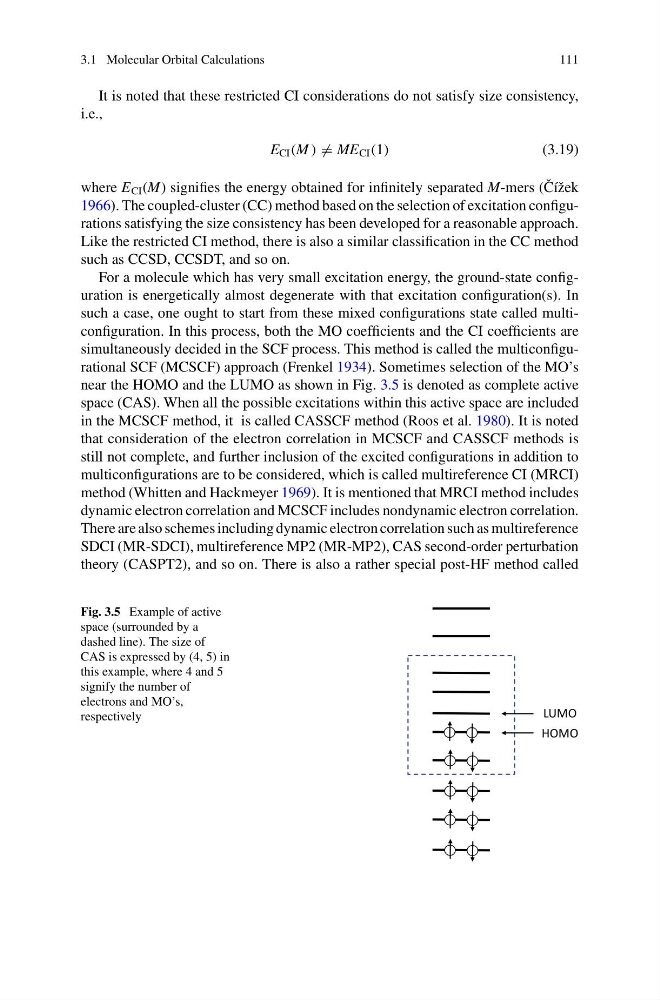
near the HOMO and the LUMO as shown in Fig. 3.5 is denoted as complete active
space (CAS). When all the possible excitations within this active space are included
in the MCSCF method, it is called CASSCF method (Roos et al. 1980). It is noted
that consideration of the electron correlation in MCSCF and CASSCF methods is
still not complete, and further inclusion of the excited configurations in addition to
multiconfigurations are to be considered, which is called multireference CI (MRCI)
method (Whitten and Hackmeyer 1969). It is mentioned that MRCI method includes
dynamic electron correlation and MCSCF includes nondynamic electron correlation.
There are also schemes including dynamic electron correlation such as multireference
SDCI (MR-SDCI), multireference MP2 (MR-MP2), CAS second-order perturbation
theory (CASPT2), and so on. There is also a rather special post-HF method called
Fig. 3.5 Example of active
space (surrounded by a
dashed line). The size of
CAS is expressed by (4, 5) in
this example, where 4 and 5
signify the number of
electrons and MO’s,
respectively
HOMO
LUMO
111
It is noted that these restricted CI considerations do not satisfy size consistency,
i.e.,
E CI (M ) = ME CI (1)
(3.19)
where E CI (M) signifies the energy obtained for infinitely separated M-mers ( ˇ
Cížek
1966). The coupled-cluster (CC) method based on the selection of excitation configurations satisfying the size consistency has been developed for a reasonable approach.
Like the restricted CI method, there is also a similar classification in the CC method
such as CCSD, CCSDT, and so on.
For a molecule which has very small excitation energy, the ground-state configuration is energetically almost degenerate with that excitation configuration(s). In
such a case, one ought to start from these mixed configurations state called multiconfiguration. In this process, both the MO coefficients and the CI coefficients are
simultaneously decided in the SCF process. This method is called the multiconfigurational SCF (MCSCF) approach (Frenkel 1934). Sometimes selection of the MO’s
near the HOMO and the LUMO as shown in Fig. 3.5 is denoted as complete active
space (CAS). When all the possible excitations within this active space are included
in the MCSCF method, it is called CASSCF method (Roos et al. 1980). It is noted
that consideration of the electron correlation in MCSCF and CASSCF methods is
still not complete, and further inclusion of the excited configurations in addition to
multiconfigurations are to be considered, which is called multireference CI (MRCI)
method (Whitten and Hackmeyer 1969). It is mentioned that MRCI method includes
dynamic electron correlation and MCSCF includes nondynamic electron correlation.
There are also schemes including dynamic electron correlation such as multireference
SDCI (MR-SDCI), multireference MP2 (MR-MP2), CAS second-order perturbation
theory (CASPT2), and so on. There is also a rather special post-HF method called
Fig. 3.5 Example of active
space (surrounded by a
dashed line). The size of
CAS is expressed by (4, 5) in
this example, where 4 and 5
signify the number of
electrons and MO’s,
respectively
HOMO
LUMO