

110
3 Fundamentals of the Analysis Tools
PerturbaƟon method
MP2, MP3, MP4, MP5, MP6, MP7, …..
ConfiguraƟon InteracƟon (CI) method
CIS, CID, CISD, CISDT, CISTDQ, …..
MCSCF, CASSCF, MRCI, …..
Coupled Cluster (CC) method
CCSD, CCSDT, CCSDTQ, …….
SAC-CI, EOM-CCSD, …….
HF method
Post-HF
method
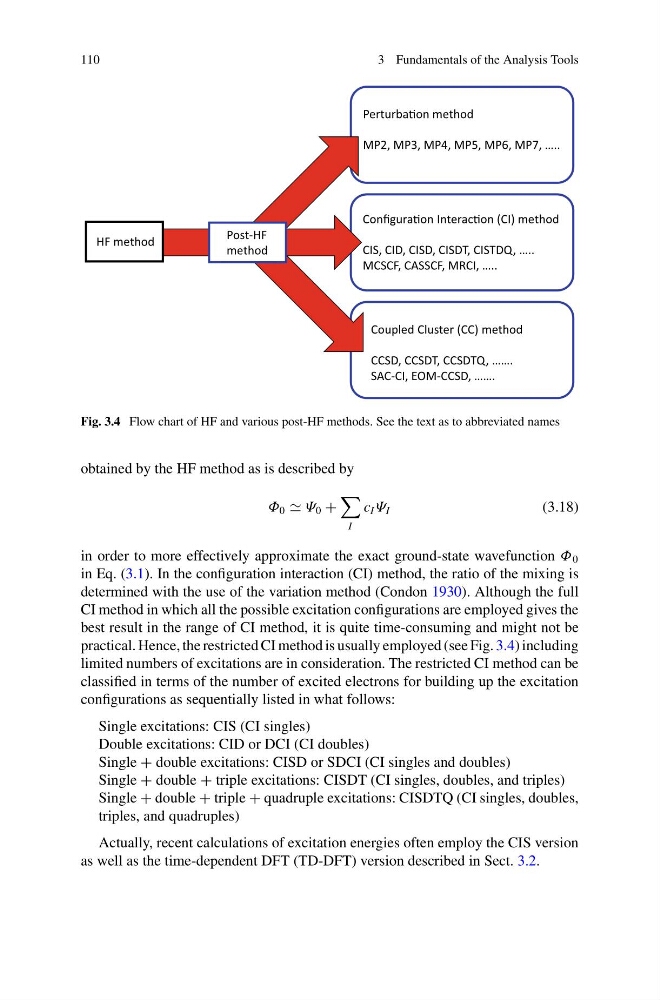
Fig. 3.4 Flow chart of HF and various post-HF methods. See the text as to abbreviated names
obtained by the HF method as is described by
Φ 0 Ψ 0 +
I
c I Ψ I
(3.18)
in order to more effectively approximate the exact ground-state wavefunction Φ 0
in Eq. (3.1). In the configuration interaction (CI) method, the ratio of the mixing is
determined with the use of the variation method (Condon 1930). Although the full
CI method in which all the possible excitation configurations are employed gives the
best result in the range of CI method, it is quite time-consuming and might not be
practical. Hence, the restricted CI method is usually employed (see Fig. 3.4) including
limited numbers of excitations are in consideration. The restricted CI method can be
classified in terms of the number of excited electrons for building up the excitation
configurations as sequentially listed in what follows:
Single excitations: CIS (CI singles)
Double excitations: CID or DCI (CI doubles)
Single + double excitations: CISD or SDCI (CI singles and doubles)
Single + double + triple excitations: CISDT (CI singles, doubles, and triples)
Single + double + triple + quadruple excitations: CISDTQ (CI singles, doubles,
triples, and quadruples)
Actually, recent calculations of excitation energies often employ the CIS version
as well as the time-dependent DFT (TD-DFT) version described in Sect. 3.2.
3 Fundamentals of the Analysis Tools
PerturbaƟon method
MP2, MP3, MP4, MP5, MP6, MP7, …..
ConfiguraƟon InteracƟon (CI) method
CIS, CID, CISD, CISDT, CISTDQ, …..
MCSCF, CASSCF, MRCI, …..
Coupled Cluster (CC) method
CCSD, CCSDT, CCSDTQ, …….
SAC-CI, EOM-CCSD, …….
HF method
Post-HF
method
Fig. 3.4 Flow chart of HF and various post-HF methods. See the text as to abbreviated names
obtained by the HF method as is described by
Φ 0 Ψ 0 +
I
c I Ψ I
(3.18)
in order to more effectively approximate the exact ground-state wavefunction Φ 0
in Eq. (3.1). In the configuration interaction (CI) method, the ratio of the mixing is
determined with the use of the variation method (Condon 1930). Although the full
CI method in which all the possible excitation configurations are employed gives the
best result in the range of CI method, it is quite time-consuming and might not be
practical. Hence, the restricted CI method is usually employed (see Fig. 3.4) including
limited numbers of excitations are in consideration. The restricted CI method can be
classified in terms of the number of excited electrons for building up the excitation
configurations as sequentially listed in what follows:
Single excitations: CIS (CI singles)
Double excitations: CID or DCI (CI doubles)
Single + double excitations: CISD or SDCI (CI singles and doubles)
Single + double + triple excitations: CISDT (CI singles, doubles, and triples)
Single + double + triple + quadruple excitations: CISDTQ (CI singles, doubles,
triples, and quadruples)
Actually, recent calculations of excitation energies often employ the CIS version
as well as the time-dependent DFT (TD-DFT) version described in Sect. 3.2.