

study area according to the survey, and the bedrock fissure water is partially
developed which occurs as perched groundwater, not forming coherent and uniform
aquifer, with small water content.
I. Main water-bearing formations and characteristics
The water-bearing formations in the study area are dominated by Sinian dolomite
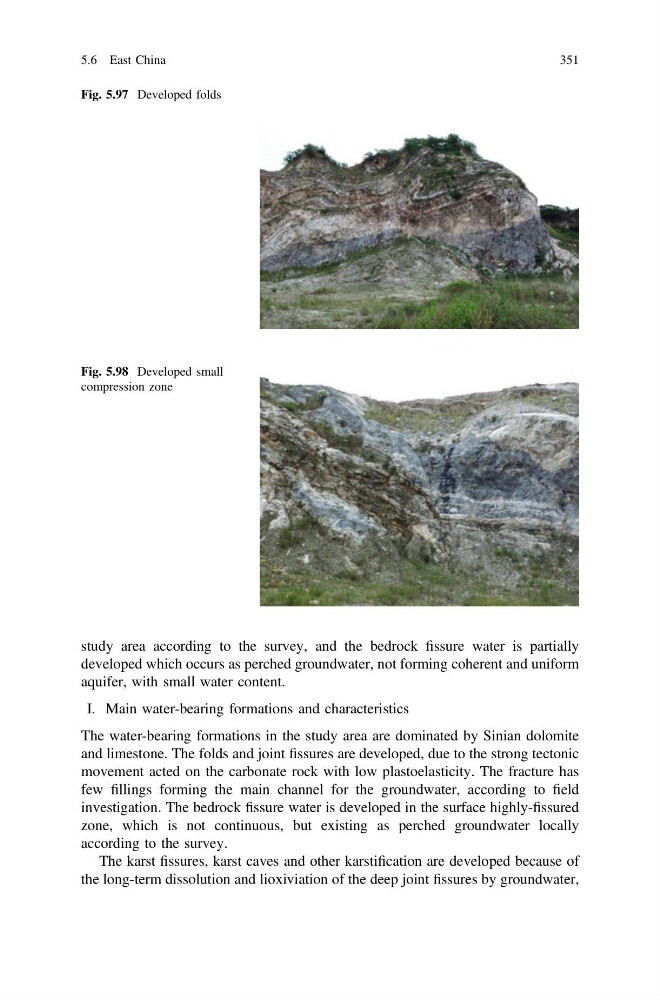
and limestone. The folds and joint fissures are developed, due to the strong tectonic
movement acted on the carbonate rock with low plastoelasticity. The fracture has
few fillings forming the main channel for the groundwater, according to field
investigation. The bedrock fissure water is developed in the surface highly-fissured
zone, which is not continuous, but existing as perched groundwater locally
according to the survey.
The karst fissures, karst caves and other karstification are developed because of
the long-term dissolution and lioxiviation of the deep joint fissures by groundwater,
Fig. 5.97 Developed folds
Fig. 5.98 Developed small
compression zone
5.6 East China
351
developed which occurs as perched groundwater, not forming coherent and uniform
aquifer, with small water content.
I. Main water-bearing formations and characteristics
The water-bearing formations in the study area are dominated by Sinian dolomite
and limestone. The folds and joint fissures are developed, due to the strong tectonic
movement acted on the carbonate rock with low plastoelasticity. The fracture has
few fillings forming the main channel for the groundwater, according to field
investigation. The bedrock fissure water is developed in the surface highly-fissured
zone, which is not continuous, but existing as perched groundwater locally
according to the survey.
The karst fissures, karst caves and other karstification are developed because of
the long-term dissolution and lioxiviation of the deep joint fissures by groundwater,
Fig. 5.97 Developed folds
Fig. 5.98 Developed small
compression zone
5.6 East China
351