

metaplatform, at the site where the Ningzhen arcuate structure is located. The area
is extremely complex in structure, being held by massive compression-shear faults
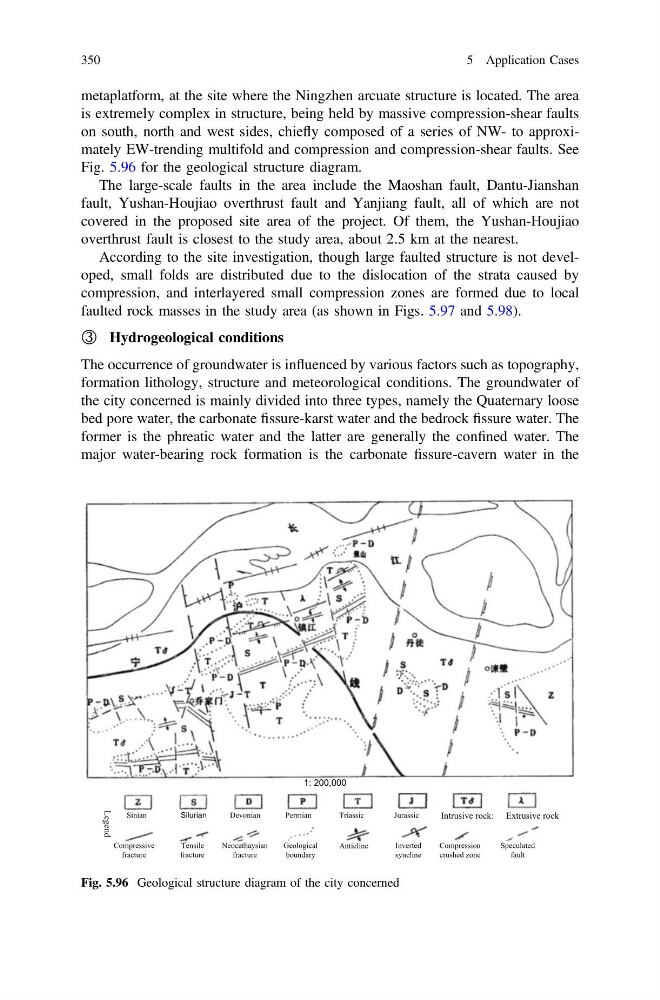
on south, north and west sides, chiefly composed of a series of NW- to approximately EW-trending multifold and compression and compression-shear faults. See
Fig. 5.96 for the geological structure diagram.
The large-scale faults in the area include the Maoshan fault, Dantu-Jianshan
fault, Yushan-Houjiao overthrust fault and Yanjiang fault, all of which are not
covered in the proposed site area of the project. Of them, the Yushan-Houjiao
overthrust fault is closest to the study area, about 2.5 km at the nearest.
According to the site investigation, though large faulted structure is not developed, small folds are distributed due to the dislocation of the strata caused by
compression, and interlayered small compression zones are formed due to local
faulted rock masses in the study area (as shown in Figs. 5.97 and 5.98).
③ Hydrogeological conditions
The occurrence of groundwater is influenced by various factors such as topography,
formation lithology, structure and meteorological conditions. The groundwater of
the city concerned is mainly divided into three types, namely the Quaternary loose
bed pore water, the carbonate fissure-karst water and the bedrock fissure water. The
former is the phreatic water and the latter are generally the confined water. The
major water-bearing rock formation is the carbonate fissure-cavern water in the
1: 200,000
Legend
Sinian
Silurian
Devonian
Permian
Triassic
Jurassic
Compressive
fracture
Tensile
fracture
Neocathaysian
fracture
Geological
boundary
Anticline
Inverted
syncline
Compression
crushed zone
Speculated
fault
Intrusive rock: Extrusive rock
Fig. 5.96 Geological structure diagram of the city concerned
350
5 Application Cases
is extremely complex in structure, being held by massive compression-shear faults
on south, north and west sides, chiefly composed of a series of NW- to approximately EW-trending multifold and compression and compression-shear faults. See
Fig. 5.96 for the geological structure diagram.
The large-scale faults in the area include the Maoshan fault, Dantu-Jianshan
fault, Yushan-Houjiao overthrust fault and Yanjiang fault, all of which are not
covered in the proposed site area of the project. Of them, the Yushan-Houjiao
overthrust fault is closest to the study area, about 2.5 km at the nearest.
According to the site investigation, though large faulted structure is not developed, small folds are distributed due to the dislocation of the strata caused by
compression, and interlayered small compression zones are formed due to local
faulted rock masses in the study area (as shown in Figs. 5.97 and 5.98).
③ Hydrogeological conditions
The occurrence of groundwater is influenced by various factors such as topography,
formation lithology, structure and meteorological conditions. The groundwater of
the city concerned is mainly divided into three types, namely the Quaternary loose
bed pore water, the carbonate fissure-karst water and the bedrock fissure water. The
former is the phreatic water and the latter are generally the confined water. The
major water-bearing rock formation is the carbonate fissure-cavern water in the
1: 200,000
Legend
Sinian
Silurian
Devonian
Permian
Triassic
Jurassic
Compressive
fracture
Tensile
fracture
Neocathaysian
fracture
Geological
boundary
Anticline
Inverted
syncline
Compression
crushed zone
Speculated
fault
Intrusive rock: Extrusive rock
Fig. 5.96 Geological structure diagram of the city concerned
350
5 Application Cases